Department of Psychiatry, Yale School of Medicine, New Haven, CT, USA.
Connecticut Veteran Healthcare System, West Haven, CT, USA.
Clin Epigenetics. 2020 Sep 14;12(1):140. doi: 10.1186/s13148-020-00934-1.
Cocaine use accelerates human immunodeficiency virus (HIV) progression and worsens HIV outcomes. We assessed whether DNA methylation in blood mediates the association between cocaine use and HIV severity in a veteran population.
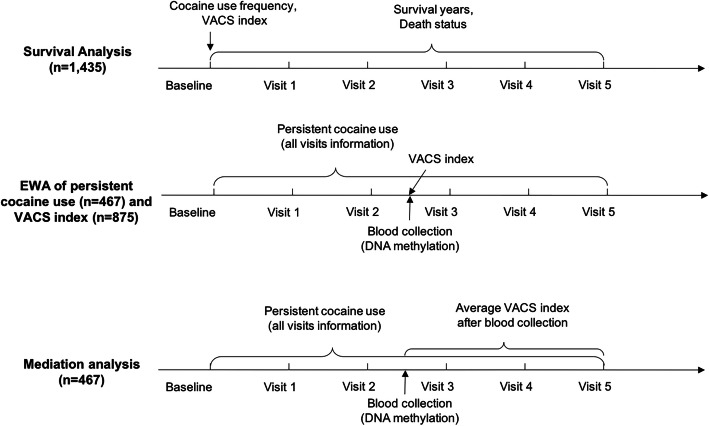
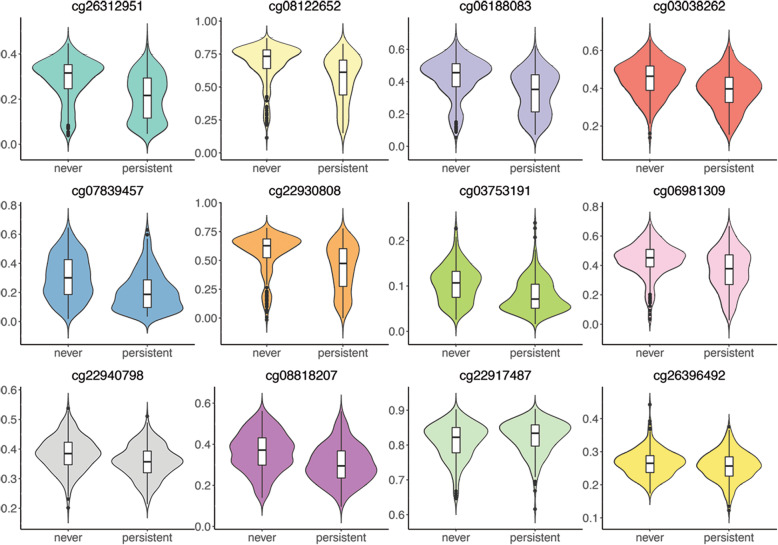
We analyzed 1435 HIV-positive participants from the Veterans Aging Cohort Study Biomarker Cohort (VACS-BC). HIV severity was measured by the Veteran Aging Cohort Study (VACS) index. We assessed the effect of cocaine use on VACS index and mortality among the HIV-positive participants. We selected candidate mediators that were associated with both persistent cocaine use and VACS index by epigenome-wide association (EWA) scans at a liberal p value cutoff of 0.001. Mediation analysis of the candidate CpG sites between cocaine's effect and the VACS index was conducted, and the joint mediation effect of multiple CpGs was estimated. A two-step epigenetic Mendelian randomization (MR) analysis was conducted as validation.
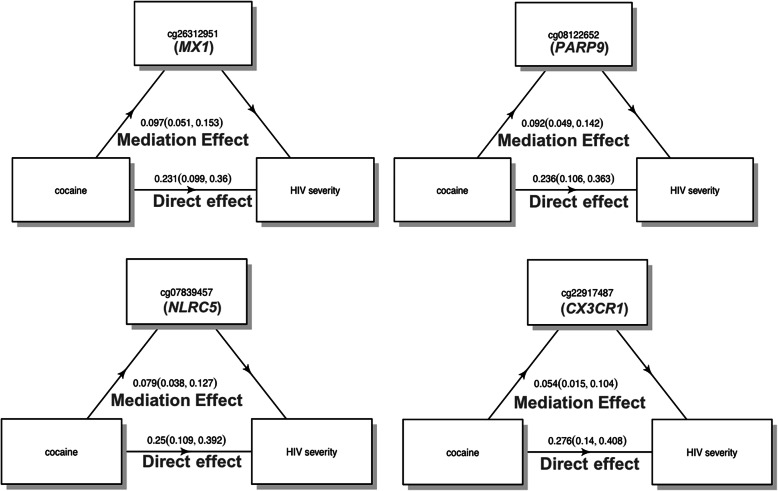
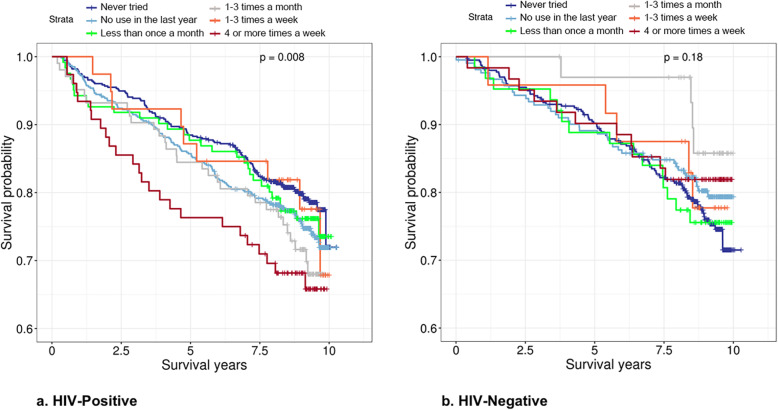
More frequent cocaine use was significantly associated with a higher VACS index (β = 1.00, p = 2.7E-04), and cocaine use increased the risk of 10-year mortality (hazard ratio = 1.10, p = 0.011) with adjustment for confounding factors. Fifteen candidate mediator CpGs were selected from the EWA scan. Twelve of these CpGs showed significant mediation effects, with each explaining 11.3-29.5% of the variation. The mediation effects for 3 of the 12 CpGs were validated by the two-step epigenetic MR analysis. The joint mediation effect of the 12 CpGs accounted for 47.2% of cocaine's effect on HIV severity. Genes harboring these 12 CpGs are involved in the antiviral response (IFIT3, IFITM1, NLRC5, PLSCR1, PARP9) and HIV progression (CX3CR1, MX1).
We identified 12 DNA methylation CpG sites that appear to play a mediation role in the association between cocaine use and HIV severity.
可卡因的使用会加速人类免疫缺陷病毒(HIV)的进展,并恶化 HIV 的预后。我们评估了在退伍军人人群中,血液中的 DNA 甲基化是否在可卡因使用与 HIV 严重程度之间起中介作用。
我们分析了退伍军人老龄化队列研究生物标志物队列(VACS-BC)中的 1435 名 HIV 阳性参与者。HIV 严重程度通过退伍军人老龄化队列研究(VACS)指数来衡量。我们评估了可卡因使用对 HIV 阳性参与者的 VACS 指数和死亡率的影响。我们通过全基因组关联(EWA)扫描选择了与持续可卡因使用和 VACS 指数都相关的候选中介物,扫描的宽松 p 值截止值为 0.001。对可卡因作用与 VACS 指数之间的候选 CpG 位点进行中介分析,并估计多个 CpG 位点的联合中介效应。进行两步法表观遗传孟德尔随机化(MR)分析作为验证。
更频繁的可卡因使用与更高的 VACS 指数显著相关(β=1.00,p=2.7E-04),且可卡因使用增加了 10 年死亡率的风险(风险比=1.10,p=0.011),调整了混杂因素。从 EWA 扫描中选择了 15 个候选中介物 CpG。其中 12 个 CpG 显示出显著的中介作用,每个 CpG 解释了 11.3-29.5%的变异。两步法表观遗传 MR 分析验证了其中 3 个 CpG 的中介作用。12 个 CpG 的联合中介效应占可卡因对 HIV 严重程度影响的 47.2%。这些 CpG 所在的基因参与抗病毒反应(IFIT3、IFITM1、NLRC5、PLSCR1、PARP9)和 HIV 进展(CX3CR1、MX1)。
我们确定了 12 个 DNA 甲基化 CpG 位点,它们似乎在可卡因使用与 HIV 严重程度之间的关联中起中介作用。