Institute of Sport Sciences and Physiotherapy, University of Tartu, Tartu, EE 51008, Estonia.
Institute of Sport Sciences and Physiotherapy, University of Tartu, Tartu, EE 51008, Estonia.
J Sport Health Sci. 2020 Sep;9(5):462-471. doi: 10.1016/j.jshs.2019.06.001. Epub 2019 Jun 8.
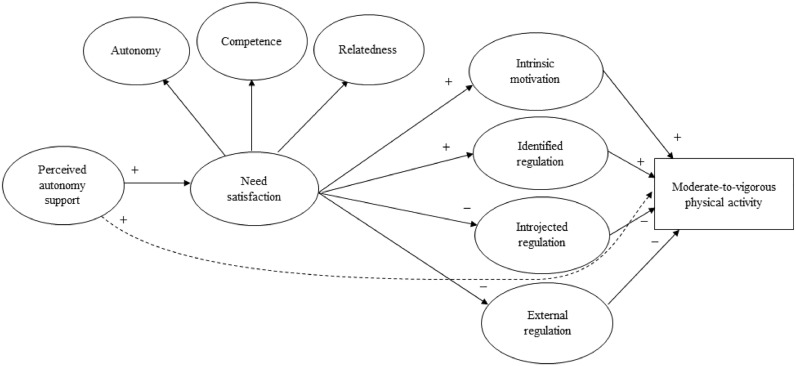
Grounded in self-determination theory (SDT), the present study tested how students' perceptions of autonomy support from physical education teachers predicts objectively measured moderate-to-vigorous physical activity (MVPA) of adolescents. According to SDT, it was expected that psychological needs and autonomous and controlled forms of motivation would mediate these relationships.
Students (n = 397) aged from 11 to 15 years in 17 different schools filled in questionnaires regarding SDT variables. In addition, objective MVPA was measured using an accelerometer (ActiGraph GT3X; ActiGraph, Pensacola, FL, USA) for 7 days. Structural equation modelling was used to examine the hypothesized relationships among the study variables.
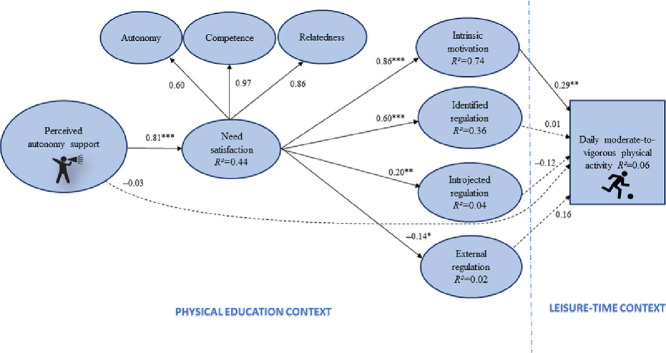
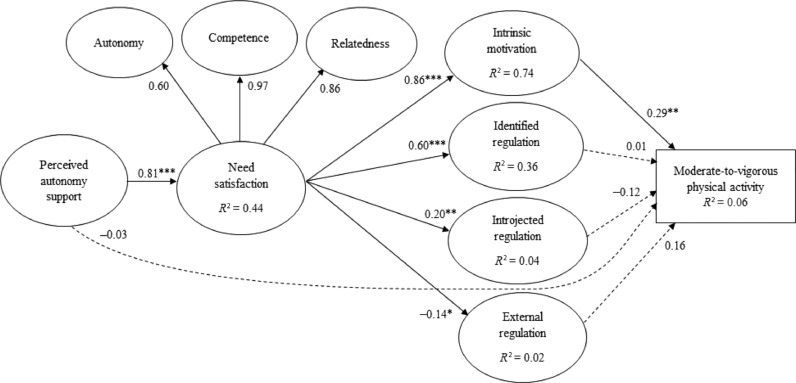
The theory-based model showed a good fit with the data: χ = 642.464, df = 257; comparative fit index = 0.932; non-normed fit index = 0.921; root mean square error of approximation = 0.062; root mean square error of approximation 90% confidence interval: 0.054-0.067. As hypothesized, there was a significant and positive direct relationship between autonomy support and need satisfaction (β = 0.81, p = 0.001). In turn, need satisfaction positively predicted intrinsic motivation (β = 0.86, p = 0.001). Intrinsic motivation was positively related to MVPA (β = 0.29, p = 0.009). A significant indirect effect (β = 0.20, p = 0.004) supported the mediating role of psychological need satisfaction and intrinsic motivation in the relationship between perceived autonomy support and objectively measured MVPA.
The findings of the current study support the applicability of the SDT-based model in explaining the antecedents of objectively measured MVPA of adolescents. To enhance adolescents' daily MVPA, special focus should be put on increasing their intrinsic motivation toward physical education.
本研究根植于自我决定理论(SDT),旨在检验体育教师对学生自主性的支持感知如何预测青少年的中等到剧烈身体活动(MVPA)。根据 SDT,预计心理需求以及自主和控制形式的动机将调节这些关系。
来自 17 所不同学校的 397 名 11 至 15 岁的学生填写了关于 SDT 变量的问卷。此外,使用加速度计(ActiGraph GT3X;ActiGraph,彭萨科拉,佛罗里达州,美国)对 7 天的客观 MVPA 进行了测量。结构方程模型用于检验研究变量之间的假设关系。
基于理论的模型与数据拟合良好:χ²=642.464,df=257;比较拟合指数=0.932;非规范拟合指数=0.921;均方根误差近似值=0.062;均方根误差近似值 90%置信区间:0.054-0.067。正如假设的那样,自主性支持与需求满足之间存在显著的正相关关系(β=0.81,p=0.001)。反过来,需求满足积极预测内在动机(β=0.86,p=0.001)。内在动机与 MVPA 呈正相关(β=0.29,p=0.009)。显著的间接效应(β=0.20,p=0.004)支持心理需求满足和内在动机在感知自主性支持与客观测量的 MVPA 之间关系中的中介作用。
本研究的结果支持基于 SDT 的模型在解释青少年客观测量的 MVPA 前因方面的适用性。为了提高青少年的日常 MVPA,应特别关注提高他们对体育教育的内在动机。