
昼夜节律时钟和光照对贯叶连翘中褪黑素浓度的影响。
Effects of circadian clock and light on melatonin concentration in Hypericum perforatum L. (St. John's Wort).
作者信息
Chung Ming-Hsiu, Deng Tzu-Shing
机构信息
Taiwan Sugar Corporation, Nanjing Farm, Shuishang Township, Chiayi County, 608, Taiwan R.O.C.
Department of Agronomy, National Chung-Hsing University, 145 Xingda Rd, South District, Taichung City, 40227, Taiwan R.O.C.
出版信息
Bot Stud. 2020 Sep 15;61(1):23. doi: 10.1186/s40529-020-00301-6.
BACKGROUND
Melatonin acts as a signaling hormone and entraining agent in many organisms. We studied the spatiotemporal regulation and influence of light (photoperiods, intensities, and spectral qualities) on melatonin concentration in the medicinal herb Hypericum perforatum L. Furthermore, melatonin concentrations in the leaves of eight species of the Hypericum genus were compared and analyzed using high-performance liquid chromatography.
RESULTS
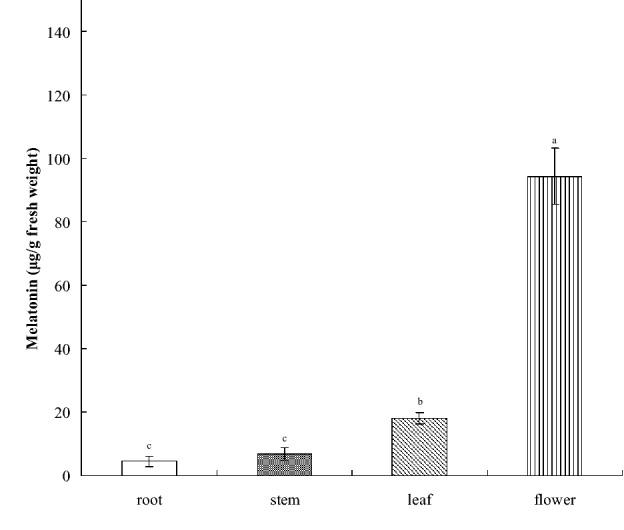
Melatonin concentration was found to be the highest in its flowers and leaves. The leaves exhibited a rhythmic variation in melatonin concentration of approximately 24 h under both light-dark entrained (Zeitgeber time) and constant light [circadian time (CT)] conditions, with melatonin concentration peaking at approximately CT6 in the middle of the subjective day. Melatonin concentration was influenced significantly by not only photoperiods but also applied light's wavelength and intensity. It was approximately six times higher under long-day conditions (18-h light:6-h dark) than under short-day photoperiods (10-h light:14-h dark) and was the highest (131 μg/g fresh weight [FW]) under treatment with blue light at an intensity of 45 µmol·m/s of photons. The melatonin concentration of the two examined Hypericum spp., namely H. kouytchense Lev. and H. coris L., were approximately twice that of H. perforatum L.
CONCLUSION
Our findings provide first insights on melatonin-related functions and mechanisms in the circadian system of H. perforatum and useful resources for further melatonin-oriented research and possible applications in agriculture and pharmaceutical industries.
背景
褪黑素在许多生物体中作为信号激素和同步因子发挥作用。我们研究了光(光周期、强度和光谱质量)对药用植物贯叶连翘中褪黑素浓度的时空调节和影响。此外,使用高效液相色谱法对金丝桃属八种植物叶片中的褪黑素浓度进行了比较和分析。
结果
发现褪黑素浓度在其花和叶中最高。在明暗同步(授时时间)和持续光照[昼夜时间(CT)]条件下,叶片中的褪黑素浓度均表现出约24小时的节律性变化,褪黑素浓度在主观日中午约CT6时达到峰值。褪黑素浓度不仅受光周期的显著影响,还受所施加光的波长和强度的影响。在长日照条件下(18小时光照:6小时黑暗),其浓度约为短日照光周期(10小时光照:14小时黑暗)下的六倍,在45 μmol·m/s光子强度的蓝光处理下最高(131 μg/g鲜重[FW])。所检测的两种金丝桃属植物,即贵州金丝桃和滨海金丝桃的褪黑素浓度约为贯叶连翘的两倍。
结论
我们的研究结果首次揭示了贯叶连翘昼夜节律系统中与褪黑素相关的功能和机制,为进一步开展以褪黑素为导向的研究以及在农业和制药行业的可能应用提供了有用的资源。




 Zotero 插件