Cryo-Electron Microscopy, Bijvoet Centre for Biomolecular Research, Utrecht University, 3584CH Utrecht, The Netherlands.
Division of Structural Biology, Wellcome Centre for Human Genetics, The University of Oxford, Oxford OX3 7BN, UK.
Open Biol. 2020 Sep;10(9):200186. doi: 10.1098/rsob.200186. Epub 2020 Sep 16.
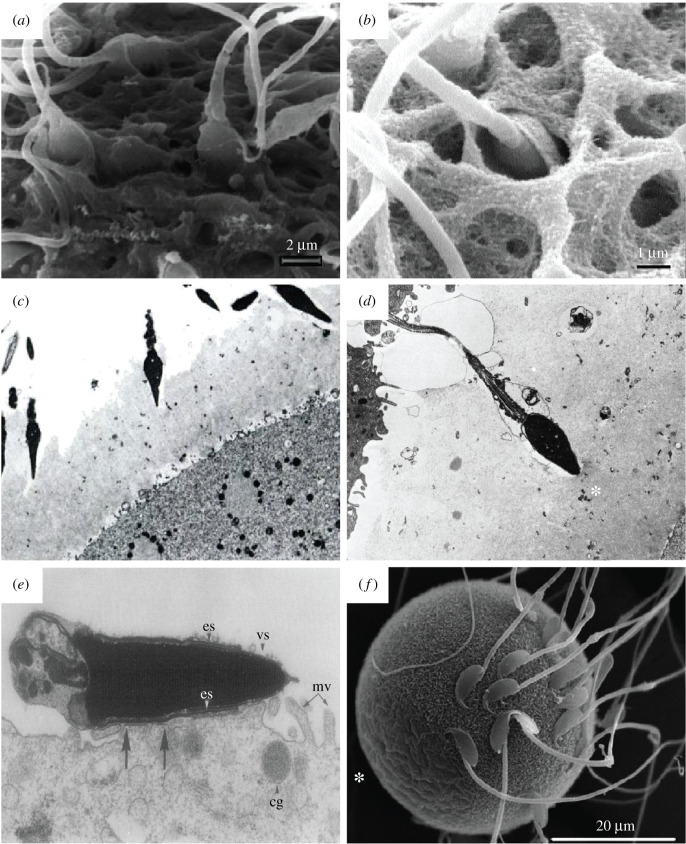
Mammalian gametes-the sperm and the egg-represent opposite extremes of cellular organization and scale. Studying the ultrastructure of gametes is crucial to understanding their interactions, and how to manipulate them in order to either encourage or prevent their union. Here, we survey the prominent electron microscopy (EM) techniques, with an emphasis on considerations for applying them to study mammalian gametes. We review how conventional EM has provided significant insight into gamete ultrastructure, but also how the harsh sample preparation methods required preclude understanding at a truly molecular level. We present recent advancements in cryo-electron tomography that provide an opportunity to image cells in a near-native state and at unprecedented levels of detail. New and emerging cellular EM techniques are poised to rekindle exploration of fundamental questions in mammalian reproduction, especially phenomena that involve complex membrane remodelling and protein reorganization. These methods will also allow novel lines of enquiry into problems of practical significance, such as investigating unexplained causes of human infertility and improving assisted reproductive technologies for biodiversity conservation.
哺乳动物配子——精子和卵子——代表了细胞组织和规模的两个极端。研究配子的超微结构对于理解它们的相互作用以及如何操纵它们以促进或阻止它们的结合至关重要。在这里,我们调查了突出的电子显微镜(EM)技术,并强调了将它们应用于研究哺乳动物配子的考虑因素。我们回顾了传统的 EM 如何为配子的超微结构提供了重要的见解,但也说明了需要苛刻的样品制备方法如何排除了在真正分子水平上的理解。我们介绍了冷冻电子断层扫描的最新进展,该技术为在近乎天然状态下以空前的细节水平对细胞进行成像提供了机会。新出现的细胞 EM 技术有望重新激发对哺乳动物生殖中基本问题的探索,特别是涉及复杂膜重塑和蛋白质重组的现象。这些方法还将为具有实际意义的问题提供新的研究途径,例如研究人类不育症的不明原因并改进用于生物多样性保护的辅助生殖技术。