Nathan Nadia, Prevost Blandine, Sileo Chiara, Richard Nicolas, Berdah Laura, Thouvenin Guillaume, Aubertin Guillaume, Lecarpentier Thibault, Schnuriger Aurélie, Jegard Julien, Guellec Isabelle, Taytard Jessica, Corvol Harriet
Pediatric Pulmonology Department, APHP Hôpital Trousseau, Sorbonne Université, 75012 Paris, France.
Sorbonne Université, Inserm UMR_S933, Childhood Genetic Disorders, 75012 Paris, France.
J Clin Med. 2020 Sep 12;9(9):2950. doi: 10.3390/jcm9092950.
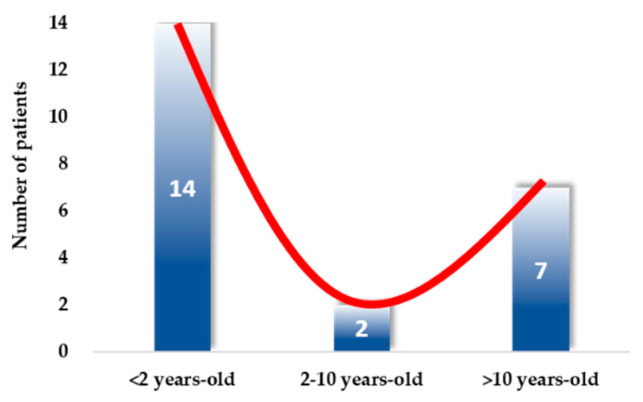
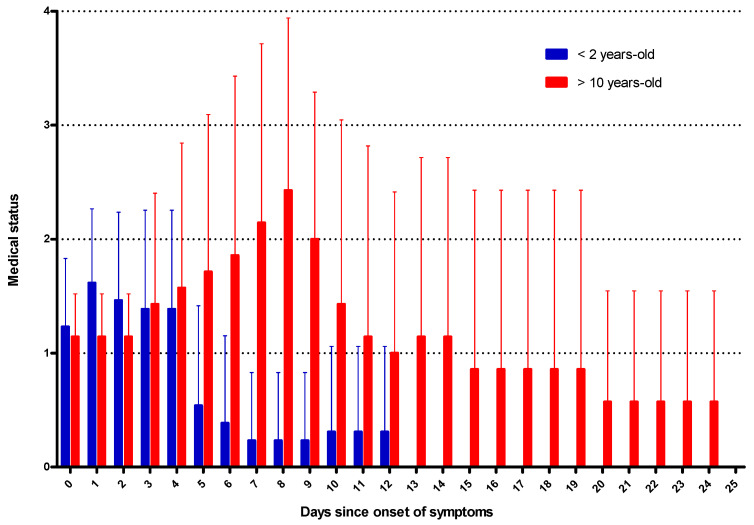
Ten months after its appearance in December 2019, SARS-CoV-2 has infected more than 25 million patients worldwide. Because children were first identified as potential spreaders of the virus, schools were closed in several countries. However, it rapidly became evident that the number of hospitalized children infected by SARS-CoV-2 was dramatically lower than that of adults. To date, only hypotheses have been raised to explain this difference, so it is of great importance to describe the presentation of this disease among children. Here, we describe a wide spectrum of COVID-19 manifestation in children in a dedicated pediatric unit in France. Patients hospitalized with COVID-19 who were diagnosed on the basis of either positive SARS-CoV-2 RT-PCR in nasopharyngeal swabs and/or typical aspects in chest-computed tomography (CT) were included between March and May 2020 in Paris. Twenty-three patients were included on the basis of positive RT-PCR ( = 20) and/or typical aspects in CT ( = 4). The median age was 4.9 years [0.1-17.6]. Patients were grouped by age (<2 years old: = 14, 61%; 2-10 years old: = 2, 9%; >10 years old: = 7, 30%). Overweight or obesity was reported in only three patients. At presentation, the most frequent symptom in the overall cohort was fever ( = 18, 78%), followed by acute rhinitis ( = 9, 64%) and cough ( = 7, 50%) in the under 2-year-old group and cough ( = 4, 57%), fatigue, dyspnea and abdominal pain ( = 3, 43% each) in the over 10-year-old group. Five patients required ICU treatment, four of whom were aged >10 years, two presented with acute myocarditis, and two were sickle cell disease patients who presented with acute chest syndrome. The youngest patients seem to present milder forms of COVID-19 without the need for ICU treatment and with a shorter length of hospitalization. More severe evolutions were observed in teenagers, with, however, favorable outcomes. Given the context of closed schools and confinement, the infection of these children suggests intra-familial transmission that needs to be further assessed. This description might help to understand the intriguing differences in COVID-19 severity across age-classes.
2019年12月出现的新型冠状病毒(SARS-CoV-2)在十个月后已感染全球超过2500万患者。由于儿童最初被认定为该病毒的潜在传播者,多个国家关闭了学校。然而,很快就发现感染SARS-CoV-2的住院儿童数量显著低于成人。迄今为止,对于这种差异仅提出了一些假说,因此描述该疾病在儿童中的表现具有重要意义。在此,我们描述了法国一家专门儿科病房中儿童新冠病毒病(COVID-19)的广泛表现。2020年3月至5月期间,收治了因鼻咽拭子SARS-CoV-2逆转录聚合酶链反应(RT-PCR)呈阳性和/或胸部计算机断层扫描(CT)有典型表现而被诊断为COVID-19的住院患者。23例患者基于RT-PCR阳性(n = 20)和/或CT典型表现(n = 4)被纳入研究。中位年龄为4.9岁[0.1 - 17.6岁]。患者按年龄分组(<2岁:n = 14,61%;2 - 10岁:n = 2,9%;>10岁:n = 7,30%)。仅3例患者报告有超重或肥胖。就诊时,整个队列中最常见的症状是发热(n = 18,78%),2岁以下组其次是急性鼻炎(n = 9,64%)和咳嗽(n = 7,50%),10岁以上组是咳嗽(n = 4,57%)、疲劳、呼吸困难和腹痛(各n = 3,43%)。5例患者需要重症监护病房(ICU)治疗,其中4例年龄>10岁,2例患有急性心肌炎,2例是镰状细胞病患者并伴有急性胸综合征。最年幼的患者似乎表现为症状较轻的COVID-19,无需ICU治疗且住院时间较短。青少年中观察到病情进展较为严重,但预后良好。鉴于学校关闭和居家隔离的背景,这些儿童的感染提示家庭内传播,需要进一步评估。这一描述可能有助于理解COVID-19严重程度在不同年龄组之间存在的有趣差异。