Aliev Gjumrakch, Beeraka Narasimha M, Nikolenko Vladimir N, Svistunov Andrey A, Rozhnova Tatyana, Kostyuk Svetlana, Cherkesov Igor, Gavryushova Liliya V, Chekhonatsky Andrey A, Mikhaleva Liudmila M, Somasundaram Siva G, Avila-Rodriguez Marco F, Kirkland Cecil E
GALLY International Research Institute, 7733 Louis Pasteur Drive, #330, San Antonio, TX 78229, USA.
I.M. Sechenov First Moscow State Medical University of the Ministry of Health of the Russian Federation (Sechenov University), 8/2 Trubetskaya Str., 119991 Moscow, Russia.
J Clin Med. 2020 Sep 12;9(9):2951. doi: 10.3390/jcm9092951.
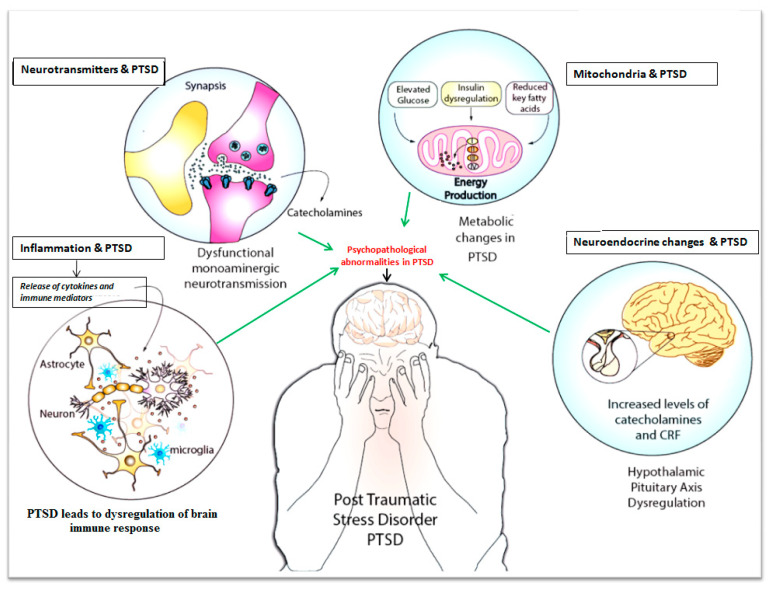
Post-traumatic stress disorder (PTSD) is a well-known psychiatric disorder that affects millions of people worldwide. Pharmacodynamic and cognitive-behavioral therapies (CBT) have been used to treat patients with PTSD. However, it remains unclear whether there are concurrent changes in psychopathological and neurophysiological factors associated with PTSD patients. Past reports described those PTSD patients with efficient fatty acid metabolism, neurogenesis, mitochondrial energy balance could improve ability to cope against the conditioned fear responses and traumatic memories. Furthermore, cognitive, behavioral, cellular, and molecular evidence can be combined to create personalized therapies for PTSD sufferers either with or without comorbidities such as depression or memory impairment. Unfortunately, there is still evidence lacking to establish a full understanding of the underlying neurophysiological and psychopathological aspects associated with PTSD. This review has extensively discussed the single nucleotide polymorphism (SNPs) of genetic factors to cause PTSD, the implications of inflammation, neurotransmitter genomics, metabolic alterations, neuroendocrine disturbance (hypothalamus-pituitary-adrenal (HPA) axis), mitochondrial dynamics, neurogenesis, and premature aging related to PTSD-induced psychopathology and neurophysiology. In addition, the review delineated the importance of CBT and several pharmacodynamic therapies to mitigate symptomatology of PTSD.
创伤后应激障碍(PTSD)是一种广为人知的精神障碍,影响着全球数百万人。药物动力学和认知行为疗法(CBT)已被用于治疗PTSD患者。然而,目前尚不清楚与PTSD患者相关的心理病理学和神经生理学因素是否同时发生变化。过去的报告描述了那些脂肪酸代谢、神经发生、线粒体能量平衡有效的PTSD患者能够提高应对条件性恐惧反应和创伤性记忆的能力。此外,认知、行为、细胞和分子证据可以结合起来,为患有或未患有抑郁症或记忆障碍等合并症的PTSD患者制定个性化治疗方案。不幸的是,目前仍缺乏证据来全面了解与PTSD相关的潜在神经生理学和心理病理学方面。本综述广泛讨论了导致PTSD的遗传因素的单核苷酸多态性(SNP)、炎症的影响、神经递质基因组学、代谢改变、神经内分泌紊乱(下丘脑-垂体-肾上腺(HPA)轴)、线粒体动力学、神经发生以及与PTSD诱导的心理病理学和神经生理学相关的早衰。此外,该综述还阐述了CBT和几种药物动力学疗法对减轻PTSD症状的重要性。