
飞秒绿光激光在钛表面制备的二维周期性纳米结构
Two-Dimensional Periodic Nanostructure Fabricated on Titanium by Femtosecond Green Laser.
作者信息
Liu Yi-Hsien, Yeh Shu-Chun, Cheng Chung-Wei
机构信息
Department of Mechanical Engineering, National Chiao Tung University, No. 1001, Ta Hsueh Road, Hsinchu 300, Taiwan.
出版信息
Nanomaterials (Basel). 2020 Sep 12;10(9):1820. doi: 10.3390/nano10091820.
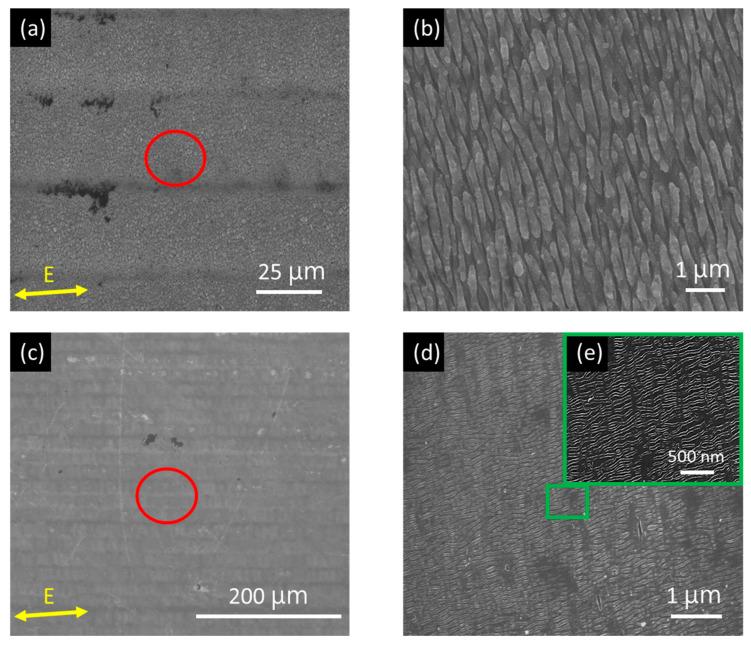
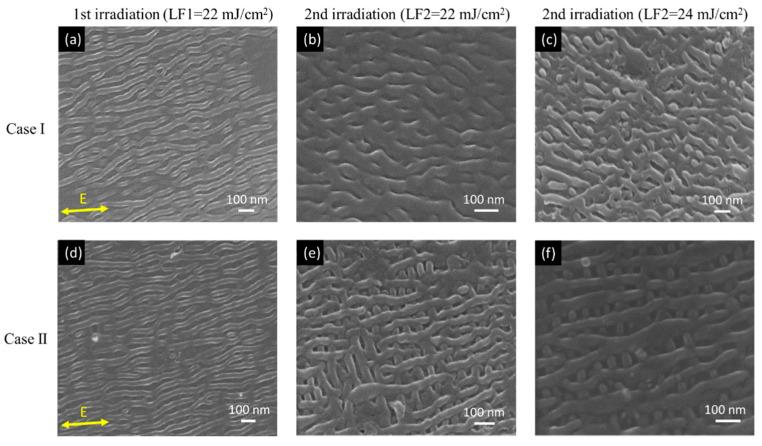
Laser-induced periodic surface structures (LIPSS) is the sub-wavelength periodic nanostructure, which is generally generated by the femtosecond laser. There are two kinds of LIPSS, low spatial frequency LIPSS (LSFL) and high spatial LIPSS (HSFL), and the period size is close and less than half of the laser wavelength, respectively. Fabrication of two-dimensional (2D) LSFL and HSFL on a titanium surface with a linear-polarized femtosecond green laser beam (wavelength 515 nm) and cross-scanning strategies is demonstrated in this study. Four types of LIPSS structures are obtained by controlling the laser fluence, irradiated pulses, and cross-scanning strategies: 1D-LSFL perpendicular to laser polarization with a period of 300-360 nm, 1D-HSFL parallel to laser polarization with a period of 55-75 nm, 2D-LSFL dot-like structures with a period ~200 nm, and 2D-HSFL net-like structures with a period of 50-100 nm.
激光诱导周期性表面结构(LIPSS)是一种亚波长周期性纳米结构,通常由飞秒激光产生。LIPSS有两种类型,即低空间频率LIPSS(LSFL)和高空间频率LIPSS(HSFL),其周期尺寸分别接近且小于激光波长的一半。本研究展示了利用线偏振飞秒绿色激光束(波长515nm)和交叉扫描策略在钛表面制备二维(2D)LSFL和HSFL。通过控制激光能量密度、辐照脉冲和交叉扫描策略,获得了四种类型的LIPSS结构:垂直于激光偏振方向、周期为300 - 360nm的一维LSFL;平行于激光偏振方向、周期为55 - 75nm的一维HSFL;周期约为200nm的二维LSFL点状结构;以及周期为50 - 100nm的二维HSFL网状结构。




 Zotero 插件