Faculty of Science, Sydney School of Veterinary Science, The University of Sydney, Camden, NSW, 2570, Australia.
Sydney Informatics Hub, Core Research Facilities, The University of Sydney, Sydney, NSW, 2006, Australia.
BMC Genet. 2020 Sep 15;21(1):106. doi: 10.1186/s12863-020-00913-8.
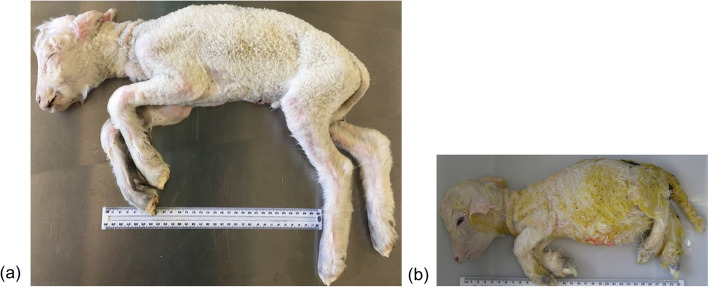
Brachygnathia, cardiomegaly and renal hypoplasia syndrome (BCRHS, OMIA 001595-9940 ) is a previously reported recessively inherited disorder in Australian Poll Merino/Merino sheep. Affected lambs are stillborn with various congenital defects as reflected in the name of the disease, as well as short stature, a short and broad cranium, a small thoracic cavity, thin ribs and brachysternum. The BCRHS phenotype shows similarity to certain human short stature syndromes, in particular the human 3M syndrome-2. Here we report the identification of a likely disease-causing variant and propose an ovine model for human 3M syndrome-2.
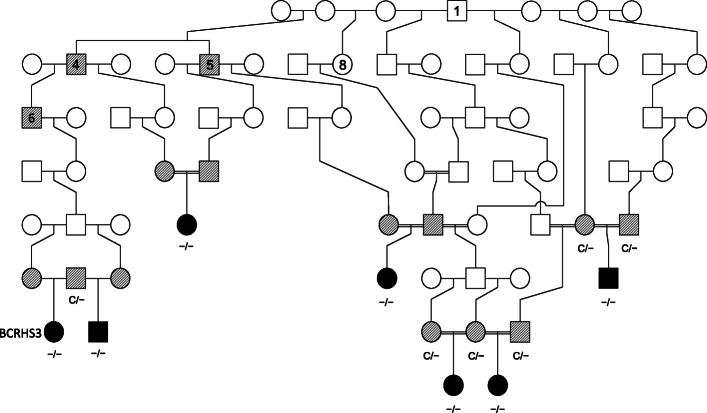
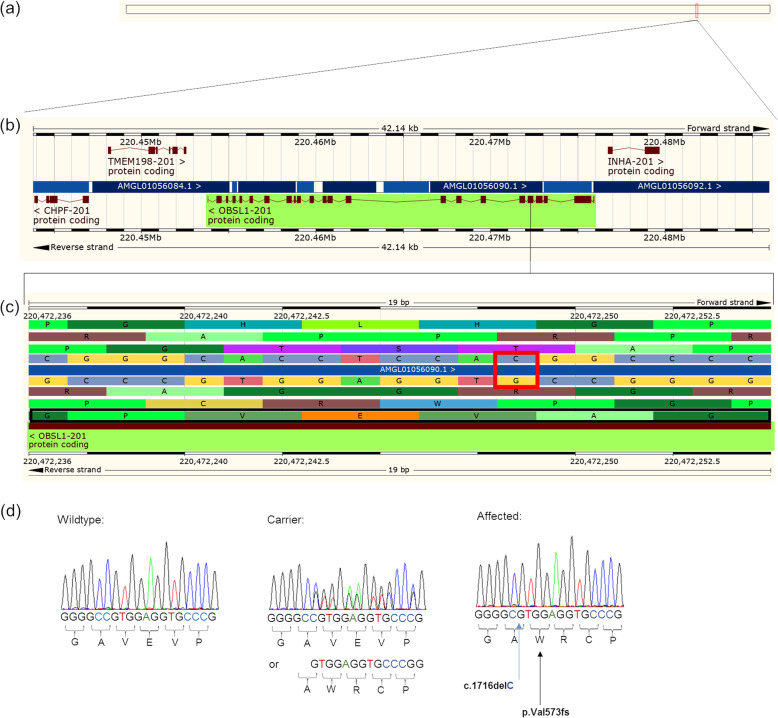
Eight positional candidate genes were identified among the 39 genes in the approximately 1 Mb interval to which the disease was mapped previously. Obscurin like cytoskeletal adaptor 1 (OBSL1) was selected as a strong positional candidate gene based on gene function and the resulting phenotypes observed in humans with mutations in this gene. Whole genome sequencing of an affected lamb (BCRHS3) identified a likely causal variant ENSOARG00000020239:g.220472248delC within OBSL1. Sanger sequencing of seven affected, six obligate carrier, two phenotypically unaffected animals from the original flock and one unrelated control animal validated the variant. A genotyping assay was developed to genotype 583 animals from the original flock, giving an estimated allele frequency of 5%.
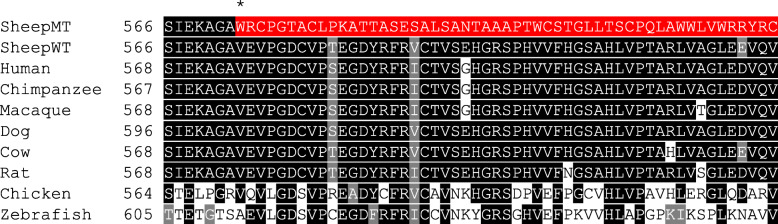
The identification of a likely disease-causing variant resulting in a frameshift (p.(Val573Trpfs*119)) in the OBSL1 protein has enabled improved breeding management of the implicated flock. The opportunity for an ovine model for human 3M syndrome and ensuing therapeutic research is promising given the availability of carrier ram semen for BCRHS.
短面、心肌肥大和肾发育不良综合征(BCRHS,OMIA 001595-9940)是一种先前报道的澳大利亚美利奴羊/美利奴羊隐性遗传疾病。受影响的羔羊是死胎,具有各种先天性缺陷,如疾病名称所示,还有身材矮小、短而宽的颅骨、小胸腔、细肋骨和短胸骨。BCRHS 表型与某些人类矮小综合征相似,特别是人类 3M 综合征-2。在这里,我们报告了一个可能的致病变异体的鉴定,并提出了一个人类 3M 综合征-2 的绵羊模型。
在先前疾病定位的大约 1Mb 区间内的 39 个基因中,确定了 8 个位置候选基因。根据基因功能和该基因突变导致的人类表型,选择肌球蛋白结合蛋白 L like 细胞骨架衔接蛋白 1(OBSL1)作为一个强有力的位置候选基因。受影响羔羊(BCRHS3)的全基因组测序确定了 OBSL1 内的一个可能的致病变异 ENSOARG00000020239:g.220472248delC。对来自原始羊群的 7 只受影响、6 只必然携带者、2 只表型正常的动物和 1 只无关的对照动物进行 Sanger 测序,验证了该变异。开发了一种基因分型检测方法,对原始羊群中的 583 只动物进行基因分型,估计等位基因频率为 5%。
鉴定出一种可能的致病变异,导致 OBSL1 蛋白发生移码(p.(Val573Trpfs*119)),这使得受影响羊群的繁殖管理得到了改善。鉴于有 BCRHS 携带者公羊的精液,为人类 3M 综合征提供了一个绵羊模型,并有希望进行治疗研究。