Arrigo Alessandro, Aragona Emanuela, Di Nunzio Carlo, Bandello Francesco, Parodi Maurizio Battaglia
Department of Ophthalmology, IRCCS San Raffaele Hospital, Vita-Salute University, Milan, Italy.
Transl Vis Sci Technol. 2020 Aug 31;9(9):48. doi: 10.1167/tvst.9.9.48. eCollection 2020 Aug.
The purpose of this paper was to study type 1 macular neovascularization (MNV) quantitative optical coherence tomography (OCT) angiography (OCTA) features by means of advanced postprocessing analyses.
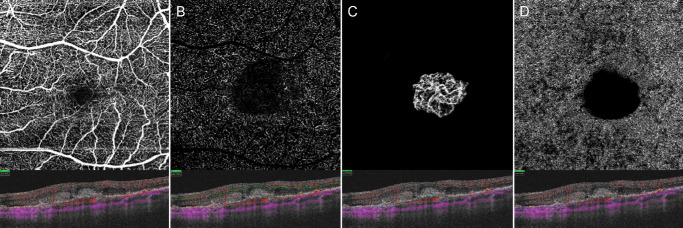
We recruited patients affected by naïve type 1 MNV secondary to age-related macular degeneration (AMD) and age-matched controls. All patients underwent ophthalmologic examination and multimodal imaging. They were treated with pro-re-nata anti-VEGF injections. The ensuing follow-up lasted 24 months. Quantitative OCT and OCTA parameters were statistically analyzed to obtain cutoff values able to distinguish two clinically different patient subgroups. Main outcome measures were best-corrected visual acuity (BCVA), central macular thickness, vessel density of superficial, deep and choriocapillaris plexa, vessel tortuosity (VT) of MNV, vessel dispersion of MNV, number of injections, blooding, pigment epithelium detachment, subretinal fluid, photoreceptor elongation, subretinal fibrosis, and outer retinal atrophy.
Ninety-one eyes (91 patients; 49 men; mean age 78 ± 7 years) and 91 control eyes were included. Mean logarithm of the minimum angle of resolution (logMAR) BCVA was 0.46 ± 0.56 at baseline, increasing up to 0.29 ± 0.30 after 2 years of treatment ( < 0.01). The mean number of intravitreal injections was 7.1 ± 2.0 during the first year and 4.5 ± 1.4 during the second year. A baseline VT cutoff of 8.40 detected two patients' subgroups differing significantly in terms of BCVA improvement after 2 years of treatment.
OCTA-based classification of type 1 MNV, performed at baseline, provided useful information in terms of the functional outcome achievable after 24 months of anti-VEGF treatment.
Quantitative OCTA-based classification of type 1 MNV, performed at baseline, provided useful information in terms of the functional outcome achievable after 24 months of anti-VEGF treatment.
本文旨在通过先进的后处理分析研究1型黄斑新生血管(MNV)的定量光学相干断层扫描(OCT)血管造影(OCTA)特征。
我们招募了年龄相关性黄斑变性(AMD)继发的初发1型MNV患者以及年龄匹配的对照者。所有患者均接受眼科检查和多模态成像。他们接受按需抗VEGF注射治疗。随后的随访持续24个月。对定量OCT和OCTA参数进行统计分析,以获得能够区分两个临床不同患者亚组的临界值。主要观察指标为最佳矫正视力(BCVA)、黄斑中心厚度、浅层、深层和脉络膜毛细血管丛的血管密度、MNV的血管迂曲度(VT)、MNV的血管离散度、注射次数、出血、色素上皮脱离、视网膜下液、光感受器伸长、视网膜下纤维化和外层视网膜萎缩。
纳入91只眼(91例患者;49例男性;平均年龄78±7岁)和91只对照眼。基线时最小分辨角对数(logMAR)BCVA平均为0.46±0.56,治疗2年后增至0.29±0.30(<0.01)。第一年玻璃体内注射的平均次数为7.1±2.0次,第二年为4.5±1.4次。基线VT临界值为8.40时,可检测出两个在治疗2年后BCVA改善方面有显著差异的患者亚组。
基于OCTA在基线时对1型MNV进行分类,可为抗VEGF治疗24个月后可实现的功能结局提供有用信息。
基于OCTA在基线时对1型MNV进行定量分类,可为抗VEGF治疗24个月后可实现的功能结局提供有用信息。