Pharmacotechnology Documentation and Transfer Unit, Section of Preclinical and Translational Pharmacology, Department of Pharmacy, Health and Nutritional Sciences, University of Calabria, Rende, Italy.
Pharmacovigilance Territorial Service, Pharmaceutical Department, Provincial Health Authority, Cosenza, Italy.
Eur J Clin Pharmacol. 2021 Feb;77(2):241-249. doi: 10.1007/s00228-020-02995-w. Epub 2020 Sep 15.
Data concerning the number of diagnoses and of the drugs prescribed to patients affected by dementia are still scarce. Here we test whether or not (1) prescription of symptomatic drugs against Alzheimer's disease (AD) may approximate the number of patients affected by dementia in Italy and (2) adherence to this treatment affects the pattern of prescription of drugs (i.e. antipsychotics and antidepressants) for behavioural and psychological symptoms of dementia (BPSD) and the previously reported limited prescription of analgesics.
This retrospective observational study concerns 84,235 subjects older than 60 years and registered in the provincial prescription database of the health district of Cosenza accounting for a population of 298,000 inhabitants. The prescribing pattern of antipsychotics, antidepressants, and analgesics has been investigated in patients receiving concurrent prescriptions of acetylcholinesterase inhibitors (AChEI) and/or memantine. Data from a single centre for cognitive disturbances and dementia (CDCD) in the same health district were used to explore at which stage dementia was diagnosed. The study was approved by Calabria Region Ethical Committee no. 31/2017 and registered on October 31, 2017.
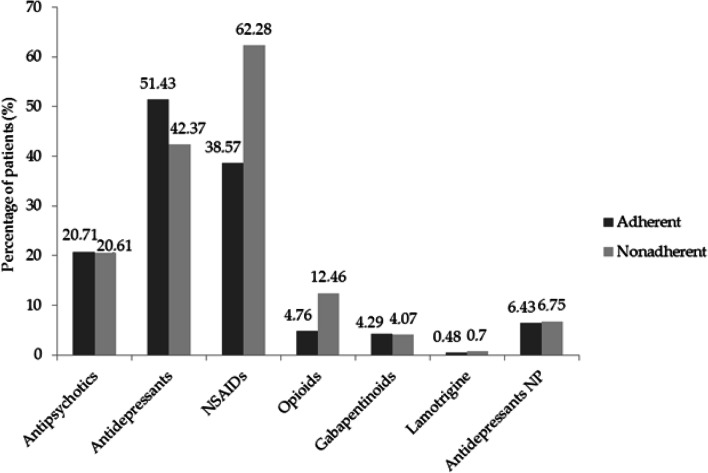
The data show that 859 patients are treated with AChEI and/or memantine; 420 patients (48.89%) receive at least 80% of the recommended medications. CDCD data indicate a delay in dementia diagnosis, which often was made when the patients were moderately to severely demented (Mini Mental State Examination, MMSE ≤ 20). Adherence did not influence prescription of most of the drugs explored, but use of non-steroidal anti-inflammatory drugs was higher in non-adherent patients. Antipsychotics and antidepressants are frequently used (20.61-20.71% and 42.37-51.43%, respectively), and this, at least in part, might stem from the observed under-treatment of chronic pain (opioids are prescribed in the 4.76% and 12.46% of adherent and non-adherent patients and gabapentin and pregabalin are used in the 4.29% and 4.07% of adherent and non-adherent patients respectively), resulting in more frequent BPSD. 16.43% of patients receive antipsychotics for longer than 6-12 weeks.
This 2-year period study, including a wide cohort of community demented patients, shows that dementia is diagnosed late and that prevalence of BPSD prescriptions is high and not impacted by adherence to anti-dementia drugs. The rate of prescription of potentially harmful antipsychotics and antidepressants appears to be high though whether the concomitantly observed limited prescription of analgesics might be a contributing factor needs to be further investigated. Our data support the development of strategies to improve the management of BPSD.
有关受痴呆影响的患者的诊断数量和所开药物数量的数据仍然很少。在这里,我们检验以下两个假设:(1) 针对阿尔茨海默病(AD)的对症药物的处方是否可以近似代表意大利受痴呆影响的患者数量;以及 (2) 这种治疗方法的依从性是否会影响用于治疗痴呆患者行为和心理症状的药物(即抗精神病药和抗抑郁药)和先前报告的有限的镇痛药处方。
本回顾性观察性研究涉及了 84235 名年龄大于 60 岁的患者,这些患者在科森扎省的省级处方数据库中注册,该数据库涵盖了 298000 名居民。在同时接受乙酰胆碱酯酶抑制剂 (AChEI) 和/或美金刚治疗的患者中,我们调查了抗精神病药、抗抑郁药和镇痛药的处方模式。来自同一卫生区的认知障碍和痴呆单一中心 (CDCD) 的数据用于探索痴呆的诊断阶段。该研究得到卡拉布里亚地区伦理委员会的批准(编号为 31/2017),并于 2017 年 10 月 31 日注册。
数据显示,有 859 名患者接受了 AChEI 和/或美金刚治疗;420 名患者(48.89%)至少服用了 80%的推荐药物。CDCD 数据表明,痴呆的诊断存在延迟,当患者处于中度至重度痴呆(简易精神状态检查,MMSE≤20)时,通常才做出痴呆的诊断。依从性并未影响大多数探索药物的处方,但非依从患者更常使用非甾体抗炎药。抗精神病药和抗抑郁药的使用频率较高(分别为 20.61-20.71%和 42.37-51.43%),这至少部分是由于慢性疼痛治疗不足所致(阿片类药物在依从性和非依从性患者中的处方率分别为 4.76%和 12.46%,加巴喷丁和普瑞巴林在依从性和非依从性患者中的处方率分别为 4.29%和 4.07%),导致更多的行为和心理症状出现。16.43%的患者接受抗精神病药治疗超过 6-12 周。
这项为期 2 年的研究纳入了大量社区痴呆患者,结果表明痴呆的诊断较晚,行为和心理症状药物的处方率较高,且不受抗痴呆药物依从性的影响。潜在有害的抗精神病药和抗抑郁药的处方率似乎很高,但是同时观察到的镇痛药处方受限是否是一个促成因素仍需进一步研究。我们的数据支持制定改善行为和心理症状管理的策略。