Gyurkovics Mate, Kovacs Marton, Jaquiery Matt, Palfi Bence, Dechterenko Filip, Aczel Balazs
Beckman Institute, University of Illinois at Urbana-Champaign, 405 N Mathews Ave, Urbana, IL, 61801, USA.
Institute of Psychology, ELTE, Eotvos Lorand University, Budapest, Hungary.
Atten Percept Psychophys. 2020 Nov;82(8):3777-3787. doi: 10.3758/s13414-020-02021-2.
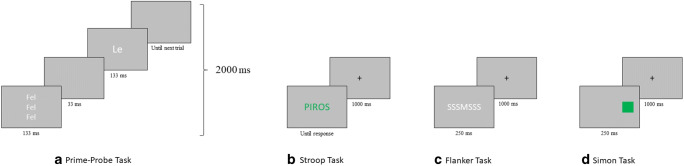
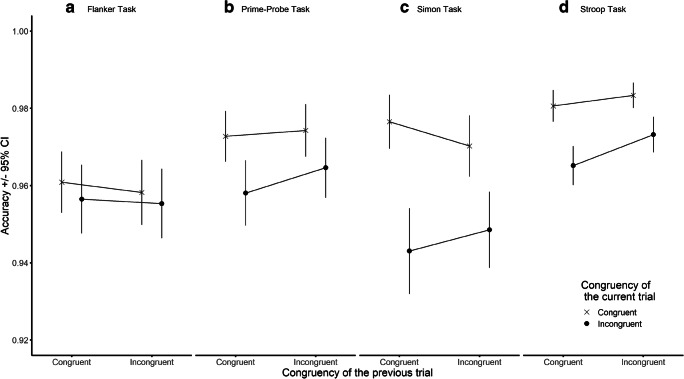
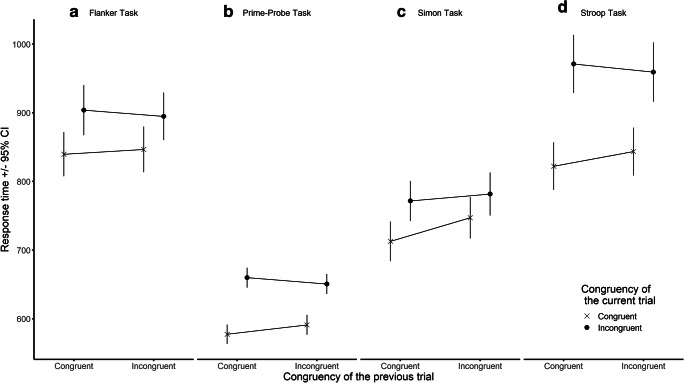
The congruency sequence effect (CSE) refers to the finding that the effect of cognitive conflict is smaller following conflicting, incongruent trials than after non-conflicting, congruent trials in conflict tasks, such as the Stroop, Simon, and flanker tasks. This is typically interpreted as an upregulation of cognitive control in response to conflict. Weissman, Jiang, & Egner (2014) investigated whether the CSE appears in these three tasks and a further variant where task-irrelevant distractors precede the target (prime-probe task), in the absence of learning and memory confounds in samples collected online. They found significant CSEs only in the prime-probe and Simon tasks, suggesting that the effect is more robust in tasks where the distractor can be translated into a response faster than the target. In this Registered Replication Report we collected data online from samples approx. 2.5 times larger than in the original study for each of the four tasks to investigate whether the task-related differences in the magnitude of the CSE are replicable (Nmin = 115, Nmax = 130). Our findings extend but do not contradict the original results: Bayesian analyses suggested that the CSE was present in all four tasks in RT but only in the Simon task in accuracy. The size of the effect did not differ between tasks, and the size of the congruency effect was not correlated with the size of the CSE across participants. These findings suggest it might be premature to conclude that the difference in the speed of distractor- vs target-related response activation is a determinant of the size of cross-trial modulations of control. The practical implications of our results for online data collection in cognitive control research are also discussed.
一致性序列效应(CSE)指的是在冲突任务(如斯特鲁普任务、西蒙任务和侧翼任务)中,与非冲突、一致的试验相比,冲突、不一致的试验后认知冲突的影响较小。这通常被解释为对冲突的认知控制上调。魏斯曼、江和埃格纳(2014年)研究了在在线收集的样本中不存在学习和记忆混淆的情况下,CSE是否出现在这三个任务以及任务无关干扰物先于目标出现的另一种变体任务(启动-探测任务)中。他们发现仅在启动-探测任务和西蒙任务中存在显著的CSE,这表明在干扰物比目标能更快转化为反应的任务中,该效应更强。在本注册复制报告中,我们针对这四个任务中的每一个,从比原始研究大约大2.5倍的样本中在线收集数据,以调查CSE大小的任务相关差异是否可复制(最小样本量N = 115,最大样本量N = 130)。我们的研究结果扩展了但并不与原始结果矛盾:贝叶斯分析表明,CSE在反应时的所有四个任务中均存在,但在准确率方面仅在西蒙任务中存在。各任务间效应大小无差异,且一致性效应大小与参与者间CSE大小不相关。这些发现表明,得出干扰物与目标相关反应激活速度的差异是控制的跨试验调制大小的决定因素这一结论可能为时过早。我们还讨论了我们的结果对认知控制研究中在线数据收集的实际意义。