Yun Xiaoya, Zhang Ya, Wang Xin
Department of Hematology, Shandong Provincial Hospital, Cheeloo College of Medicine, Shandong University, Jinan, 250021 Shandong China.
Department of Hematology, Shandong Provincial Hospital Affiliated to Shandong First Medical University, No.324, Jingwu Road, Jinan, 250021 Shandong China.
Biomark Res. 2020 Sep 7;8:40. doi: 10.1186/s40364-020-00222-3. eCollection 2020.
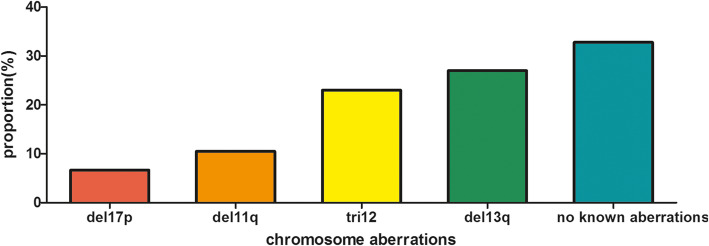
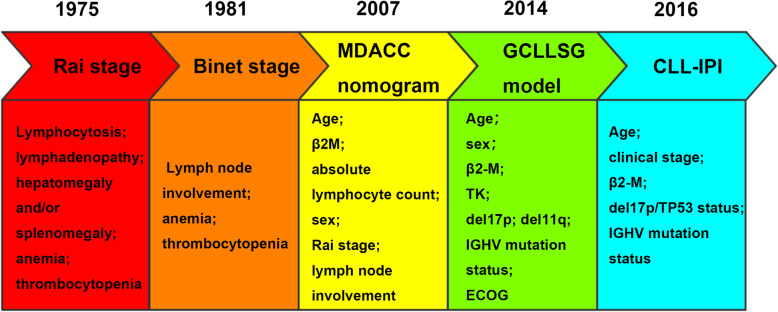
Chronic lymphocytic leukemia (CLL) is the most prevalent adult leukemia with high heterogeneity in the western world. Thus, investigators identified a number of prognostic biomarkers and scoring systems to guide treatment decisions and validated them in the context of immunochemotherapy. A better understanding of prognostic biomarkers, including serum markers, flow cytometry outcomes, IGHV mutation status, microRNAs, chromosome aberrations and gene mutations, have contributed to prognosis in CLL. Del17p/ TP53 mutation, NOTCH1 mutation, CD49d, IGHV mutation status, complex karyotypes and microRNAs were reported to be of predictive values to guide clinical decisions. Based on the biomarkers above, classic prognostic models, such as the Rai and Binet staging systems, MDACC nomogram, GCLLSG model and CLL-IPI, were developed to improve risk stratification and tailor treatment intensity. Considering the presence of novel agents, many investigators validated the conventional prognostic biomarkers in the setting of novel agents and only TP53 mutation status/del 17p and CD49d expression were reported to be of prognostic value. Whether other prognostic indicators and models can be used in the context of novel agents, further studies are required.
慢性淋巴细胞白血病(CLL)是西方世界最常见的成人白血病,具有高度异质性。因此,研究人员确定了许多预后生物标志物和评分系统来指导治疗决策,并在免疫化疗的背景下对其进行了验证。对包括血清标志物、流式细胞术结果、IGHV突变状态、微小RNA、染色体畸变和基因突变在内的预后生物标志物的更好理解有助于CLL的预后判断。据报道,17p缺失/TP53突变、NOTCH1突变、CD49d、IGHV突变状态、复杂核型和微小RNA对指导临床决策具有预测价值。基于上述生物标志物,开发了经典的预后模型,如Rai和Binet分期系统、MDACC列线图、GCLLSG模型和CLL-IPI,以改善风险分层并调整治疗强度。考虑到新型药物的出现,许多研究人员在新型药物的背景下验证了传统的预后生物标志物,据报道只有TP53突变状态/17p缺失和CD49d表达具有预后价值。其他预后指标和模型是否可用于新型药物的背景下,还需要进一步研究。