Department of Medical Biochemistry and Microbiology, Uppsala University, Uppsala, Sweden.
Department of Medical Cell Biology, Uppsala University, Uppsala, Sweden.
PLoS Biol. 2020 Sep 17;18(9):e3000856. doi: 10.1371/journal.pbio.3000856. eCollection 2020 Sep.
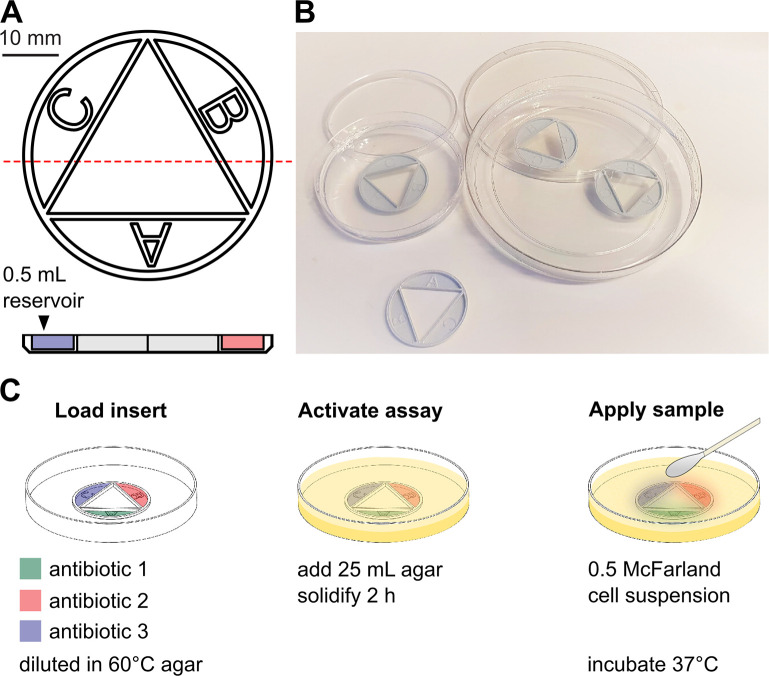
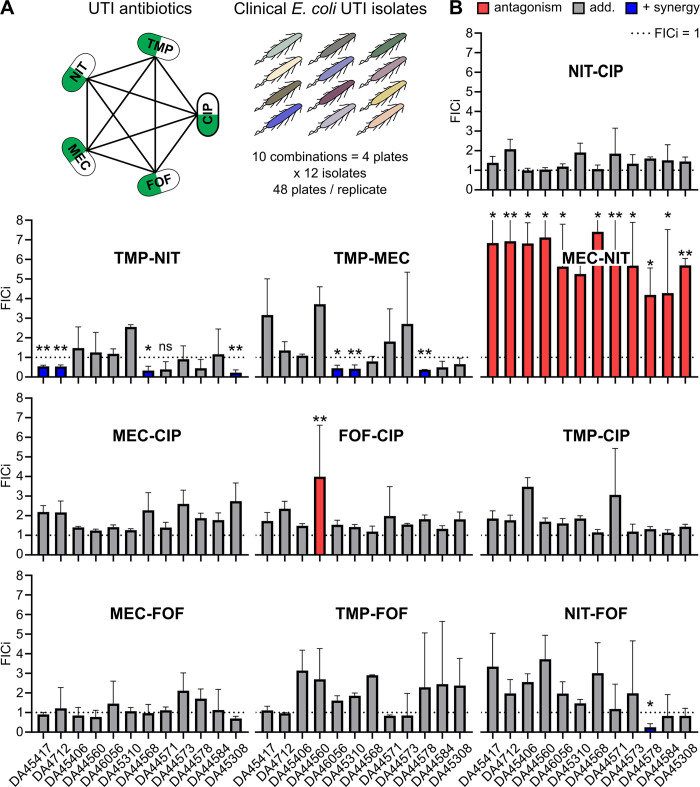
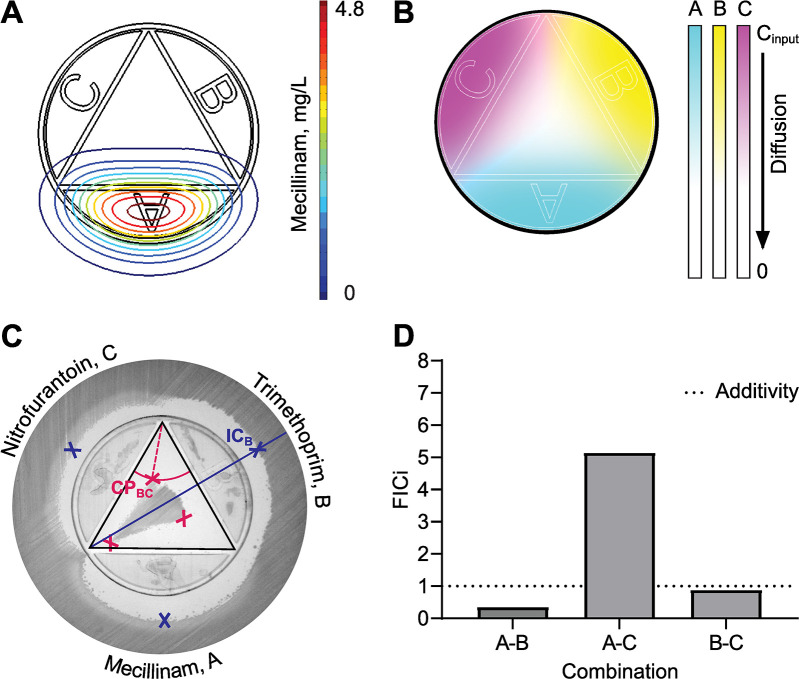
Antibiotic combination therapies are important for the efficient treatment of many types of infections, including those caused by antibiotic-resistant pathogens. Combination treatment strategies are typically used under the assumption that synergies are conserved across species and strains, even though recent results show that the combined treatment effect is determined by specific drug-strain interactions that can vary extensively and unpredictably, both between and within bacterial species. To address this problem, we present a new method in which antibiotic synergy is rapidly quantified on a case-by-case basis, allowing for improved combination therapy. The novel CombiANT methodology consists of a 3D-printed agar plate insert that produces defined diffusion landscapes of 3 antibiotics, permitting synergy quantification between all 3 antibiotic pairs with a single test. Automated image analysis yields fractional inhibitory concentration indices (FICis) with high accuracy and precision. A technical validation with 3 major pathogens, Escherichia coli, Pseudomonas aeruginosa, and Staphylococcus aureus, showed equivalent performance to checkerboard methodology, with the advantage of strongly reduced assay complexity and costs for CombiANT. A synergy screening of 10 antibiotic combinations for 12 E. coli urinary tract infection (UTI) clinical isolates illustrates the need for refined combination treatment strategies. For example, combinations of trimethoprim (TMP) + nitrofurantoin (NIT) and TMP + mecillinam (MEC) showed synergy, but only for certain individual isolates, whereas MEC + NIT combinations showed antagonistic interactions across all tested strains. These data suggest that the CombiANT methodology could allow personalized clinical synergy testing and large-scale screening. We anticipate that CombiANT will greatly facilitate clinical and basic research of antibiotic synergy.
抗生素联合治疗对于治疗许多类型的感染(包括由抗生素耐药病原体引起的感染)非常重要。联合治疗策略通常基于协同作用在物种和菌株之间保守的假设,尽管最近的结果表明,联合治疗效果由特定的药物-菌株相互作用决定,这些相互作用可能广泛且不可预测地变化,无论是在细菌之间还是在细菌内部。为了解决这个问题,我们提出了一种新方法,该方法可以快速逐案量化抗生素协同作用,从而改善联合治疗效果。新的 CombiANT 方法由一个 3D 打印琼脂板插入物组成,该插入物产生 3 种抗生素的定义扩散景观,允许通过单次测试对所有 3 种抗生素对进行协同作用量化。自动化图像分析以高精度和高精确度产生分数抑制浓度指数(FICis)。对 3 种主要病原体大肠杆菌、铜绿假单胞菌和金黄色葡萄球菌进行的技术验证表明,CombiANT 的性能与棋盘法相当,但具有显著降低的检测复杂性和成本优势。对 10 种抗生素组合对 12 种大肠杆菌尿路感染(UTI)临床分离株的协同筛选表明,需要精细化的联合治疗策略。例如,甲氧苄啶(TMP)+呋喃妥因(NIT)和 TMP+美西林(MEC)的组合表现出协同作用,但仅针对某些特定的分离株,而 MEC+NIT 的组合在所有测试菌株中均表现出拮抗相互作用。这些数据表明,CombiANT 方法可以允许进行个性化的临床协同测试和大规模筛选。我们预计 CombiANT 将极大地促进抗生素协同作用的临床和基础研究。