Division of Blood and Marrow Transplantation, Department of Medicine.
Department of Dermatology.
Blood Adv. 2020 Sep 22;4(18):4474-4482. doi: 10.1182/bloodadvances.2020001627.
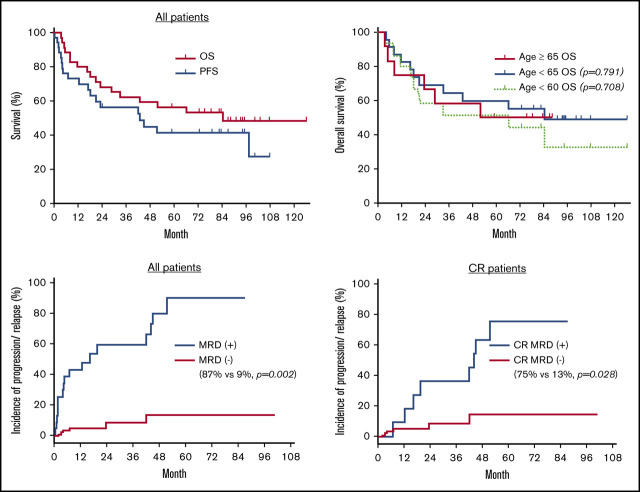
The majority of patients with refractory, advanced-stage mycosis fungoides (MF) or Sézary syndrome (SS) have a life expectancy of <5 years. Here, we report a phase 2 study of a novel nonmyeloablative allogeneic transplantation strategy tailored for this patient population. This study has completed the enrollment, and 35 patients (13 MF, 22 SS) have undergone transplant as planned. The majority (80%) of the patients had stage IV disease and received multiple previous systemic therapies. All patients had active disease at the time of conditioning using total skin electron beam therapy, total lymphoid irradiation, and antithymocyte globulin, and received allograft infusion as outpatients. Cyclosporine or tacrolimus and mycophenolate mofetil were used for graft-versus-host disease (GVHD) prophylaxis. Patients tolerated the transplant well, with 1- and 2-year nonrelapse mortality of 3% and 14%, respectively. The day +180 cumulative incidence of grade 2 to 4 acute GVHD was 16%, and the 2-year incidence of moderate/severe chronic GVHD was 32%. With a median posttransplant follow-up of 5.4 years, the 2-, 3-, and 5-year overall survival rates were 68%, 62%, and 56%. Using high-throughput sequencing of the T-cell receptor for minimal residual disease monitoring, we observed that 43% achieved molecular remission, which was associated with a lower incidence of disease progression or relapse (9% vs 87%; P = .02). Our study also showed that patients who were aged ≥65 years at the time of allotransplant had similar clinical outcomes compared with younger patients. Thus, we have developed an alternative and potentially curative nonmyeloablative allogeneic transplant regimen for patients with advanced stage MF/SS. This trial was registered at www.clinicaltrials.gov as #NCT00896493.
大多数难治性晚期蕈样真菌病 (MF) 或 Sézary 综合征 (SS) 患者的预期寿命<5 年。在这里,我们报告了一项针对该患者群体的新型非清髓性同种异体移植策略的 2 期研究。该研究已完成入组,35 例患者(13 例 MF,22 例 SS)按计划接受了移植。大多数(80%)患者患有 IV 期疾病,并接受了多次先前的系统治疗。所有患者在接受全身电子束治疗、全身淋巴照射和抗胸腺细胞球蛋白的条件下均有活动性疾病,并作为门诊患者接受同种异体输注。环孢素或他克莫司和霉酚酸酯用于移植物抗宿主病(GVHD)预防。患者对移植的耐受性良好,1 年和 2 年无复发生存率分别为 3%和 14%。+180 天的 2-4 级急性 GVHD 的累积发生率为 16%,2 年中重度/慢性 GVHD 的发生率为 32%。在移植后中位随访 5.4 年后,2 年、3 年和 5 年的总生存率分别为 68%、62%和 56%。使用 T 细胞受体高通量测序进行微小残留病监测,我们观察到 43%的患者达到分子缓解,这与疾病进展或复发的发生率较低(9%对 87%;P=0.02)相关。我们的研究还表明,在同种异体移植时年龄≥65 岁的患者与年龄较小的患者具有相似的临床结局。因此,我们为晚期 MF/SS 患者开发了一种替代的、潜在可治愈的非清髓性同种异体移植方案。该试验在 www.clinicaltrials.gov 上注册,编号为 #NCT00896493。