El-Kazzaz Waleed, Metwally Lobna, Yahia Reham, Al-Harbi Najwa, El-Taher Ayat, Hetta Helal F
Molecular Microbiology Lab., Botany Department, Faculty of Science, Suez Canal University, Ismailia 41522, Egypt.
Microbiology and Immunology Department, Faculty of Medicine, Suez Canal University, Ismailia 41522, Egypt.
Antibiotics (Basel). 2020 Sep 15;9(9):603. doi: 10.3390/antibiotics9090603.
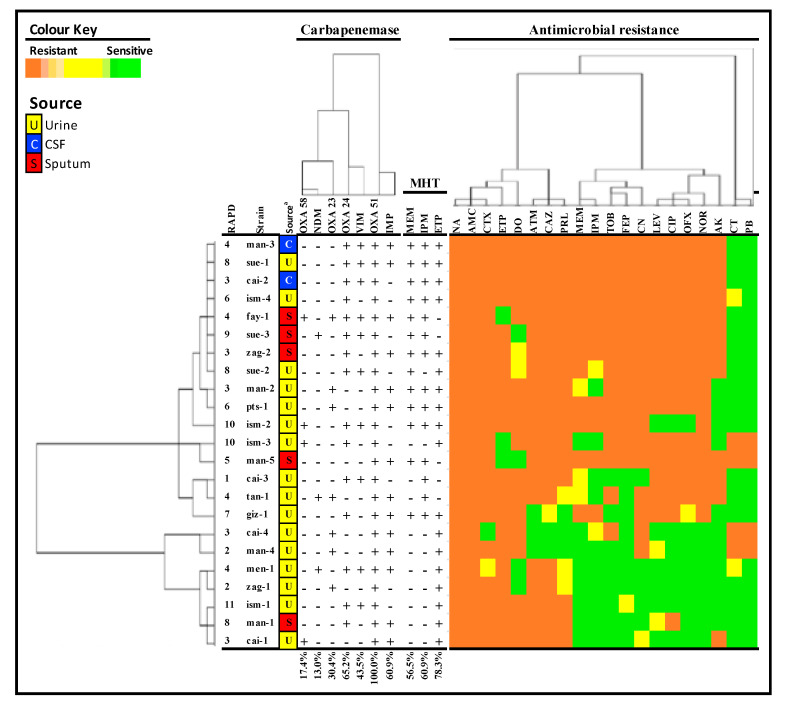
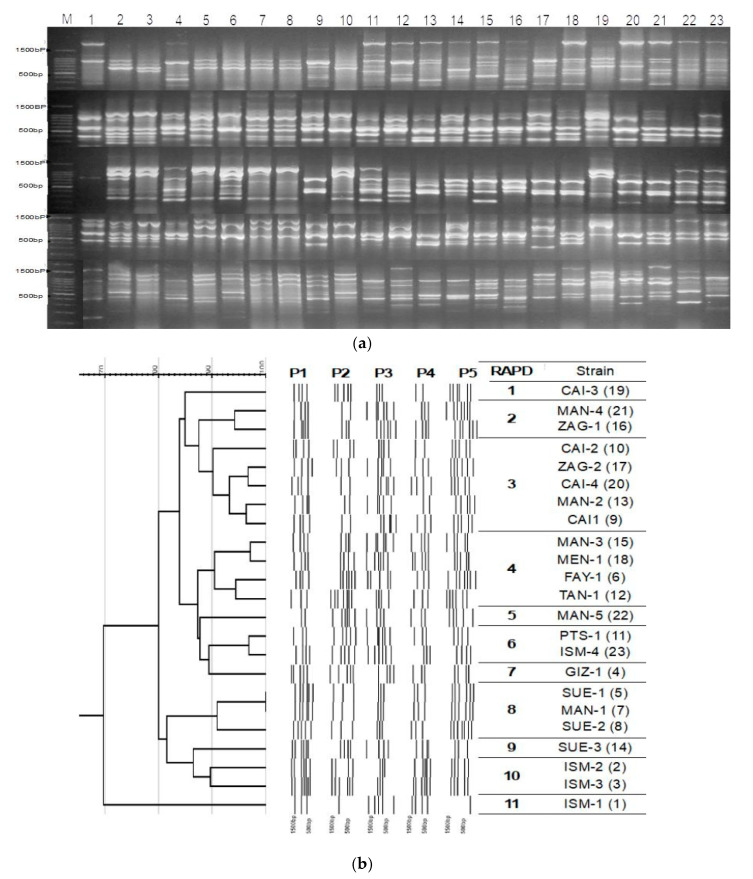
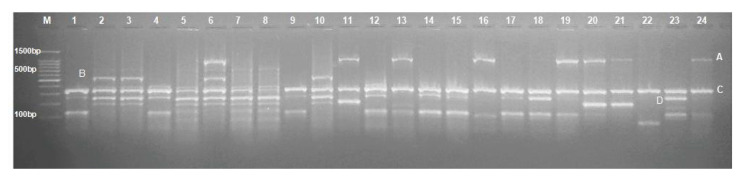
spp. has gained fame from their ability to resist difficult conditions and their constant development of antimicrobial resistance. This study aimed to investigate the prevalence, susceptibility testing, OXA carbapenemase-encoding genes, and RAPD-genotyping of multidrug resistant incriminated in hidden community-acquired infections in Egypt. The antimicrobial susceptibility testing was assessed phenotypically using Kirby-Bauer disk diffusion method. Also, Modified-Hodge test (MHT) was carried out to detect the carbapenemases production. Multiplex-PCR was used to detect the carbapenemase-encoding genes. Furthermore, the genetic relationship among the isolated strains was investigated using RAPD fingerprinting. The bacteriological examination revealed that, out of 200 Gram-negative non-fermentative isolates, 44 (22%) were identified phenotypically and biochemically as spp. and 23 (11.5%) were molecularly confirmed as . The retrieved strains were isolated from urine (69%), sputum (22%), and cerebrospinal fluid (csf) (9%). The isolated strains exhibited multidrug resistance and the production rates of carbapenemases were 56.5, 60.9, and 78.3% with meropenem, imipenem, and ertapenem disks, respectively. The -like genes were the most predominant among the tested strains (65.2%), followed by (30.4%) and (17.4%), in addition, the examined strains are harbored IMP, VIM, and NDM genes with prevalence of 60.9, 43.5, and 13%, respectively, while KPC and GES genes were not detected. RAPD-PCR revealed that the examined strains are clustered into 11 different genotypes at ≥90% similarity. Briefly, to the best of our knowledge, this study is the first report concerning community-associated infections in Egypt. The high prevalence of hidden multidrug-resistant (MDR) and extensively drug-resistant (XDR) strains associated with non-hospitalized patients raises an alarm for healthcare authorities to set strict standards to control the spread of such pathogens with high rates of morbidity and mortality.
某菌属因其抵抗恶劣条件的能力以及不断发展的抗菌药物耐药性而声名远扬。本研究旨在调查埃及隐匿性社区获得性感染中涉及的多重耐药菌的流行情况、药敏试验、OXA碳青霉烯酶编码基因以及随机扩增多态性DNA(RAPD)基因分型。采用 Kirby-Bauer 纸片扩散法对药敏试验进行表型评估。此外,进行改良 Hodge 试验(MHT)以检测碳青霉烯酶的产生。使用多重聚合酶链反应(Multiplex-PCR)检测碳青霉烯酶编码基因。此外,利用RAPD指纹图谱研究分离菌株之间的遗传关系。细菌学检查显示,在200株革兰氏阴性非发酵菌分离物中,44株(22%)经表型和生化鉴定为某菌属,23株(11.5%)经分子确认。回收的某菌株分别从尿液(69%)、痰液(22%)和脑脊液(CSF)(9%)中分离得到。分离出的某菌株表现出多重耐药性,美罗培南、亚胺培南和厄他培南纸片检测的碳青霉烯酶产生率分别为56.5%、60.9%和78.3%。在所测试的菌株中,某样基因最为常见(65.2%),其次是某基因(30.4%)和某基因(17.4%),此外,所检测的菌株携带IMP、VIM和NDM基因,其流行率分别为60.9%、43.5%和13%,而未检测到KPC和GES基因。RAPD-PCR显示,所检测的菌株在相似度≥90%时被聚类为11种不同的基因型。简而言之,据我们所知,本研究是关于埃及社区相关某菌感染的首份报告。与非住院患者相关的隐匿性多重耐药(MDR)和广泛耐药(XDR)某菌株的高流行率给卫生当局敲响了警钟,促使其制定严格标准以控制此类发病率和死亡率高的病原体的传播。