Department of Morphology, Faculty of Medicine, Riga Stradins University, LV-1010 Riga, Latvia.
Statistics Unit, Faculty of Medicine, Riga Stradins University, LV-1046 Riga, Latvia.
Sensors (Basel). 2020 Sep 15;20(18):5277. doi: 10.3390/s20185277.
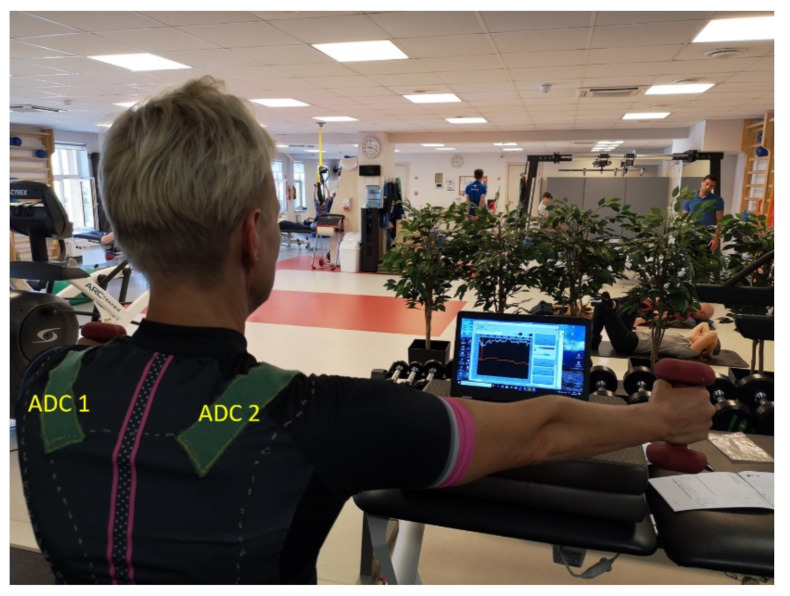
Wearable technologies provide many possibilities for applications in medicine, and especially in physiotherapy, where tracking and evaluation of body motion are of utmost importance. Despite the existence of multiple smart garments produced for applications in physiotherapy, there is limited information available on the actual impact of these technologies on the clinical outcomes. The objective of this paper is to evaluate the impact of the Double Aid (DAid) smart shirt, a purely textile-based system, on the training process of patients with subacromial pain syndrome. A randomized controlled trial was performed where patients with subacromial pain syndrome had to perform the assigned training exercises while employing the DAid smart shirt system. The core point of each exercise was to perform a movement while holding the shoulders stationary. The smart shirt was designed to sense even slight shoulder motion thus providing the patient with feedback on the accuracy of the motion, and allowing the patient to adjust the movement. The appropriate muscles should be strengthened through an increased effort to control the shoulder motion. The recovery of patients using the feedback system at the end of the treatment was compared to that of a reference group through standardized tests-the Disabilities of the Arm, Shoulder, and Hand score (DASH score), Closed Kinetic Chain Upper Extremity Stability test (CKCUES test), and internal/external rotation ratio. The test group that used the DAid system demonstrated significantly better results of the performed tests for all applied outcome measures compared to the reference group ( < 0.001). An overall positive impact on the patient recovery was observed from the DAid smart shirt system when applied for rehabilitation training of patients with subacromial pain syndrome.
可穿戴技术在医学领域,尤其是在物理治疗中,提供了许多应用的可能性,因为跟踪和评估身体运动在这两个领域都非常重要。尽管已经有多种智能服装被开发出来用于物理治疗应用,但关于这些技术对临床结果的实际影响的信息却非常有限。本文的目的是评估双辅助(DAid)智能衬衫在治疗肩峰下疼痛综合征患者的训练过程中的影响。这是一项随机对照试验,让肩峰下疼痛综合征患者在使用 DAid 智能衬衫系统的同时进行规定的训练。每个运动的核心点是在保持肩部静止的情况下进行运动。智能衬衫旨在感知到哪怕是轻微的肩部运动,从而为患者提供运动准确性的反馈,并允许患者调整运动。患者应该通过增加控制肩部运动的努力来增强适当的肌肉。通过标准化测试,即手臂、肩部和手的残疾(DASH 评分)、闭合运动链上肢稳定性测试(CKCUES 测试)和内外旋转比,比较使用反馈系统治疗结束后的患者的恢复情况与参考组。与参考组相比,使用 DAid 系统的测试组在所有应用的结果测量中都表现出显著更好的测试结果(<0.001)。当应用于肩峰下疼痛综合征患者的康复训练时,DAid 智能衬衫系统对患者的恢复有整体的积极影响。