Karoulla Eirini, Matsangidou Maria, Frangoudes Fotos, Paspalides Panayiotis, Neokleous Kleanthis, Pattichis Constantinos S
CEA-List, Université Paris-Saclay, Gif-sur-Yvette, France.
CYENS - Centre of Excellence, Nicosia, Cyprus.
J Med Internet Res. 2024 Dec 23;26:e51994. doi: 10.2196/51994.
The development of wearable solutions for tracking upper limb motion has gained research interest over the past decade. This paper provides a systematic review of related research on the type, feasibility, signal processing techniques, and feedback of wearable systems for tracking upper limb motion, mostly in rehabilitation applications, to understand and monitor human movement.
The aim of this article is to investigate how wearables are used to capture upper limb functions, especially related to clinical and rehabilitation applications.
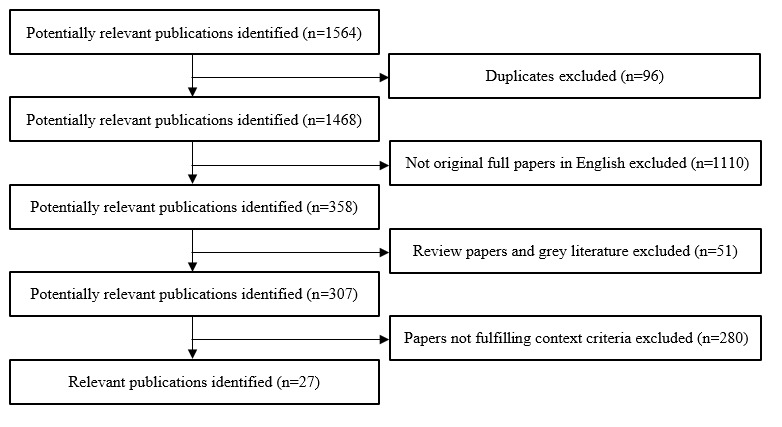
A systematic literature search identified 27 relevant studies published in English from 2011 to 2023, across 4 databases: ACM Digital Library, IEEE Xplore, PubMed, and ScienceDirect. We included papers focusing on motion or posture tracking for the upper limbs, wearable devices, feedback given to end users, and systems having clinical or rehabilitation purposes. We excluded papers focusing on exoskeletons, robotics, prosthetics, orthoses, or activity recognition systems; reviews; and books.
The results from this research focus on wearable devices that are designed to monitor upper limb movement. More specifically, studies were divided into 2 distinct categories: clinical motion tracking (15/27, 56%) and rehabilitation (12/27, 44%), involving healthy individuals and patients, with a total of 439 participants. Among the 27 studies, the majority (19/27) used inertial measurement units to track upper limb movement or smart textiles embedded with sensors. These devices were attached to the body with straps (mostly Velcro), providing flexibility and stability. The developed wearable devices positively influenced user motivation through the provided feedback, with visual feedback being the most common owing to the high level of independence provided. Moreover, a variety of signal processing techniques, such as Kalman and Butterworth filters, were applied to ensure data accuracy. However, limitations persist and include sensor positioning, calibration, and battery life, as well as a lack of clinical data on the effectiveness of these systems. The sampling rate of the data collection ranged from 50 Hz to 2000 Hz, which notably affected data quality and battery life. In addition, several findings were inconclusive, and thus, further future research is needed to understand and improve upper limb posture to develop progressive wearable systems.
This paper offers a comprehensive overview of wearable monitoring systems, with a focus on upper limb motion tracking and rehabilitation. It emphasizes the various types of available solutions; their efficacy, wearability, and feasibility; and proposed processing techniques. Finally, it presents robust findings regarding feedback accuracy derived from experiments and outlines potential future research directions.
在过去十年中,用于跟踪上肢运动的可穿戴解决方案的开发引起了研究兴趣。本文对用于跟踪上肢运动的可穿戴系统的类型、可行性、信号处理技术和反馈方面的相关研究进行了系统综述,这些研究主要用于康复应用,以了解和监测人体运动。
本文旨在研究可穿戴设备如何用于捕捉上肢功能,特别是与临床和康复应用相关的功能。
通过系统的文献检索,在4个数据库(ACM数字图书馆、IEEE Xplore、PubMed和ScienceDirect)中识别出2011年至2023年以英文发表的27项相关研究。我们纳入了专注于上肢运动或姿势跟踪、可穿戴设备、给予终端用户的反馈以及具有临床或康复目的的系统的论文。我们排除了专注于外骨骼、机器人技术、假肢、矫形器或活动识别系统的论文、综述和书籍。
本研究结果聚焦于旨在监测上肢运动的可穿戴设备。更具体地说,研究分为2个不同类别:临床运动跟踪(15/27,56%)和康复(12/27,44%),涉及健康个体和患者,共有439名参与者。在这27项研究中,大多数(19/27)使用惯性测量单元来跟踪上肢运动或嵌入传感器的智能纺织品。这些设备通过绑带(大多是尼龙搭扣)附着在身体上,提供了灵活性和稳定性。所开发的可穿戴设备通过提供的反馈对用户动机产生了积极影响,由于提供的高度独立性,视觉反馈最为常见。此外,还应用了各种信号处理技术,如卡尔曼滤波器和巴特沃斯滤波器,以确保数据准确性。然而,局限性仍然存在,包括传感器定位、校准和电池寿命,以及缺乏关于这些系统有效性的临床数据。数据收集的采样率范围为50赫兹至2000赫兹,这显著影响了数据质量和电池寿命。此外,一些研究结果尚无定论,因此,需要进一步的未来研究来了解和改善上肢姿势,以开发先进的可穿戴系统。
本文全面概述了可穿戴监测系统,重点是上肢运动跟踪和康复。它强调了可用解决方案的各种类型;它们的功效、可穿戴性和可行性;以及提出的处理技术。最后,它展示了从实验中得出关于反馈准确性的有力发现,并概述了潜在的未来研究方向。