Department of Reproductive Immunology and Pathology, Institute of Animal Reproduction and Food Research of Polish Academy of Sciences, Olsztyn, Tuwima-st 10, 10-748, Olsztyn, Poland.
Department of Animal Physiology and Biochemistry and Biostructure, Faculty of Veterinary Medicine and Animal Science, Poznan University of Life Sciences, Poznan, Poland.
BMC Vet Res. 2020 Sep 17;16(1):343. doi: 10.1186/s12917-020-02562-6.
Equine endometrosis is a chronic degenerative condition, described as endometrial fibrosis that forms in the stroma, under the basement membrane and around the endometrial glands. The role of lysophosphatidic acid (LPA) in the development of tissue fibrosis varies depending on the organ, and its profibrotic role in mare endometrosis remains unclear. The study aimed to establish the endometrial presence of LPA and its receptors (LPAR1-4), together with its effects on connective tissue growth factor (CTGF) and prostaglandins (PG) secretion from equine endometrium under physiological (estrous cycle), or pathological conditions (endometrosis). Mare endometria in the mid-luteal phase (n = 5 for each category I, IIA, IIB, III of Kenney and Doig) and in the follicular phase (n = 5 for each category I, IIA, III and n = 4 for IIB) were used. In experiment 1, the levels of LPA, LPAR1-4 mRNA level and protein abundance were investigated in endometria at different stages of endometrosis. In experiment 2, the in vitro effect of LPA (10 M) on the secretion of CTGF and PGs from endometrial tissue explants at different stages of endometrosis were determined.
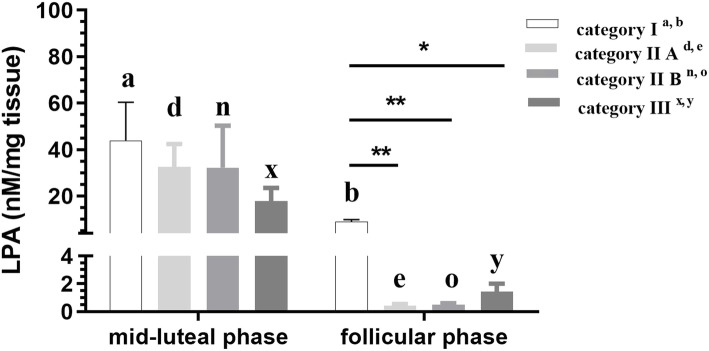
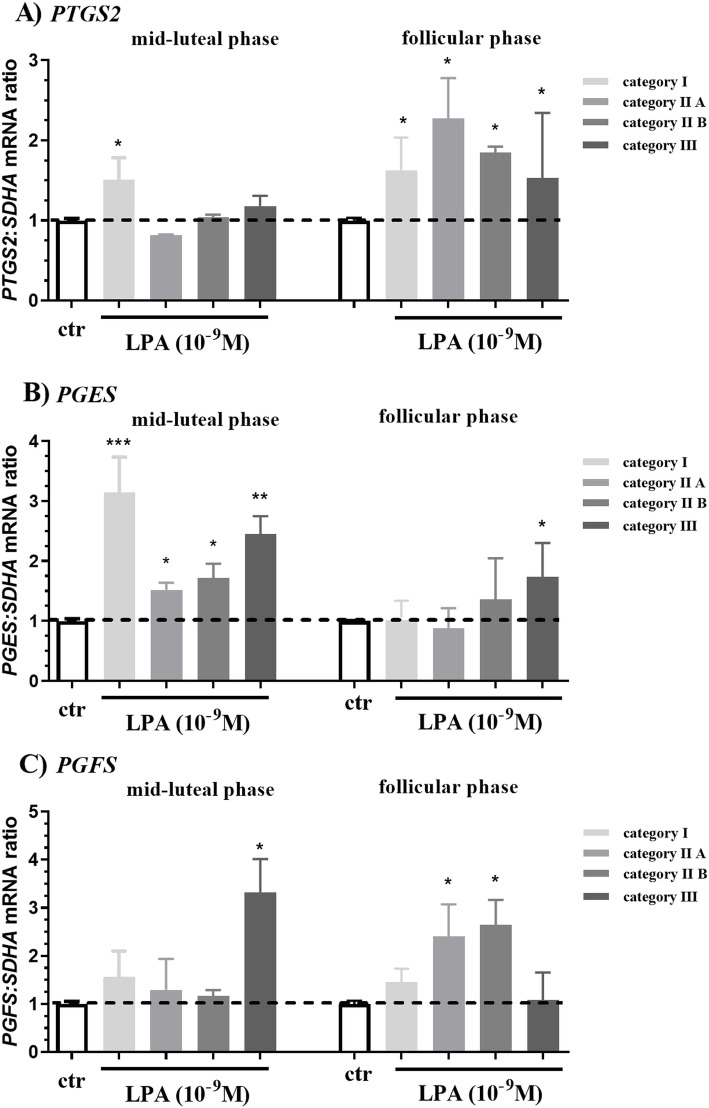
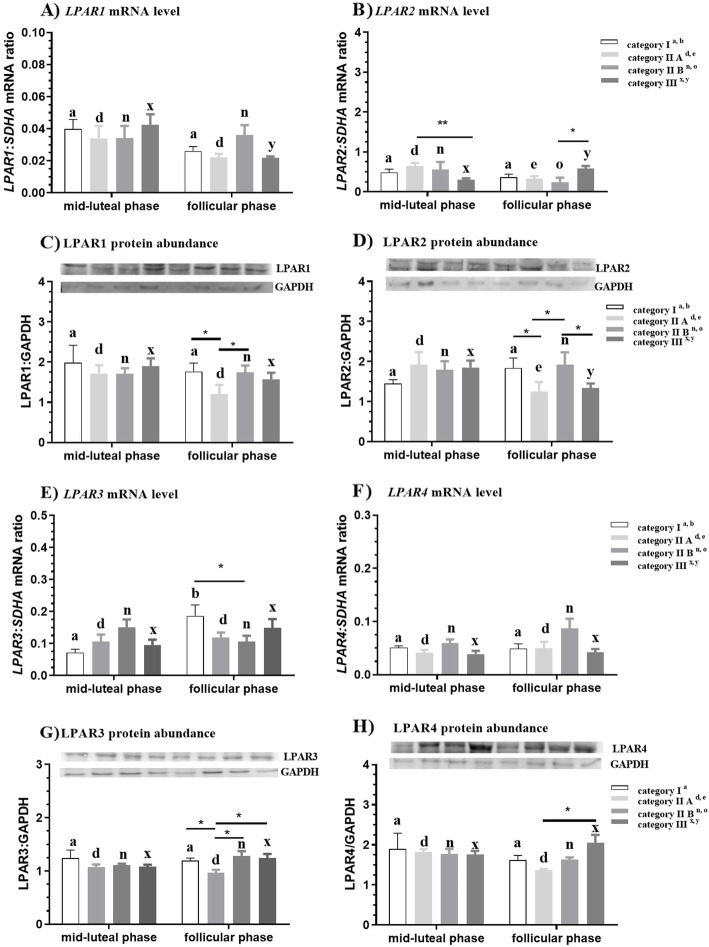
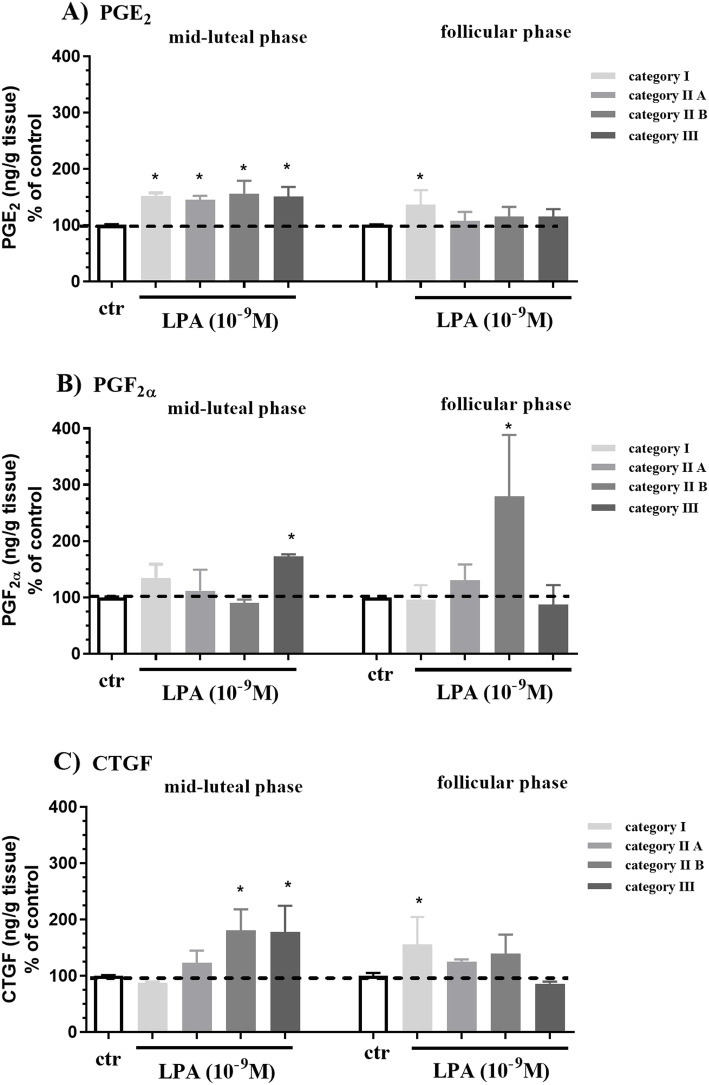
Endometrial LPA concentration was higher in the mid-luteal phase compared to the follicular phase in category I endometrium (P < 0.01). There was an alteration in endometrial concentrations of LPA and LPAR1-4 protein abundance in the follicular phase at different stages of endometrosis (P < 0.05). Additionally, LPA increased the secretion of PGE from category I endometrium in both phases of the estrous cycle (P < 0.05). The effect of LPA on the secretion of CTGF and PGF from endometrial tissue was altered depending on different stages of endometrosis (P < 0.05).
Our data indicate that endometrosis disturbs proper endometrial function and is associated with altered endometrial LPA concentration, its receptor expression and protein abundance, PGE/PGF ratio, and CTGF secretion in response to LPA. These changes could influence several physiological events occurring in endometrium in mare during estrous cycle and early pregnancy.
马属动物子宫内膜异位症是一种慢性退行性疾病,表现为子宫内膜纤维化,形成于基质中、基底层下和子宫内膜腺体周围。溶血磷脂酸(LPA)在组织纤维化发展中的作用因器官而异,其在母马子宫内膜异位症中的促纤维化作用尚不清楚。本研究旨在确定 LPA 及其受体(LPAR1-4)在马属动物子宫内膜中的存在,并研究其在生理状态(发情周期)或病理状态(子宫内膜异位症)下对结缔组织生长因子(CTGF)和前列腺素(PG)分泌的影响。在黄体中期(Kenney 和 Doig 的分类 I、IIA、IIB、III 期,每组 5 例)和卵泡期(分类 I、IIA、III 期,每组 5 例,IIB 期 4 例)采集母马子宫内膜。在实验 1 中,研究了不同子宫内膜异位症阶段子宫内膜中 LPA、LPAR1-4mRNA 水平和蛋白丰度的水平。在实验 2 中,测定了 LPA(10μM)对不同子宫内膜异位症阶段子宫内膜组织块分泌 CTGF 和 PGs 的体外作用。
在分类 I 子宫内膜中,黄体中期子宫内膜中 LPA 的浓度高于卵泡期(P<0.01)。在不同阶段的子宫内膜异位症的卵泡期,子宫内膜中 LPA 和 LPAR1-4 蛋白丰度的浓度发生了变化(P<0.05)。此外,在发情周期的两个阶段,LPA 均增加了分类 I 子宫内膜 PGE 的分泌(P<0.05)。LPA 对子宫内膜组织 CTGF 和 PGF 分泌的作用因子宫内膜异位症的不同阶段而改变(P<0.05)。
我们的数据表明,子宫内膜异位症扰乱了正常的子宫内膜功能,并与子宫内膜中 LPA 浓度、受体表达和蛋白丰度、PGE/PGF 比值以及对 LPA 的 CTGF 分泌的改变有关。这些变化可能会影响母马发情周期和早期妊娠期间子宫内膜中发生的几个生理事件。