Ninou Ioanna, Magkrioti Christiana, Aidinis Vassilis
Division of Immunology, Alexander Fleming Biomedical Sciences Research Center, Athens, Greece.
Front Med (Lausanne). 2018 Jun 13;5:180. doi: 10.3389/fmed.2018.00180. eCollection 2018.
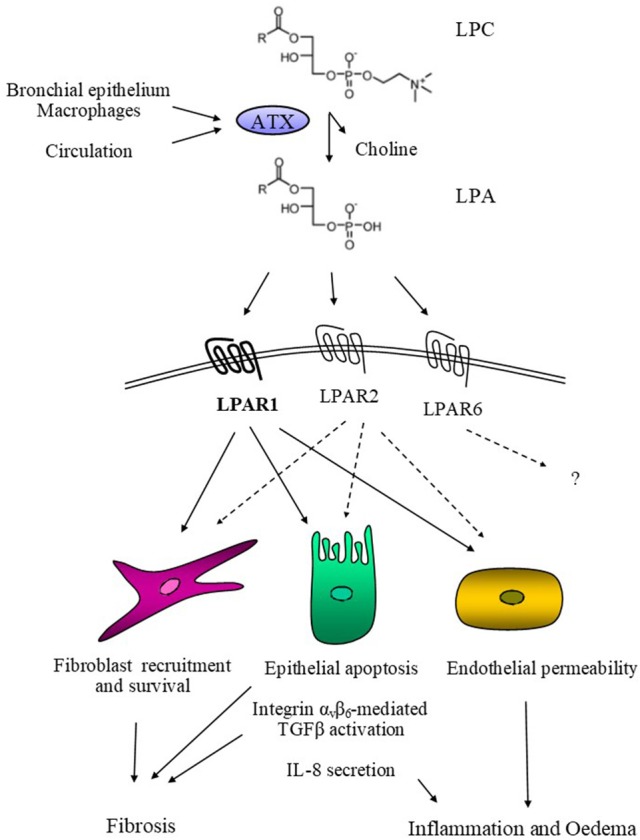
Lysophospholipid signaling is emerging as a druggable regulator of pathophysiological responses, and especially fibrosis, exemplified by the relative ongoing clinical trials in idiopathic pulmonary fibrosis (IPF) patients. In this review, we focus on ectonucleotide pyrophosphatase-phosphodiesterase 2 (ENPP2), or as more widely known Autotaxin (ATX), a secreted lysophospholipase D (lysoPLD) largely responsible for extracellular lysophosphatidic acid (LPA) production. In turn, LPA is a bioactive phospholipid autacoid, forming locally upon increased ATX levels and acting also locally through its receptors, likely guided by ATX's structural conformation and cell surface associations. Increased ATX activity levels have been detected in many inflammatory and fibroproliferative conditions, while genetic and pharmacologic studies have confirmed a pleiotropic participation of ATX/LPA in different processes and disorders. In pulmonary fibrosis, ATX levels rise in the broncheoalveolar fluid (BALF) and stimulate LPA production. LPA engagement of its receptors activate multiple G-protein mediated signal transduction pathways leading to different responses from pulmonary cells including the production of pro-inflammatory signals from stressed epithelial cells, the modulation of endothelial physiology, the activation of TGF signaling and the stimulation of fibroblast accumulation. Genetic or pharmacologic targeting of the ATX/LPA axis attenuated disease development in animal models, thus providing the proof of principle for therapeutic interventions.
溶血磷脂信号传导正逐渐成为病理生理反应(尤其是纤维化)的可药物调节靶点,特发性肺纤维化(IPF)患者正在进行的相关临床试验就是例证。在本综述中,我们聚焦于胞外核苷酸焦磷酸酶 - 磷酸二酯酶2(ENPP2),更广为人知的是自分泌运动因子(ATX),它是一种分泌型溶血磷脂酶D(lysoPLD),在很大程度上负责细胞外溶血磷脂酸(LPA)的产生。反过来,LPA是一种生物活性磷脂自分泌信号分子,在ATX水平升高时局部形成,并通过其受体在局部发挥作用,这可能受ATX的结构构象和细胞表面关联的引导。在许多炎症和纤维增生性疾病中都检测到ATX活性水平升高,而基因和药理学研究已证实ATX/LPA在不同过程和疾病中具有多效性作用。在肺纤维化中,支气管肺泡灌洗液(BALF)中的ATX水平升高并刺激LPA产生。LPA与其受体的结合激活多种G蛋白介导的信号转导途径,导致肺细胞产生不同反应,包括应激上皮细胞产生促炎信号、调节内皮生理功能、激活TGF信号传导以及刺激成纤维细胞积聚。在动物模型中,对ATX/LPA轴进行基因或药物靶向可减轻疾病发展,从而为治疗干预提供了原理证明。