Jouet Agathe, Gaudin Cyril, Badalato Nelly, Allix-Béguec Caroline, Duthoy Stéphanie, Ferré Alice, Diels Maren, Laurent Yannick, Contreras Sandy, Feuerriegel Silke, Niemann Stefan, André Emmanuel, Kaswa Michel K, Tagliani Elisa, Cabibbe Andrea, Mathys Vanessa, Cirillo Daniela, de Jong Bouke C, Rigouts Leen, Supply Philip
GenoScreen, Lille, France.
These authors contributed equally to this work.
Eur Respir J. 2021 Mar 18;57(3). doi: 10.1183/13993003.02338-2020. Print 2021 Mar.
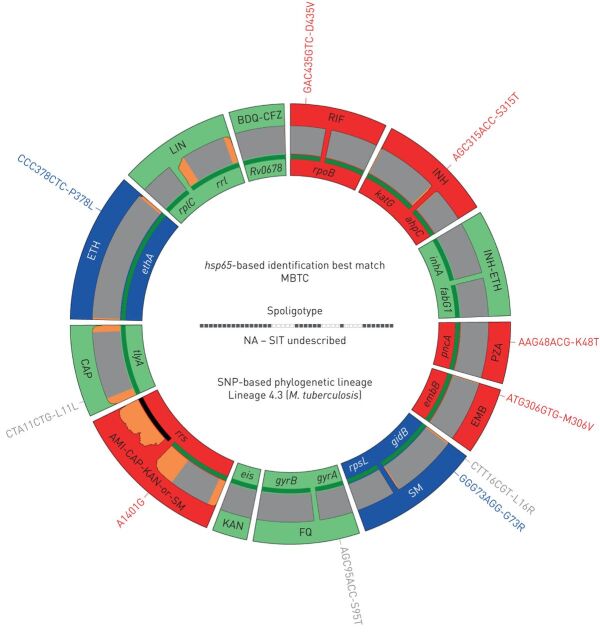
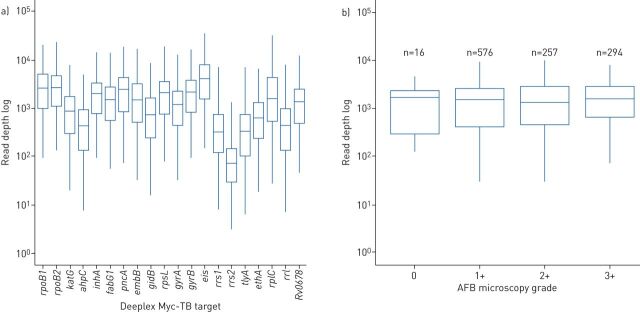
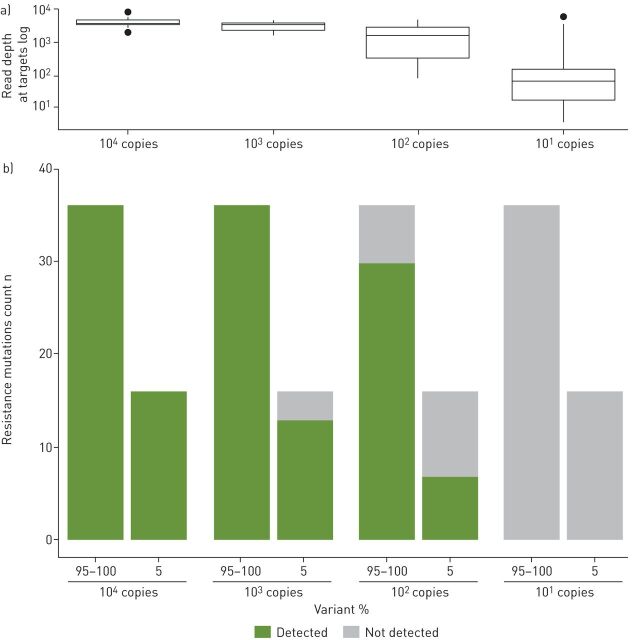
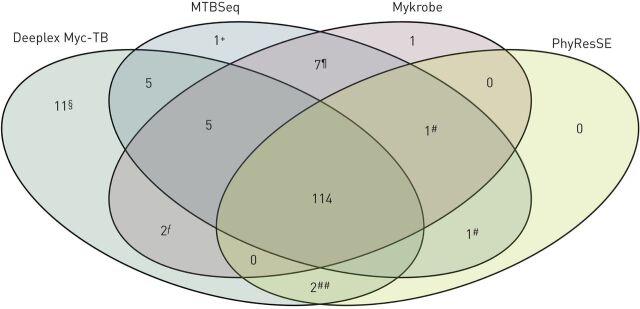
Conventional molecular tests for detecting complex (MTBC) drug resistance on clinical samples cover a limited set of mutations. Whole-genome sequencing (WGS) typically requires culture.Here, we evaluated the Deeplex Myc-TB targeted deep-sequencing assay for prediction of resistance to 13 anti-tuberculous drugs/drug classes, directly applicable on sputum.With MTBC DNA tests, the limit of detection was 100-1000 genome copies for fixed resistance mutations. Deeplex Myc-TB captured 97.1-99.3% of resistance phenotypes correctly predicted by WGS from 3651 MTBC genomes. On 429 isolates, the assay predicted 92.2% of 2369 first- and second-line phenotypes, with a sensitivity of 95.3% and a specificity of 97.4%. 56 out of 69 (81.2%) residual discrepancies with phenotypic results involved pyrazinamide, ethambutol and ethionamide, and low-level rifampicin or isoniazid resistance mutations, all notoriously prone to phenotypic testing variability. Only two out of 91 (2.2%) resistance phenotypes undetected by Deeplex Myc-TB had known resistance-associated mutations by WGS analysis outside Deeplex Myc-TB targets. Phenotype predictions from Deeplex Myc-TB analysis directly on 109 sputa from a Djibouti survey matched those of MTBSeq/PhyResSE/Mykrobe, fed with WGS data from subsequent cultures, with a sensitivity of 93.5/98.5/93.1% and a specificity of 98.5/97.2/95.3%, respectively. Most residual discordances involved gene deletions/indels and 3-12% heteroresistant calls undetected by WGS analysis or natural pyrazinamide resistance of globally rare "" strains then unreported by Deeplex Myc-TB. On 1494 arduous sputa from a Democratic Republic of the Congo survey, 14 902 out of 19 422 (76.7%) possible susceptible or resistance phenotypes could be predicted culture-free.Deeplex Myc-TB may enable fast, tailored tuberculosis treatment.
用于检测临床样本中结核分枝杆菌复合群(MTBC)耐药性的传统分子检测方法涵盖的突变种类有限。全基因组测序(WGS)通常需要进行培养。在此,我们评估了Deeplex Myc-TB靶向深度测序检测法,以预测对13种抗结核药物/药物类别的耐药性,该方法可直接应用于痰液检测。对于MTBC DNA检测,固定耐药突变的检测限为100 - 1000个基因组拷贝。Deeplex Myc-TB正确捕获了WGS从3651个MTBC基因组中正确预测的97.1 - 99.3%的耐药表型。在429株分离株上,该检测法预测了2369种一线和二线表型中的92.2%,灵敏度为95.3%,特异性为97.4%。与表型结果的69个残留差异中有56个(81.2%)涉及吡嗪酰胺、乙胺丁醇和乙硫异烟胺,以及低水平利福平或异烟肼耐药突变,这些突变在表型检测中都极易出现变异性。在Deeplex Myc-TB未检测到的91个耐药表型中,只有2个(2.2%)通过WGS分析在Deeplex Myc-TB靶点之外具有已知的耐药相关突变。直接对吉布提一项调查中的109份痰液进行Deeplex Myc-TB分析得到的表型预测结果,与使用后续培养的WGS数据的MTBSeq/PhyResSE/Mykrobe的预测结果相匹配,灵敏度分别为93.5/98.5/93.1%,特异性分别为98.5/97.2/95.3%。大多数残留不一致涉及基因缺失/插入缺失以及WGS分析未检测到的3 - 12%的异质耐药性呼叫,或全球罕见“”菌株的天然吡嗪酰胺耐药性,Deeplex Myc-TB未报告这些情况。在刚果民主共和国一项调查的1494份难以处理的痰液中,19422种可能的敏感或耐药表型中有14902种(76.7%)可以在无需培养的情况下进行预测。Deeplex Myc-TB可能有助于实现快速、个性化的结核病治疗。