Assistance Publique-Hôpitaux de Paris (AP-HP), Hôpital Pitié-Salpêtrière, Service de Bactériologie-Hygiène, Paris, France.
Centre National de Référence des Mycobactéries et de la Résistance des Mycobactéries aux Antituberculeux (CNR-MyRMA), Paris, France.
Front Cell Infect Microbiol. 2021 Oct 29;11:707244. doi: 10.3389/fcimb.2021.707244. eCollection 2021.
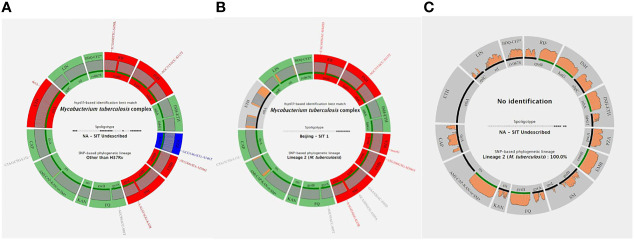
The GeneLEAD VIII (Diagenode, Belgium) is a new, fully automated, sample-to-result precision instrument for the extraction of DNA and PCR detection of complex (MTBC) directly from clinical samples. The Deeplex Myc-TB assay (Genoscreen, France) is a diagnostic kit based on the deep sequencing of a 24-plexed amplicon mix allowing simultaneously the detection of resistance to 13 antituberculous (antiTB) drugs and the determination of spoligotype. We evaluated the performance of a strategy combining the both mentioned tools to detect directly from clinical samples, in 8 days, MTBC and its resistance to 13 antiTB drugs, and identify potential transmission of strains from patient-to-patient. Using this approach, we screened 112 clinical samples (65 smear-negative) and 94 MTBC cultured strains. The sensitivity and the specificity of the GeneLEAD/Deeplex Myc-TB approach for MTBC detection were 79.3% and 100%, respectively. One hundred forty successful Deeplex Myc-TB results were obtained for 46 clinical samples and 94 strains, a total of 85.4% of which had a Deeplex Myc-TB susceptibility and resistance prediction consistent with phenotypic drug susceptibility testing (DST). Importantly, the Deeplex Myc-TB assay was able to detect 100% of the multidrug-resistant (MDR) MTBC tested. The lowest concordance rates were for pyrazinamide, ethambutol, streptomycin, and ethionamide (84.5%, 81.5%, 73%, and 55%, respectively) for which the determination of susceptibility or resistance is generally difficult with current tools. One of the main difficulties of Deeplex Myc-TB is to interpret the non-synonymous uncharacterized variants that can represent up to 30% of the detected single nucleotide variants. We observed a good level of concordance between Deeplex Myc-TB-spoligotyping and MIRU-VNTR despite a lower discriminatory power for spoligotyping. The median time to obtain complete results from clinical samples was 8 days (IQR 7-13) provided a high-throughput NGS sequencing platform was available. Our results highlight that the GeneLEAD/Deeplex Myc-TB approach could be a breakthrough in rapid diagnosis of MDR TB in routine practice.
GeneLEAD VIII(Diagenode,比利时)是一种全新的、全自动的、从样本中提取 DNA 并进行 PCR 检测的精密仪器,可直接从临床样本中检测出复杂的(MTBC)。Deeplex Myc-TB 检测(Genoscreen,法国)是一种基于 24 个多重扩增子混合物的深度测序的诊断试剂盒,同时允许检测对 13 种抗结核(antiTB)药物的耐药性,并确定 spoligotype。我们评估了结合这两种工具的策略的性能,该策略可直接从临床样本中在 8 天内检测 MTBC 及其对 13 种抗结核药物的耐药性,并确定从患者到患者的菌株潜在传播。使用这种方法,我们筛查了 112 份临床样本(65 份痰阴性)和 94 株 MTBC 培养株。GeneLEAD/Deeplex Myc-TB 方法检测 MTBC 的敏感性和特异性分别为 79.3%和 100%。在 46 份临床样本和 94 株菌株中成功获得了 140 次 Deeplex Myc-TB 结果,其中总共有 85.4%的结果与表型药物敏感性试验(DST)一致,表明对 Deeplex Myc-TB 具有敏感性和耐药性预测。重要的是,Deeplex Myc-TB 检测能够检测到 100%的测试的耐多药(MDR)MTBC。一致性最低的是吡嗪酰胺、乙胺丁醇、链霉素和乙硫异烟胺(分别为 84.5%、81.5%、73%和 55%),对于这些药物,目前的工具通常很难确定其敏感性或耐药性。Deeplex Myc-TB 的主要困难之一是解释非同义未表征的变异,这些变异可占检测到的单核苷酸变异的 30%。尽管 spoligotyping 的区分能力较低,但我们观察到 Deeplex Myc-TB-spoligotyping 和 MIRU-VNTR 之间具有良好的一致性。如果有高通量 NGS 测序平台,从临床样本中获得完整结果的中位数时间为 8 天(IQR 7-13)。我们的结果表明,GeneLEAD/Deeplex Myc-TB 方法可能是快速诊断常规实践中 MDR-TB 的突破。