National Tuberculosis Program et Laboratoire National de Référence des Mycobactéries (LNRM), Kinshasa, Democratic Republic of the Congo.
Faculté de Médecine, Université de Kinshasa, Kinshasa, Democratic Republic of the Congo.
Sci Rep. 2020 Jul 1;10(1):10786. doi: 10.1038/s41598-020-67479-4.
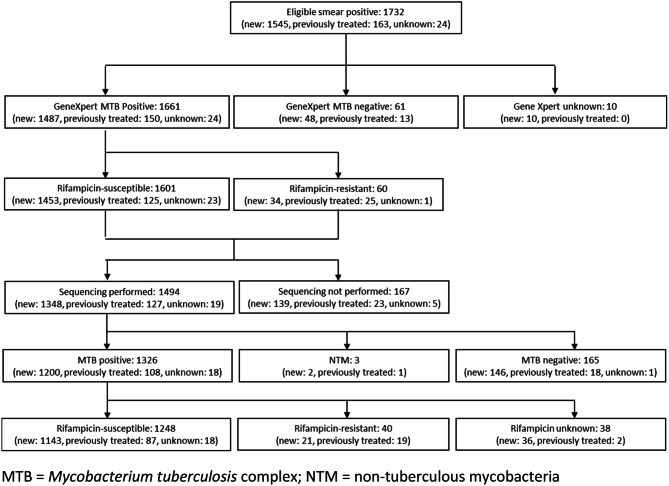
The surveillance of drug resistance among tuberculosis (TB) patients is central to preventing the spread of antimicrobial resistance. The Democratic Republic of the Congo (DR Congo) is classified by the World Health Organization (WHO) as a country with a high burden of TB and multidrug-resistant TB (MDR-TB), but there are no nationally representative data on drug resistance. In 2016-2017, a national survey of TB patients was conducted in 108 microscopy centres across all 11 provinces of the country using innovative molecular approaches. Sputum samples were collected from 1,545 new and 163 previously treated patients. These were tested by the Xpert MTB/RIF assay, followed by targeted next-generation sequencing performed directly on sputum. The prevalence of rifampicin resistance was low, at 1.8% (95% CI: 1.0-3.2) among new and 17.3% (95% CI: 11.9-24.4) among previously treated patients. Resistance to pyrazinamide, fluoroquinolones and second-line injectables was also low. The prevalence of resistance to isoniazid among rifampicin-susceptible patients was higher, at 6.6% (95% CI: 4.4-9.8) among new and 8.7% (95% : 3.2-21.2) among previously treated patients. Diagnosing and treating isoniazid-resistant patients remains a challenge, given that many will be missed by the current national diagnostic algorithm that is driven by detecting rifampicin resistance by Xpert MTB/RIF. This is the first nationwide survey incorporating targeted sequencing directly on sputum. It serves as a proof-of-concept for other settings that do yet have rapid specimen transport networks or capacity to conduct culture.
对结核病(TB)患者耐药性的监测对于防止抗微生物药物耐药性的传播至关重要。刚果民主共和国(DRC)被世界卫生组织(WHO)列为结核病和耐多药结核病(MDR-TB)负担沉重的国家,但该国没有全国代表性的耐药性数据。2016-2017 年,在全国 11 个省的 108 个显微镜中心,使用创新的分子方法对结核病患者进行了全国性调查。从 1545 名新发病例和 163 名既往治疗过的患者中采集了痰液样本。这些样本通过 Xpert MTB/RIF 检测进行检测,然后直接对痰液进行靶向下一代测序。利福平耐药率较低,新发病例为 1.8%(95%CI:1.0-3.2),既往治疗过的患者为 17.3%(95%CI:11.9-24.4)。对吡嗪酰胺、氟喹诺酮类药物和二线注射剂的耐药率也较低。在利福平敏感的患者中,异烟肼耐药率较高,新发病例为 6.6%(95%CI:4.4-9.8),既往治疗过的患者为 8.7%(95%CI:3.2-21.2)。鉴于当前的国家诊断算法主要通过 Xpert MTB/RIF 检测利福平耐药性来检测异烟肼耐药性,因此诊断和治疗异烟肼耐药患者仍然是一个挑战。这是首次在全国范围内进行的直接对痰液进行靶向测序的调查。它为其他尚未建立快速标本运输网络或培养能力的地区提供了一个概念验证。