Chen Wen-Bing, Pan Han-Qing, He Ye, Wang Xue-Hui, Zhang Wen-Hua, Pan Bing-Xing
School of Life Sciences, Nanchang University, Nanchang, 330031 China.
Institute of Life Science, Nanchang University, Nanchang, 330031 China.
Cell Biosci. 2020 Sep 11;10:107. doi: 10.1186/s13578-020-00469-1. eCollection 2020.
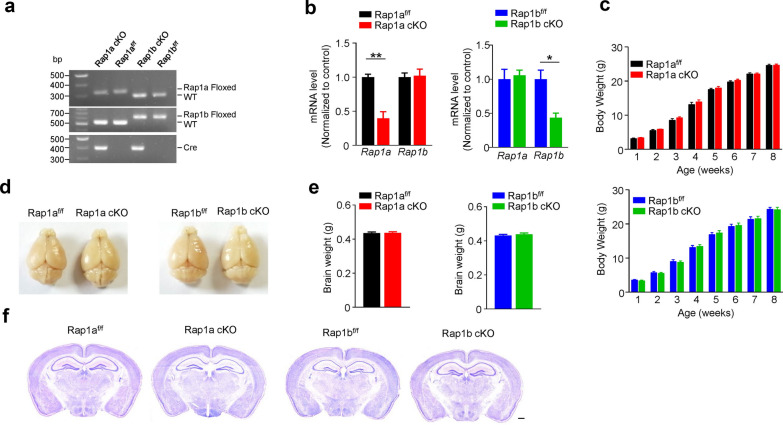
Fear is an adaptive response across species in the face of threatening cues. It can be either innate or learned through postnatal experience. We have previously shown that genetic deletion of both Rap1a and Rap1b, two isoforms of small GTPase Rap1 in forebrain, causes impairment in auditory fear conditioning. However, the specific roles of these two isoforms are not yet known.
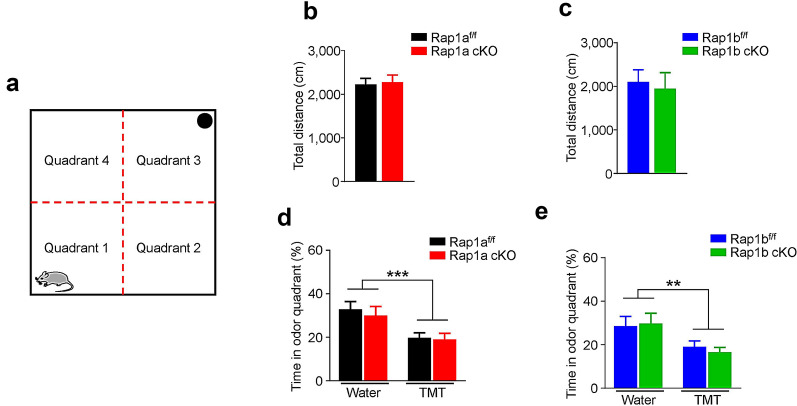
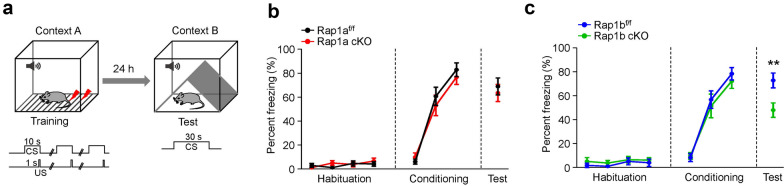
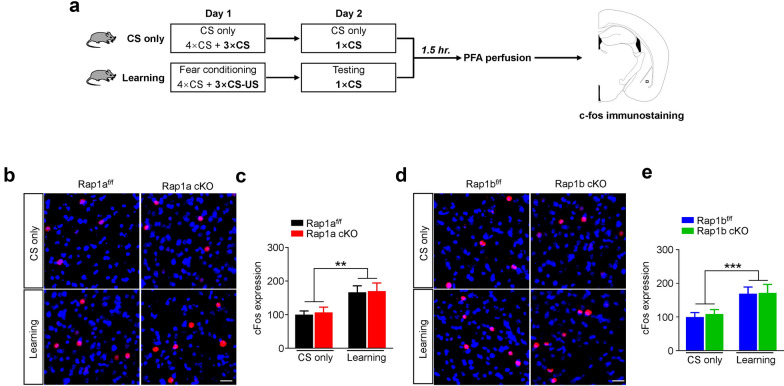
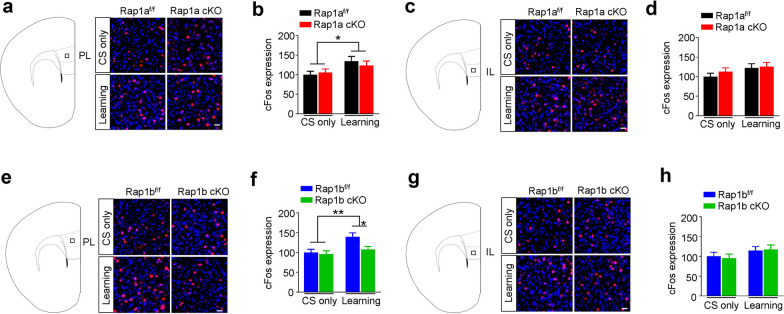
In the present study, employing mice with forebrain-restricted deletion of Rap1a or Rap1b, we found that they are both dispensable for normal acquisition of fear learning. However, Rap1b but not Rap1a knockout (KO) mice displayed impairment in the retrieval of learned fear. Subsequently, we found that the expression of c-Fos, a marker of neuronal activity, is specifically decreased in prelimbic cortex (PL) of Rap1b KO mice after auditory fear conditioning, while remained unaltered in the amygdala and infralimbic cortex (IL). On the other hand, neither Rap1a nor Rap1b knockout altered the innate fear of mice in response to their predator odor, 2,5-Dihydro-2,4,5-Trimethylthiazoline (TMT).
Thus, our results indicate that it is Rap1b but not Rap1a involved in the retrieval process of fear learning, and the learned but not innate fear requires Rap1 signaling in forebrain.
恐惧是物种面对威胁线索时的一种适应性反应。它既可以是先天的,也可以通过出生后的经历习得。我们之前已经表明,在前脑中小GTP酶Rap1的两种亚型Rap1a和Rap1b的基因缺失会导致听觉恐惧条件反射受损。然而,这两种亚型的具体作用尚不清楚。
在本研究中,利用前脑特异性缺失Rap1a或Rap1b的小鼠,我们发现它们对于正常的恐惧学习获得都是可有可无的。然而,Rap1b基因敲除(KO)小鼠而非Rap1a基因敲除小鼠在习得恐惧的提取方面表现出受损。随后,我们发现,神经元活动标记物c-Fos的表达在听觉恐惧条件反射后在Rap1b基因敲除小鼠的前边缘皮层(PL)中特异性降低,而在杏仁核和边缘下皮层(IL)中保持不变。另一方面,Rap1a和Rap1b基因敲除均未改变小鼠对其捕食者气味2,5-二氢-2,4,5-三甲基噻唑啉(TMT)的先天恐惧。
因此,我们的结果表明,参与恐惧学习提取过程的是Rap1b而非Rap1a,并且习得的而非先天的恐惧在前脑中需要Rap1信号传导。