Adachi Koichiro, Tuchiya Jumpei, Beppu Satoru, Nishiyama Kei, Shimizu Makiko, Yamazaki Hiroshi
Laboratory of Drug Metabolism and Pharmacokinetics, Showa Pharmaceutical University, 3-3165 Higashi-tamagawa Gakuen, Machida, Tokyo 194-8543 Japan.
Kyoto Medical Center, Fushimi-ku, Kyoto, 612-8555 Japan.
J Pharm Health Care Sci. 2020 Sep 11;6:20. doi: 10.1186/s40780-020-00176-6. eCollection 2020.
The anticoagulant edoxaban is used clinically at doses of 30-60 mg/day; however, we experienced a patient who had taken an overdose of edoxaban of 750 mg. We investigated the pharmacokinetics of edoxaban in this patient by using liquid chromatography-tandem spectrometry to estimate the follow-up period in emergency clinical practice with this medicine.
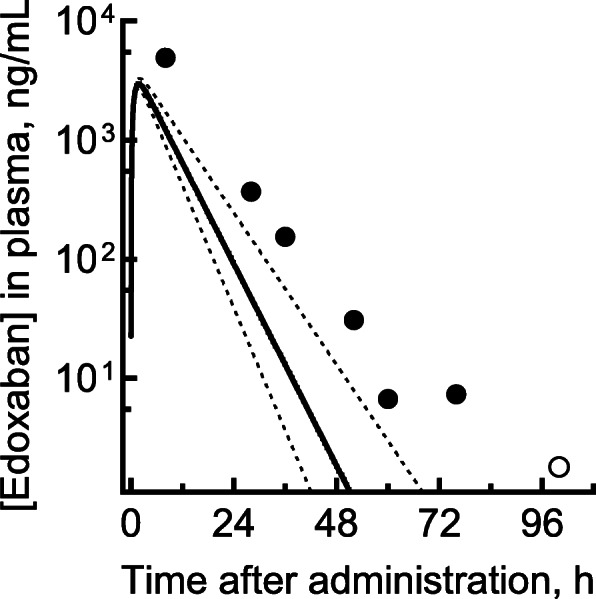
The patient was a 57-year-old woman (body weight, 69 kg) who had taken a single oral dose of 750 mg of edoxaban in a suicide attempt. She was emergently admitted to Kyoto Medical Center. The patient's edoxaban plasma concentrations during ambulance transport (8 h after oral administration) were ~ 4900 ng/ml, and the concentration gradually decreased to ~ 10 ng/mL and to detectable but unmeasurable levels of ~ 1.0 ng/mL at 60 h and 100 h, respectively. The linear range of the relationship between the dose and plasma concentration was assumed to have been exceeded during the first 8 h; however, the measured elimination rate of edoxaban was similar to that visualized curves predicted by a simplified physiologically based pharmacokinetic model previously established.
Simplified physiologically based pharmacokinetic models for creating visualized curves have proven to be useful not only during drug discovery or chemical risk assessment but also in cases of medical poisoning. We used a physiologically based pharmacokinetic model previously established for edoxaban to predict the pharmacokinetics in the current case. It is hoped that the results of this study, which encompass drug monitoring data in the patient and visualized pharmacokinetic prediction, will serve as an index when setting the treatment and follow-up period in cases of drug overdose for medicines such as edoxaban in emergency clinical practice.
抗凝药依度沙班临床使用剂量为30 - 60毫克/天;然而,我们遇到一名服用了750毫克过量依度沙班的患者。我们通过液相色谱 - 串联质谱法研究了该患者体内依度沙班的药代动力学,以估计在使用这种药物的急诊临床实践中的随访期。
该患者为一名57岁女性(体重69千克),为自杀企图单次口服了750毫克依度沙班。她被紧急送往京都医疗中心。在救护车运送期间(口服给药后8小时)患者的依度沙班血浆浓度约为4900纳克/毫升,在60小时和100小时时浓度分别逐渐降至约10纳克/毫升和可检测但无法测量的约1.0纳克/毫升水平。在最初8小时内,剂量与血浆浓度之间的线性关系范围被认为已被超过;然而,依度沙班的实测消除率与先前建立的简化生理药代动力学模型预测的可视化曲线相似。
用于创建可视化曲线的简化生理药代动力学模型已被证明不仅在药物研发或化学风险评估期间有用,而且在药物中毒病例中也有用。我们使用先前为依度沙班建立的生理药代动力学模型来预测当前病例中的药代动力学。希望本研究结果,包括患者的药物监测数据和可视化药代动力学预测,将作为在急诊临床实践中为依度沙班等药物过量病例设定治疗和随访期时的一个指标。