Adachi Koichiro, Beppu Satoru, Nishiyama Kei, Shimizu Makiko, Yamazaki Hiroshi
Laboratory of Drug Metabolism and Pharmacokinetics, Showa Pharmaceutical University, 3-3165 Higashi-tamagawa Gakuen, Machida, Tokyo, 194-8543, Japan.
Kyoto Medical Center, Fushimi-ku, Kyoto, 612-8555, Japan.
J Pharm Health Care Sci. 2021 Feb 3;7(1):6. doi: 10.1186/s40780-021-00189-9.
Combinations of antidepressant duloxetine (at doses of 40-60 mg/day) and other antipsychotics are frequently used in clinical treatment; however, several fatal and nonfatal cases of duloxetine overdose have been documented. We experienced a patient who had taken an overdose of duloxetine (780 mg) in combination with other drugs in a suicide attempt.
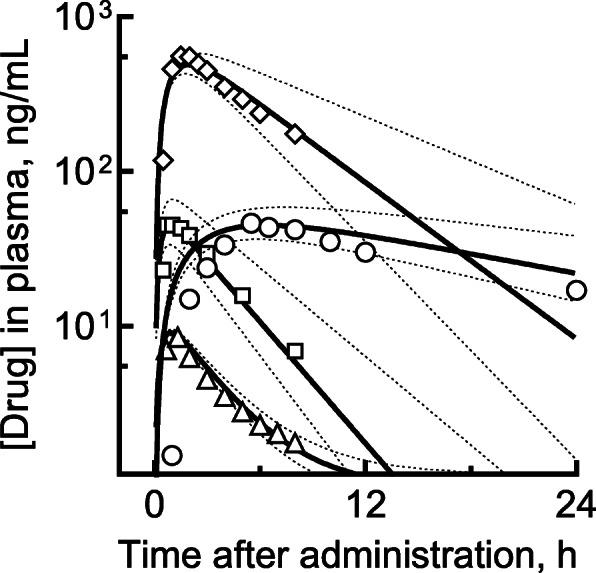
The patient was a 37-year-old man (body weight, 64 kg) with a history of gender identity disorder and depression. He intentionally took an overdose of duloxetine in combination with three other antipsychotic drugs (18 mg flunitrazepam, 850 mg quetiapine, and 1100 mg trazodone) and was emergently admitted to Kyoto Medical Center. The patient's plasma concentration of duloxetine during ambulance transport was 57 ng/ml, and the level was still as high as 126 ng/mL at 32 h after administration. Duloxetine disappeared most slowly from plasma, in contrast to quetiapine, which was the fastest to clear among the four medicines determined in this patient. The observed concentrations of duloxetine in this overdose patient were generally within the 95% confidence intervals of the plasma concentration curves predicted using a physiologically based pharmacokinetic (PBPK) model.
Even if more than 1 h (the generally recommended period) has passed after administration of duloxetine in such overdose cases, gastric lavage and/or administration of activated charcoal may be effective in clinical practice up to 6 h because of the typically slow elimination behavior illustrated by the PBPK model. Pharmacokinetic profiles visualized using PBPK modeling can inform treatment decisions in cases of drug overdose for medicines such as duloxetine in emergency clinical practice.
抗抑郁药度洛西汀(剂量为40 - 60毫克/天)与其他抗精神病药物联合使用在临床治疗中很常见;然而,已有数例度洛西汀过量导致的致命和非致命病例记录在案。我们遇到一名患者,其在自杀企图中过量服用了度洛西汀(780毫克)并联合了其他药物。
该患者为一名37岁男性(体重64千克),有性别认同障碍和抑郁症病史。他故意过量服用度洛西汀并联合另外三种抗精神病药物(18毫克氟硝西泮、850毫克喹硫平和1100毫克曲唑酮),并紧急入住京都医疗中心。患者在救护车转运期间血浆度洛西汀浓度为57纳克/毫升,给药后32小时该水平仍高达126纳克/毫升。与喹硫平相比,度洛西汀从血浆中消失得最慢,喹硫平是该患者所检测的四种药物中清除最快的。该过量用药患者中观察到的度洛西汀浓度总体上处于使用基于生理的药代动力学(PBPK)模型预测的血浆浓度曲线的95%置信区间内。
在这种过量用药病例中,即使在度洛西汀给药后已过去超过一小时(通常推荐的时间段),洗胃和/或给予活性炭在临床实践中可能在长达6小时内仍然有效,因为PBPK模型显示其通常消除行为缓慢。使用PBPK建模可视化的药代动力学特征可为紧急临床实践中如度洛西汀等药物过量病例的治疗决策提供参考。