van Mens Kasper, Elzinga Elke, Nielen Mark, Lokkerbol Joran, Poortvliet Rune, Donker Gé, Heins Marianne, Korevaar Joke, Dückers Michel, Aussems Claire, Helbich Marco, Tiemens Bea, Gilissen Renske, Beekman Aartjan, de Beurs Derek
Altrecht Mental Healthcare, Utrecht, the Netherlands.
Trimbos Institute (Netherlands Institute of Mental Health), Utrecht, the Netherlands.
Internet Interv. 2020 Aug 27;21:100337. doi: 10.1016/j.invent.2020.100337. eCollection 2020 Sep.
Suicidal behaviour is difficult to detect in the general practice. Machine learning (ML) algorithms using routinely collected data might support General Practitioners (GPs) in the detection of suicidal behaviour. In this paper, we applied machine learning techniques to support GPs recognizing suicidal behaviour in primary care patients using routinely collected general practice data.
This case-control study used data from a national representative primary care database including over 1.5 million patients (Nivel Primary Care Database). Patients with a suicide (attempt) in 2017 were selected as cases (N = 574) and an at risk control group (N = 207,308) was selected from patients with psychological vulnerability but without a suicide attempt in 2017. RandomForest was trained on a small subsample of the data (training set), and evaluated on unseen data (test set).
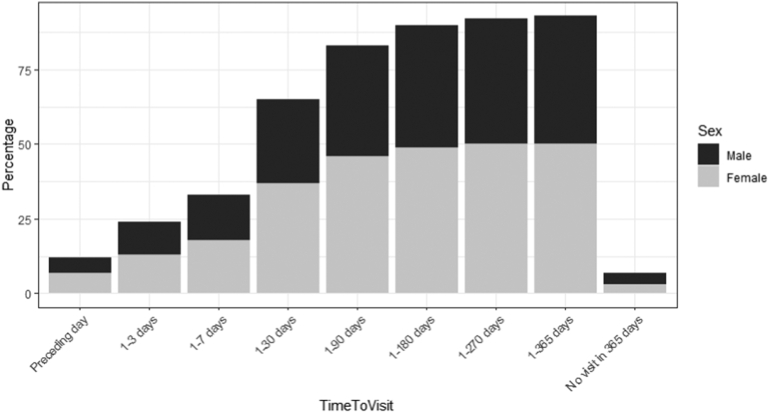
Almost two-third (65%) of the cases visited their GP within the last 30 days before the suicide (attempt). RandomForest showed a positive predictive value (PPV) of 0.05 (0.04-0.06), with a sensitivity of 0.39 (0.32-0.47) and area under the curve (AUC) of 0.85 (0.81-0.88). Almost all controls were accurately labeled as controls (specificity = 0.98 (0.97-0.98)). Among a sample of 650 at-risk primary care patients, the algorithm would label 20 patients as high-risk. Of those, one would be an actual case and additionally, one case would be missed.
In this study, we applied machine learning to predict suicidal behaviour using general practice data. Our results showed that these techniques can be used as a complementary step in the identification and stratification of patients at risk of suicidal behaviour. The results are encouraging and provide a first step to use automated screening directly in clinical practice. Additional data from different social domains, such as employment and education, might improve accuracy.
在全科医疗中,自杀行为很难被察觉。使用常规收集的数据的机器学习(ML)算法可能会帮助全科医生(GP)检测自杀行为。在本文中,我们应用机器学习技术,利用常规收集的全科医疗数据,支持全科医生识别初级保健患者中的自杀行为。
这项病例对照研究使用了来自一个具有全国代表性的初级保健数据库的数据,该数据库包含超过150万患者(Nivel初级保健数据库)。将2017年有自杀(未遂)行为的患者选为病例(N = 574),并从有心理脆弱性但在2017年无自杀未遂行为的患者中选择一个风险对照组(N = 207,308)。随机森林在数据的一个小子样本(训练集)上进行训练,并在未见过的数据(测试集)上进行评估。
近三分之二(65%)的病例在自杀(未遂)前的最后30天内看过全科医生。随机森林显示阳性预测值(PPV)为0.05(0.04 - 0.06),敏感性为0.39(0.32 - 0.47),曲线下面积(AUC)为0.85(0.81 - 0.88)。几乎所有对照组都被准确标记为对照组(特异性 = 0.98(0.97 - 0.98))。在650名有风险的初级保健患者样本中,该算法会将20名患者标记为高危。其中,一名会是实际病例,此外,会漏诊一名病例。
在本研究中,我们应用机器学习利用全科医疗数据预测自杀行为。我们的结果表明,这些技术可作为识别和分层有自杀行为风险患者的补充步骤。结果令人鼓舞,并为直接在临床实践中使用自动筛查提供了第一步。来自不同社会领域(如就业和教育)的额外数据可能会提高准确性。