Cheng Hao, Niu Zichang, Xin Fengyue, Yang Lin, Ruan Litao
Department of Ultrasonography, First Affiliated Hospital of Xi'an Jiaotong University, Xi'an, China.
Department of Ultrasonography, Shaanxi Province Cancer Hospital, Xi'an, China.
Transl Androl Urol. 2020 Aug;9(4):1735-1742. doi: 10.21037/tau-20-1096.
An important indicator of penile erectile function is erection hardness (EH), which is currently evaluated by the semi-quantitative erectile hardness score (EHS). EH increases continuously during the course of an erection, so although it is statistically a continuous variable, the EHS is a grade variable. We propose a new method for real-time quantitative measurement of penile EH using ultrasonic shear wave elastography (SWE).
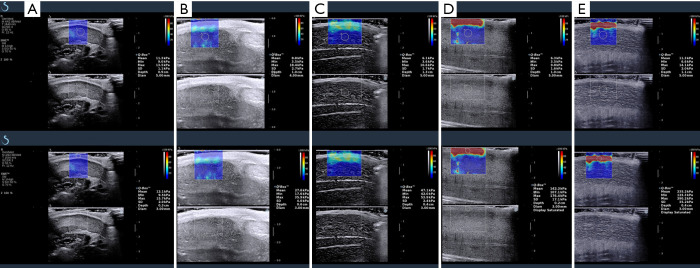
The study group comprised 40 patients with erectile dysfunction (ED) and 20 normal controls who all underwent real-time SWE to measure tissue stiffness (Young's modulus, YM) of the penile corpus cavernosum and tunica albuginea during erection, at rest and at different EH grades induced by intracavernosal injection (ICI) of prostaglandin. The examiner gently placed the high frequency probe on the ventral penis and got the two-dimensional longitudinal US image of penis, then switched to SWE mode, the appropriate region of interest (ROI) was selected, then a 3-5 mm circle ("Q-box") was automatically set to by machine to measure the SWE of the corpus cavernosum and tunica albuginea on the left side.
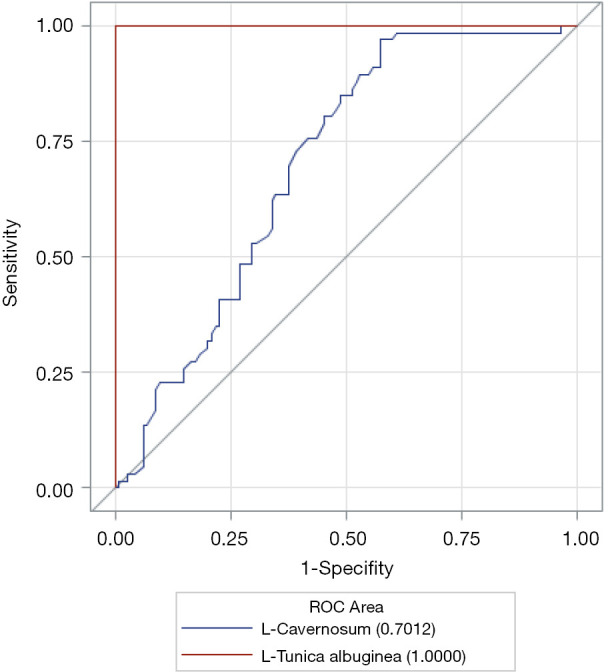
In both the ED patients and normal controls, YM slightly decreased in the corpus cavernosum during erection but the stiffness of tunica albuginea increased significantly with increasing EH (resting: 21.66±4.21 kPa, grades 1-4: 32.61±4.27, 54.86±8.69, 128.02±20.66, and 223.23±23.61 kPa, respectively). Because EH grades 1 and 2 clinically predicted failure to complete sexual intercourse, and EH grades 3 and 4 predicted ability, the cutoff point for the YM of the tunica albuginea to evaluate whether sexual intercourse could be completed was 81.60 kPa.
Our data demonstrated that tunica albuginea stiffness, not corpus cavernosum stiffness, provided a good clinical imaging index indicator for evaluating penile EH. The tunica albuginea stiffness changed continuously during penile erection, which could be measured quantitatively by SWE. Compared with the EHS, measuring the YM of the penile tunica albuginea using SWE is a new and objective technique for quantitatively assessing EH. Because of its objective and quantifiable characteristics, measuring YM enables more accurate evaluation of the effect on EH of various treatments for ED.
阴茎勃起功能的一个重要指标是勃起硬度(EH),目前通过半定量勃起硬度评分(EHS)进行评估。在勃起过程中EH会持续增加,所以尽管从统计学角度它是一个连续变量,但EHS是一个分级变量。我们提出一种使用超声剪切波弹性成像(SWE)对阴茎EH进行实时定量测量的新方法。
研究组包括40例勃起功能障碍(ED)患者和20例正常对照者,他们均接受了实时SWE检查,以测量阴茎海绵体和白膜在勃起、静息状态以及阴茎海绵体内注射前列腺素诱导的不同EH分级时的组织硬度(杨氏模量,YM)。检查者将高频探头轻轻置于阴茎腹侧,获取阴茎的二维纵向超声图像,然后切换至SWE模式,选择合适的感兴趣区域(ROI),接着机器自动设置一个3 - 5毫米的圆圈(“Q框”)来测量左侧海绵体和白膜的SWE。
在ED患者和正常对照者中,勃起时海绵体的YM均略有下降,但白膜的硬度随EH增加而显著增加(静息状态:21.66±4.21千帕,1 - 4级:分别为32.61±4.27、54.86±8.69、128.02±20.66和223.23±23.61千帕)。由于临床实践中1级和2级EH预示无法完成性交,3级和4级EH预示有性交能力,所以白膜YM评估能否完成性交的截断点为81.60千帕。
我们的数据表明,白膜硬度而非海绵体硬度为评估阴茎EH提供了良好的临床影像学指标。阴茎勃起过程中白膜硬度持续变化,可通过SWE进行定量测量。与EHS相比,使用SWE测量阴茎白膜的YM是一种定量评估EH的新的客观技术。因其具有客观和可量化的特点,测量YM能够更准确地评估各种ED治疗方法对EH的影响。