Oshvandi Khodayar, Veladati Zahra, Mahmoodi Marzieh, Rahimi Bashar Farshid, Azizi Azim
Mother and Child Care Research Center, Nursing and Midwifery School, Hamadan University of Medical Sciences, Hamadan, Iran.
Medical Surgical Nursing Student, School of Nursing and Midwifery, Hamadan University of Medical Sciences, Hamadan, Iran.
Bull Emerg Trauma. 2020 Jul;8(3):156-162. doi: 10.30476/BEAT.2020.86094.
To determine the effects of foot massage on pain severity during in unconscious trauma patients admitted to the intensive care unit (ICU).
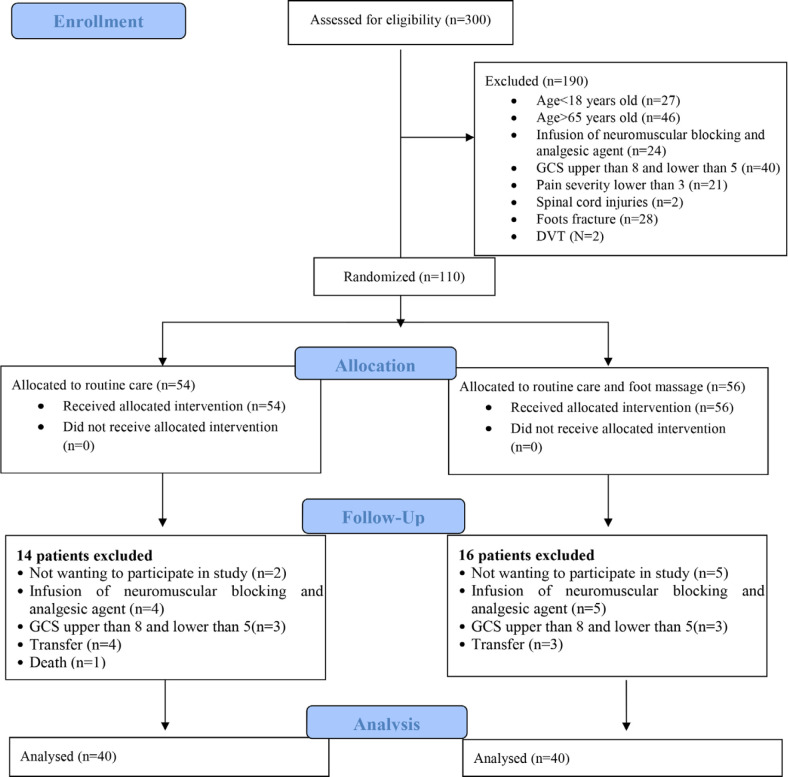
In this randomized clinical trial (RCT), 80 unconscious trauma patients admitted in the ICU of a hospital in an urban area of Iran were included using the convenience sampling method. They were randomly assigned to the intervention and control groups (n=40 in each group). In both groups, the intensity of pain was measured immediately, 10 minutes after the first change position and without any intervention before the change of position using the Critical Care Pain Observation Tool (CCPOT). In the intervention group, before the second position change, classic foot massage was performed for 20 minutes, but the control group received routine care. Pain was re-evaluated after the change position at desired times. The pain intensity was compared between the two study groups.
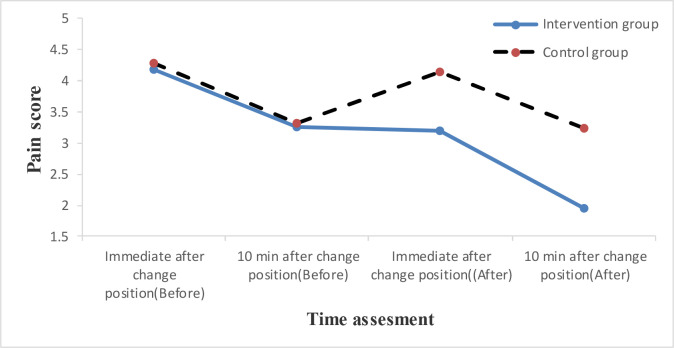
The baseline characteristics were comparable between the two study groups and no difference was found. There was no statistically significant difference between the mean scores of pain after the change of position (immediately and ten minutes later) before the intervention in the groups (p=0.915 and 0.660, respectively). However, after the intervention, the pain intensity was significantly lower in the intervention groups compared to the control group (p<0.001).
Foot massage decreases the pain intensity related to the change of position in unconscious trauma patients admitted in the ICU. Due to its simplicity and low cost, this method can be used along with analgesic drugs to reduce pain in patients.
确定足部按摩对入住重症监护病房(ICU)的昏迷创伤患者疼痛严重程度的影响。
在这项随机临床试验(RCT)中,采用便利抽样法纳入了伊朗某城市地区一家医院ICU收治的80例昏迷创伤患者。他们被随机分为干预组和对照组(每组n = 40)。在两组中,使用重症监护疼痛观察工具(CCPOT)在首次更换体位后立即、10分钟以及在更换体位前未进行任何干预的情况下测量疼痛强度。在干预组中,在第二次更换体位前,进行20分钟的经典足部按摩,而对照组接受常规护理。在更换体位后的预期时间重新评估疼痛。比较两个研究组之间的疼痛强度。
两个研究组的基线特征具有可比性,未发现差异。两组在干预前更换体位后(立即和10分钟后)的平均疼痛评分之间无统计学显著差异(分别为p = 0.915和0.660)。然而,干预后,干预组的疼痛强度明显低于对照组(p<0.001)。
足部按摩可降低入住ICU的昏迷创伤患者与体位改变相关的疼痛强度。由于其简单性和低成本,这种方法可与镇痛药一起用于减轻患者疼痛。