Department of Gynecology, The First Hospital of Jilin University, Changchun, Jilin 130021, P.R. China.
Department of First Operating Room, The First Hospital of Jilin University, Changchun, Jilin 130021, P.R. China.
Oncol Rep. 2020 Oct;44(4):1502-1510. doi: 10.3892/or.2020.7690. Epub 2020 Jul 15.
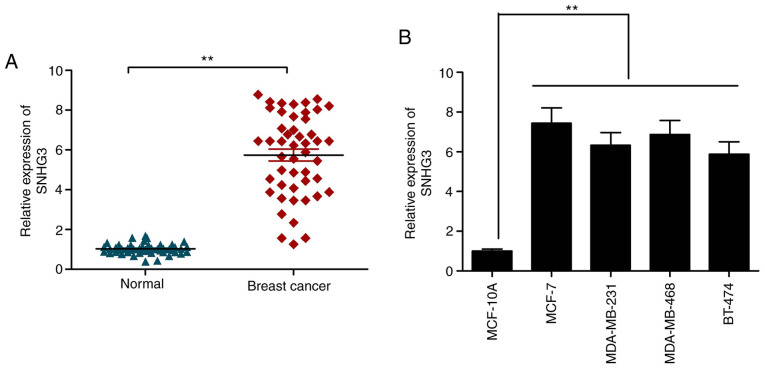
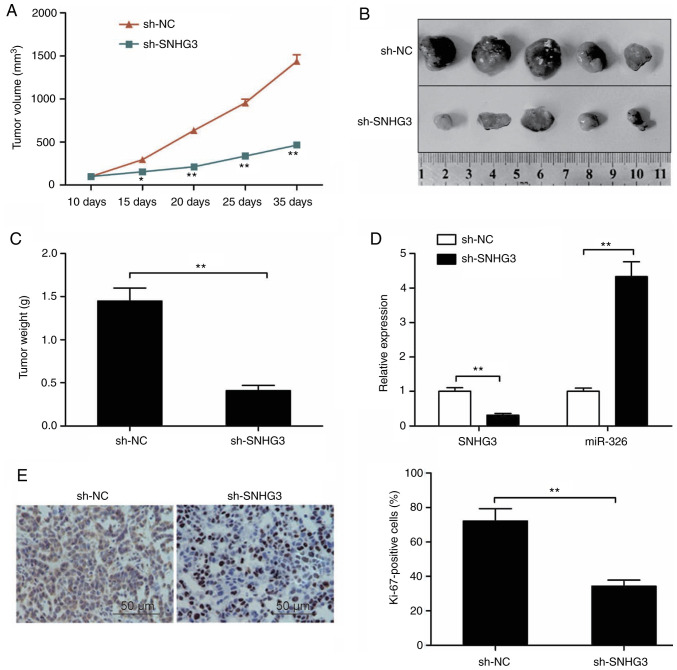
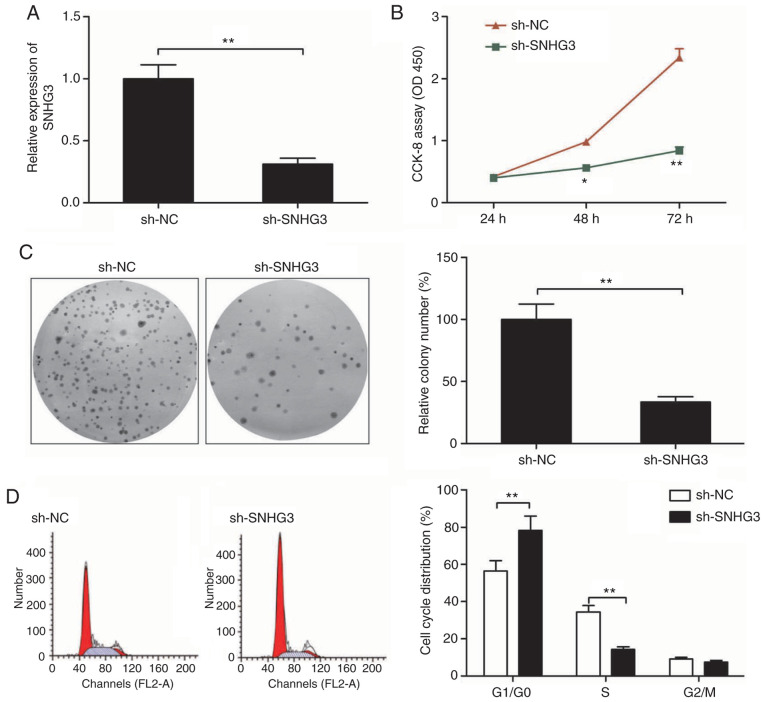
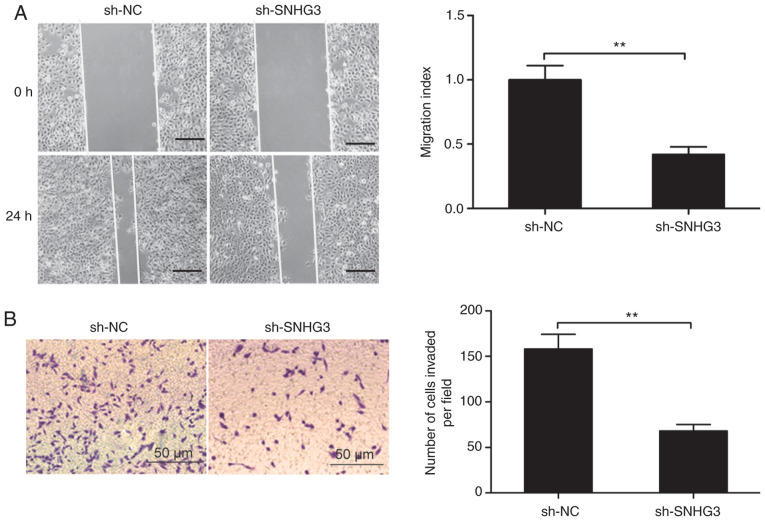
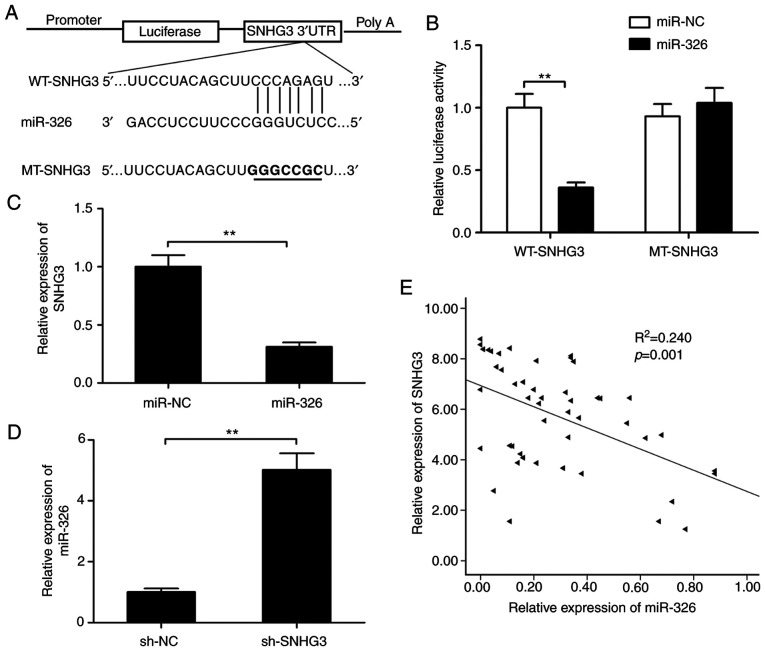
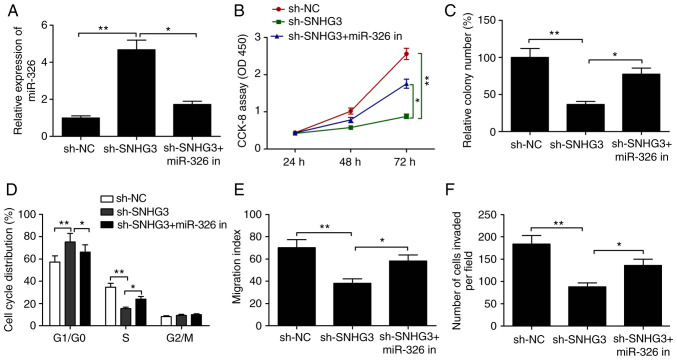
Accumulating evidence suggests that long noncoding RNA (lncRNA) small nucleolar RNA host gene 3 (SHNG3) plays crucial roles in the initiation and progression of various types of malignant cancers. Yet, the role played by SNHG3 in breast cancer as well as the associated mechanisms remain largely unclear. The expression of SNHG3 was detected in breast cancer tissues and cell lines by reverse‑transcription quantitative PCR (RT‑qPCR). Cell proliferation, colony formation, cell cycle distribution, migration and invasion abilities were detected by Cell Counting Kit‑8, colony formation assay, flow cytometry, wound‑healing and Matrigel invasion assays, respectively. The regulatory relationships between SNHG3 and miR‑326 were explored by luciferase reporter assay. A nude mouse model was established to investigate the effect of SNHG3 in vivo. The results showed an upregulation of SNHG3 in breast cancer tissues and cell lines. Loss‑of‑function assays revealed significant suppression of breast cancer behaviors such as: Abilities to proliferate, form colonies, migrate and invade in vitro coupled with a delayed growth of tumors in vivo when SNHG3 was knocked down. Mechanically, it was shown that SNHG3 served as a competing endogenous RNA (ceRNA) of miR‑326 that in turn is a tumor suppressor in this cancer. The correlation between the expression of SNHG3 and miR‑326 was found to be strongly negative in these samples. Additionally, we found that inhibition of SNHG3 caused a partially reversal in the inhibition exerted by miR‑326 on the ability of these cells to proliferate, form colonies, migrate and invade. Collectively, these findings suggest the functioning of SNHG3 as a ceRNA to enhance the ability of breast cancer cells to proliferate and metastasize to putatively serve as a new target to explore therapeutic intervention of this malignancy.
越来越多的证据表明,长非编码 RNA(lncRNA)小核仁 RNA 宿主基因 3(SHNG3)在各种类型恶性癌症的发生和发展中发挥着关键作用。然而,SNHG3 在乳腺癌中的作用以及相关机制在很大程度上仍不清楚。通过逆转录定量 PCR(RT-qPCR)检测乳腺癌组织和细胞系中 SNHG3 的表达。通过细胞计数试剂盒-8、集落形成实验、流式细胞术、划痕愈合和 Matrigel 侵袭实验分别检测细胞增殖、集落形成、细胞周期分布、迁移和侵袭能力。通过荧光素酶报告基因实验探索 SNHG3 和 miR-326 之间的调控关系。建立裸鼠模型研究 SNHG3 在体内的作用。结果显示 SNHG3 在乳腺癌组织和细胞系中上调。功能丧失实验显示,当 SNHG3 被敲低时,体外乳腺癌行为(如增殖、形成集落、迁移和侵袭的能力)显著受到抑制,体内肿瘤生长也受到抑制。机制上表明,SNHG3 作为 miR-326 的竞争性内源性 RNA(ceRNA),而 miR-326 在这种癌症中是一种肿瘤抑制因子。在这些样本中发现 SNHG3 的表达与 miR-326 的表达呈强烈负相关。此外,我们发现抑制 SNHG3 可部分逆转 miR-326 对这些细胞增殖、形成集落、迁移和侵袭能力的抑制作用。综上所述,这些发现表明 SNHG3 作为 ceRNA 增强了乳腺癌细胞的增殖和转移能力,可能成为探索这种恶性肿瘤治疗干预的新靶点。