Marques Pedro, Barry Sayka, Carlsen Eivind, Collier David, Ronaldson Amy, Dorward Neil, Grieve Joan, Mendoza Nigel, Nair Ramesh, Muquit Samiul, Grossman Ashley B, Korbonits Márta
Centre for Endocrinology, William Harvey Research Institute, Barts and the London School of Medicine and Dentistry, Queen Mary University of London, London, UK.
Department of Pathology, STHF, Skien, Norway.
Endocrine. 2020 Dec;70(3):593-606. doi: 10.1007/s12020-020-02478-z. Epub 2020 Sep 18.
Angiogenesis has been studied in pituitary neuroendocrine tumours (PitNETs), but the role of the tumour microenvironment (TME) in regulating PitNET angiogenesis remains unknown. We aimed to characterise the role of TME components in determining the angiogenetic PitNET profile, focusing on immune cells and tumour-derived cytokines.
Immune cells were studied by immunohistochemistry in 24 human PitNETs (16 non-functioning-PitNETs (NF-PitNETs) and 8 somatotrophinomas): macrophages (CD68, CD163, HLA-DR), cytotoxic (CD8) and T helper (CD4) lymphocytes, regulatory T cells (FOXP3), B cells (CD20) and neutrophils (neutrophil elastase); endothelial cells were assessed with CD31. Five normal pituitaries (NP) were included for comparison. Microvessel density and vascular morphology were estimated with ImageJ. The cytokine secretome from these PitNETs were assessed on culture supernatants using a multiplex immunoassay panel.
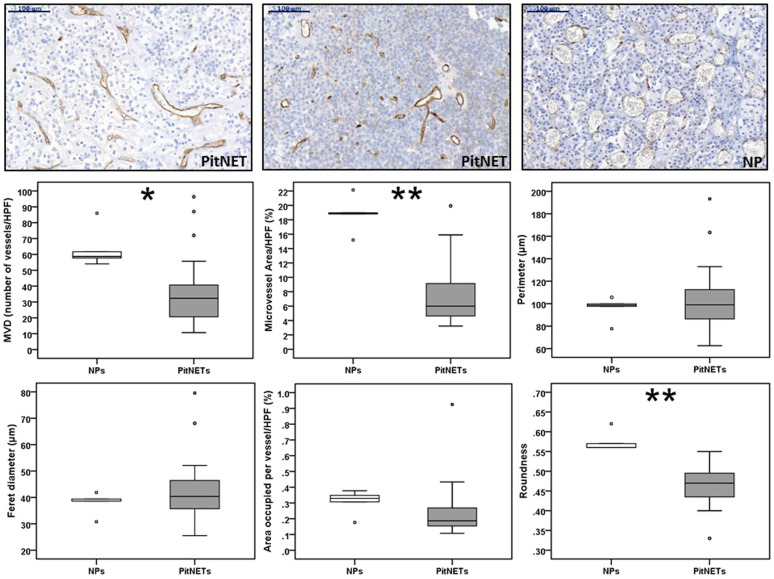
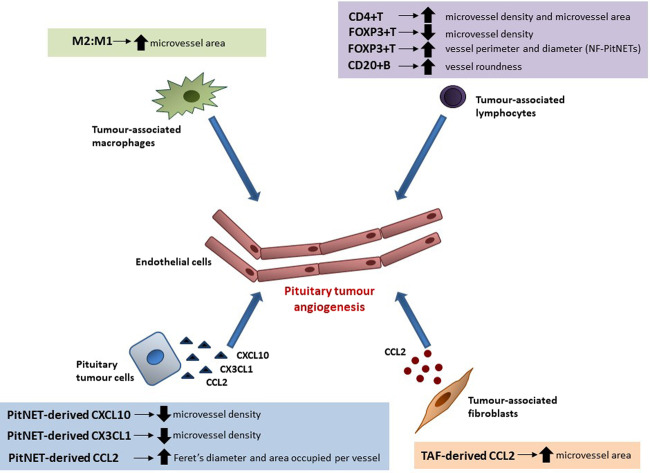
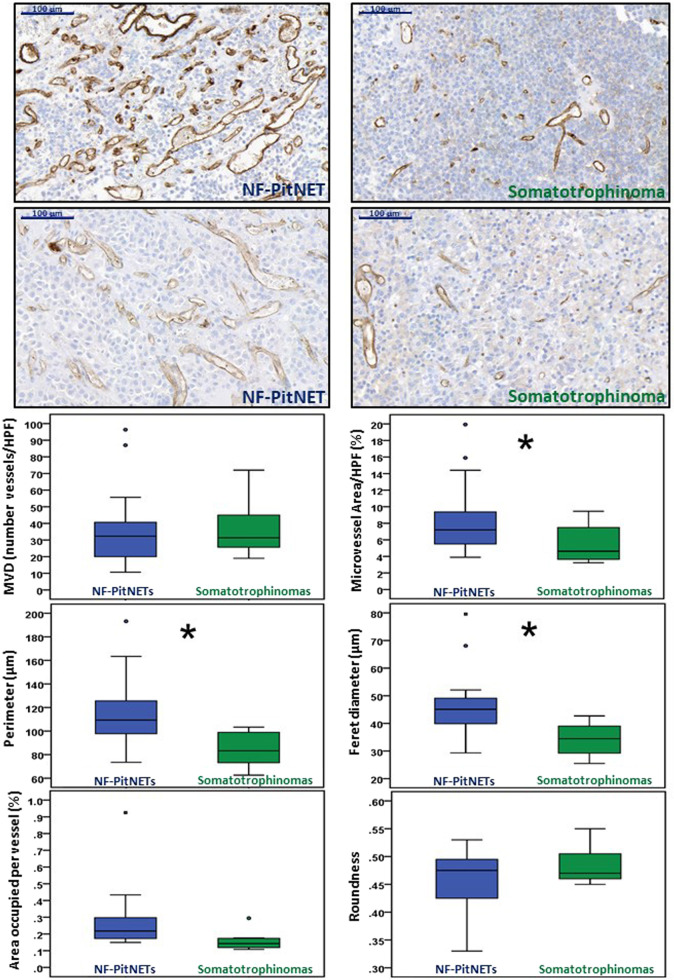
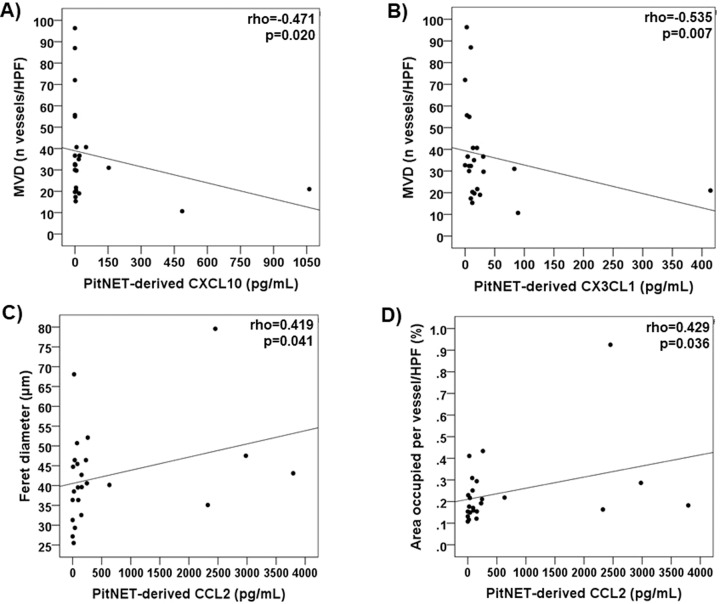
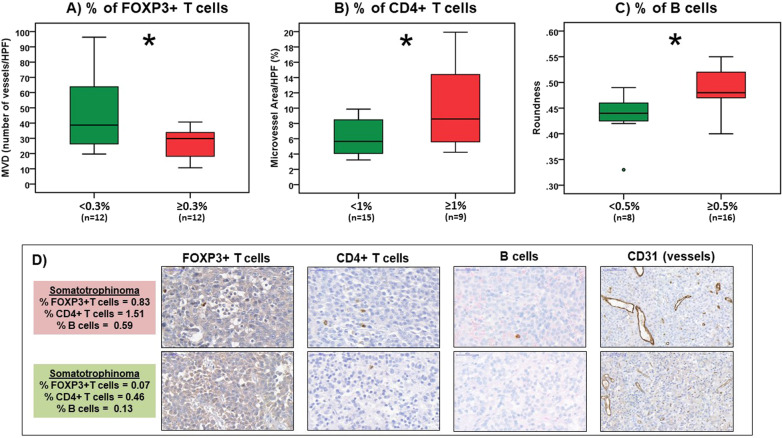
Microvessel density/area was higher in NP than PitNETs, which also had rounder and more regular vessels. NF-PitNETs had vessels of increased calibre compared to somatotrophinomas. The M2:M1 macrophage ratio correlated with microvessel area. PitNETs with more CD4+ T cells had higher microvessel area, while tumours with more FOXP3+ cells were associated with lower microvessel density. PitNETs with more B cells had rounder vessels. Of the 42 PitNET-derived cytokines studied, CCL2, CXCL10 and CX3CL1 correlated with microvessel density and vessel architecture parameters.
M2 macrophages appear to play a role in PitNET neovascularisation, while B, CD4+ and FOXP3+ lymphocytes, as well as non-cellular TME elements such as CCL2, CXCL10 and CX3CL1, may also modulate the angiogenesis of PitNETs.
垂体神经内分泌肿瘤(PitNETs)中的血管生成已得到研究,但肿瘤微环境(TME)在调节PitNET血管生成中的作用仍不清楚。我们旨在阐明TME成分在决定PitNET血管生成特征方面的作用,重点关注免疫细胞和肿瘤衍生细胞因子。
通过免疫组织化学研究了24例人类PitNETs(16例无功能PitNETs(NF-PitNETs)和8例生长激素瘤)中的免疫细胞:巨噬细胞(CD68、CD163、HLA-DR)、细胞毒性(CD8)和辅助性T(CD4)淋巴细胞、调节性T细胞(FOXP3)、B细胞(CD20)和中性粒细胞(中性粒细胞弹性蛋白酶);用CD31评估内皮细胞。纳入5例正常垂体(NP)进行比较。使用ImageJ估计微血管密度和血管形态。使用多重免疫分析板对这些PitNETs培养上清液中的细胞因子分泌组进行评估。
NP中的微血管密度/面积高于PitNETs,PitNETs的血管也更圆且更规则。与生长激素瘤相比,NF-PitNETs的血管口径更大。M2:M1巨噬细胞比率与微血管面积相关。CD4+T细胞较多的PitNETs微血管面积较高,而FOXP3+细胞较多的肿瘤与较低的微血管密度相关。B细胞较多的PitNETs血管更圆。在研究的42种PitNET衍生细胞因子中,CCL2、CXCL10和CX3CL1与微血管密度和血管结构参数相关。
M2巨噬细胞似乎在PitNET新生血管形成中起作用,而B细胞、CD4+和FOXP3+淋巴细胞,以及CCL2、CXCL10和CX3CL1等非细胞TME成分也可能调节PitNET的血管生成。