Department of Endocrinology and Metabolic Diseases (DISCLIMO), Polytechnic University of Marche, Via Conca 71, 60126, Ancona, Italy.
J Endocrinol Invest. 2021 May;44(5):1075-1084. doi: 10.1007/s40618-020-01422-2. Epub 2020 Sep 18.
COVID-19 is a novel threat to patients with adrenal insufficiency (AI), whose life expectancy and quality (QoL) are impaired by an increased risk of infections and stress-triggered adrenal crises (AC). If infected, AI patients require prompt replacement tailoring. We assessed, in a cohort of AI patients: prevalence and clinical presentation of COVID-19; prevalence of AC and association with intercurrent COVID-19 or pandemic-related psychophysical stress; lockdown-induced emotional burden, and health-related QoL.
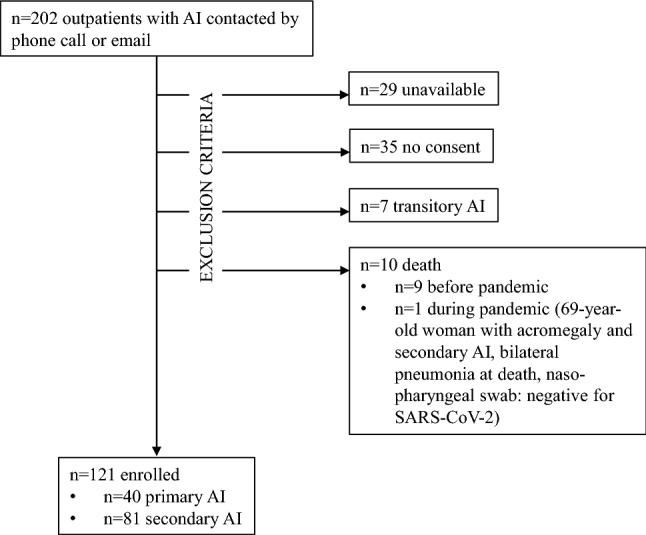
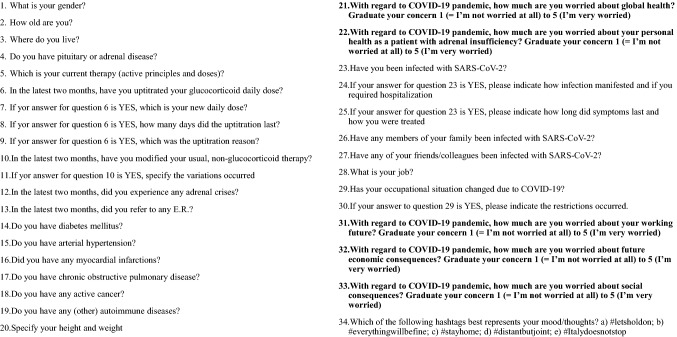
In this monocentric (Ancona University Hospital, Italy), cross-sectional study covering February-April 2020, 121 (40 primary, 81 secondary) AI patients (59 males, 55 ± 17 years) completed telematically three questionnaires: the purpose-built "CORTI-COVID", assessing medical history and concern for COVID-19-related global health, AI-specific personal health, occupational, economic, and social consequences; the AddiQoL-30; the Short-Form-36 (SF-36) Health Survey.
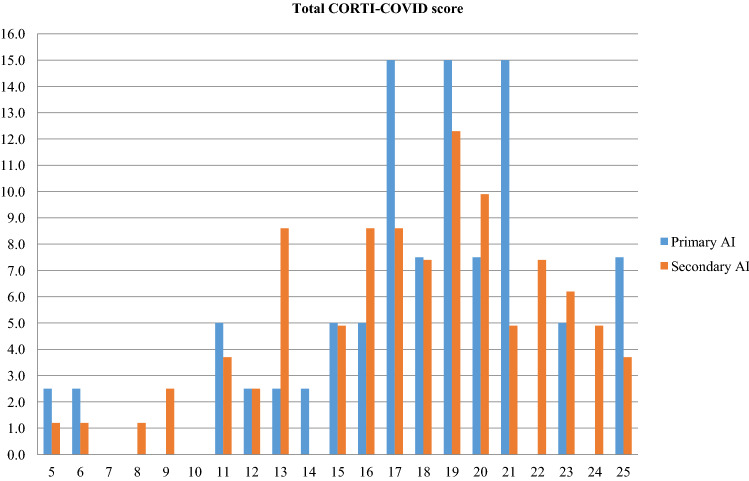
COVID-19 occurred in one (0·8% prevalence) 48-year-old woman with primary AI, who promptly tailored her replacement. Dyspnea lasted three days, without requiring hospitalization. Secondary AI patients were not involved. No AC were experienced, but pandemic-related stress accounted for 6/14 glucocorticoid up-titrations. Mean CORTI-COVID was similar between groups, mainly depending on "personal health" in primary AI (ρ = 0.888, p < 0.0001) and "economy" in secondary AI (ρ = 0.854, p < 0.0001). Working restrictions increased occupational concern. CORTI-COVID correlated inversely with QoL. AddiQoL-30 and SF-36 correlated strongly. Comorbidities worsened patients' QoL.
If educational efforts are made in preventing acute events, AI patients seem not particularly susceptible to COVID-19. The novel "CORTI-COVID" questionnaire reliably assesses the pandemic-related emotional burden in AI. Even under unconventional stress, educated AI patients preserve a good QoL.
COVID-19 是对肾上腺功能不全 (AI) 患者的新威胁,他们的预期寿命和生活质量 (QoL) 因感染风险增加和应激性肾上腺危象 (AC) 而受损。如果感染,AI 患者需要及时进行个体化的替代治疗。我们在一组 AI 患者中评估了以下内容:COVID-19 的患病率和临床表现;AC 的患病率及其与并发 COVID-19 或大流行相关心理生理应激的关联;封锁引起的情绪负担和与健康相关的 QoL。
在这项单中心(意大利安科纳大学医院)的横断面研究中,2020 年 2 月至 4 月期间,121 名(40 名原发性,81 名继发性)AI 患者(59 名男性,55 ± 17 岁)通过远程方式完成了三个问卷:专门为 COVID-19 设计的“CORTI-COVID”,评估与 COVID-19 相关的全球健康、AI 特定的个人健康、职业、经济和社会后果的医疗史和担忧;AddiQoL-30;健康调查短格式 36 项(SF-36)。
一名(0.8%患病率)48 岁原发性 AI 女性患者出现 COVID-19,她立即进行了个体化的替代治疗。呼吸困难持续了三天,无需住院治疗。继发性 AI 患者未参与。未发生 AC,但大流行相关应激导致 14 例患者中糖皮质激素剂量增加。CORTI-COVID 均值在两组之间相似,主要取决于原发性 AI 中的“个人健康”(ρ=0.888,p<0.0001)和继发性 AI 中的“经济”(ρ=0.854,p<0.0001)。工作限制增加了职业担忧。CORTI-COVID 与 QoL 呈负相关。AddiQoL-30 和 SF-36 相关性很强。合并症使患者的 QoL 恶化。
如果在预防急性事件方面进行教育,AI 患者似乎不易感染 COVID-19。新型“CORTI-COVID”问卷可靠地评估了 AI 中的大流行相关情绪负担。即使在非常规应激下,受过教育的 AI 患者也能保持良好的 QoL。