Department of Community Medicine & Family Medicine, All India Institute of Medical Sciences, Kalyani, West Bengal, India.
Department of Physiology, All India Institute of Medical Sciences, Kalyani, West Bengal, India.
PLoS One. 2020 Sep 18;15(9):e0239193. doi: 10.1371/journal.pone.0239193. eCollection 2020.
The incidents of violence against doctors, leading to grievous injury and even death, seem to be on an increasing trend in recent years. There is a paucity of studies on workplace violence against doctors and its effect, in India. The present study was conducted to assess workplace violence faced by doctors, its effect on the psycho-social wellbeing of the treating doctor and, subsequently, on patient management.
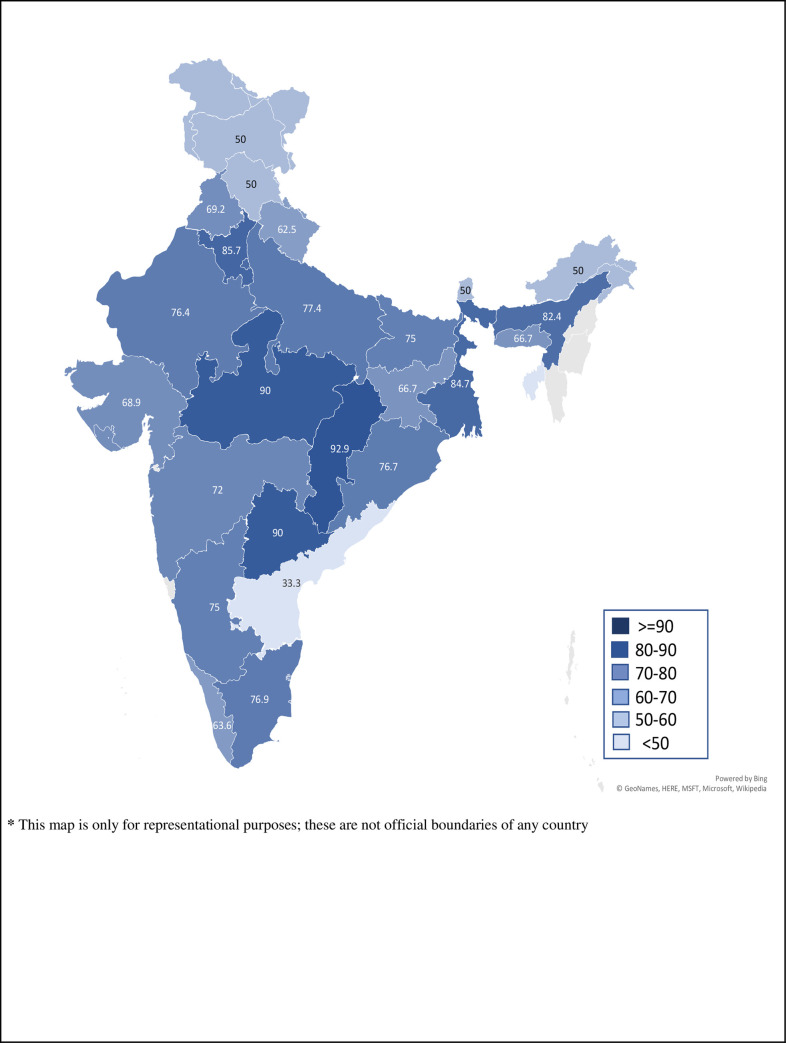
The present nationwide cross-sectional study was conducted from November 2019 -April 2020. The sample size was calculated assuming the prevalence of workplace violence as 50%, with 20% non-response. Doctors, working in private and/or public set-up, with ≥1 year clinical experience, were included. A pre-tested study tool- Google form-was sent to study participants via social media platforms. The Microsoft Excel spreadsheet was downloaded from google drive and data was analysed using STATA-12 statistical software.
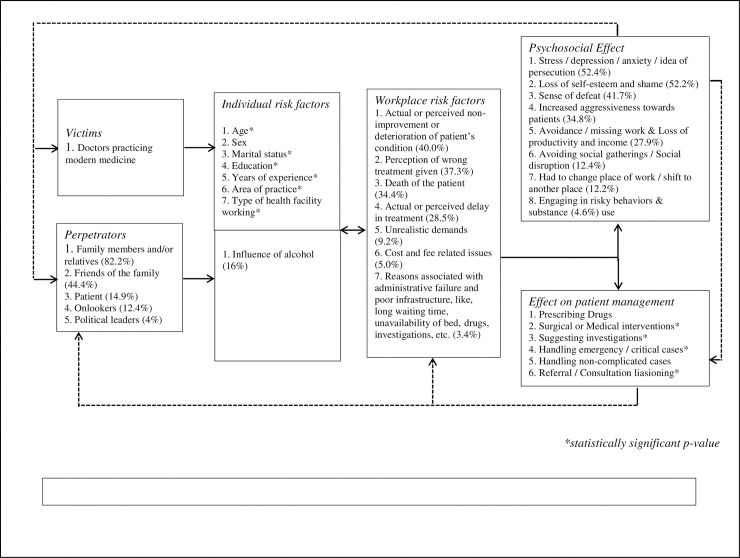
A total of 617 responses were received from doctors all over India; out of which 477 (77.3%) doctors had ever faced workplace violence. "Actual or perceived non-improvement or deterioration of patient's condition" (40.0%), followed by "perception of wrong treatment given" (37.3%) were the main causes of workplace violence; and the family members/relatives were the major perpetrators (82.2%). More than half of the participants reported "loss of self-esteem", "feeling of shame" and "stress/depression/anxiety/ideas of persecution" after the incident. Management by surgical interventions (p-value<0.001) and handling of emergency/complicated cases (p-value<0.001) decreased significantly with an increase in severity of workplace violence; while the suggestion of investigations and referrals increased (p-value<0.001).
Workplace violence has a significant effect on the psycho-social well-being of doctors, as well as on patient management; which may escalate discontent and distrust among the general public, thereby increasing incidents of workplace violence-in a self-propagating vicious cycle.
近年来,针对医生的暴力事件屡屡发生,导致重伤甚至死亡,此类事件似乎呈上升趋势。印度针对医生工作场所暴力及其影响的研究甚少。本研究旨在评估医生所面临的工作场所暴力、其对主治医生的心理社会健康的影响,以及随后对患者管理的影响。
本全国性横断面研究于 2019 年 11 月至 2020 年 4 月进行。假设工作场所暴力的患病率为 50%,无应答率为 20%,以此计算样本量。纳入在私人和/或公共机构工作、具有≥1 年临床经验的医生。通过社交媒体平台向研究参与者发送了经过预测试的研究工具——Google 表单。从谷歌云端硬盘下载 Microsoft Excel 电子表格,使用 STATA-12 统计软件分析数据。
共收到来自印度各地的 617 名医生的回复;其中 477 名(77.3%)医生曾遭遇过工作场所暴力。“患者病情实际或感知的无改善或恶化”(40.0%),其次是“感知的治疗不当”(37.3%)是工作场所暴力的主要原因;主要肇事者是家属/亲属(82.2%)。超过一半的参与者在事件发生后报告“自尊心下降”、“感到羞耻”和“压力/抑郁/焦虑/迫害感”。随着工作场所暴力严重程度的增加,手术干预(p 值<0.001)和紧急/复杂情况处理(p 值<0.001)的管理显著减少,而调查和转介的建议增加(p 值<0.001)。
工作场所暴力对医生的心理社会健康以及患者管理有重大影响;这可能会加剧公众的不满和不信任,从而增加工作场所暴力事件——形成一个自我延续的恶性循环。