The University of Adelaide, Adelaide, South Australia, Australia.
Central Adelaide Local Health Network, Adelaide, South Australia, Australia.
BMC Cancer. 2020 Sep 18;20(1):894. doi: 10.1186/s12885-020-07174-9.
To investigate the correlation between family history of prostate cancer (PCa) and survival (overall and cancer specific) in patients undergoing treatment for PCa.
ine thousand four hundred fifty-nine patients with PCa were extracted from the South Australian Prostate Cancer Clinical Outcomes Collaborative (SA-PCCOC) database. Diagnosis occurred after 1998 and treatment before 2014. Cox proportional-hazards modeling was used to assess the effect of family history on overall survival after adjustment for confounders (age at diagnosis, NCCN risk category and year of treatment), and with stratification by primary treatment group. Competing risks regression modelling was used to assess PCa specific mortality.
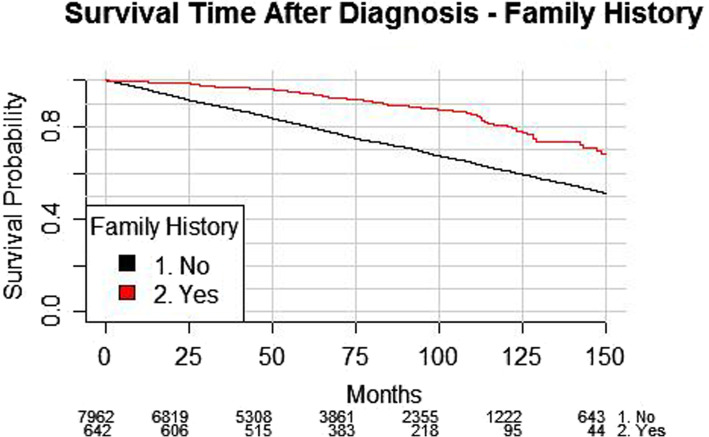
Men with a positive family history of PCa appear to have a lower Gleason score at the time of diagnosis (50% with Gleason < 7, compared to 39% in those without family history) and be diagnosed at a lower age (64 vs 69). Men with a positive family history of PCa appear to have better overall survival outcomes (p < 0.001, log rank test). In analysis adjusting for age at diagnosis, NCCN risk category and year of treatment, family history remained a significant factor when modelling overall survival (HR 0.72 95% CI 0.55-0.95, p = 0.021). There were no significant differences in treatment subgroups of radical prostatectomy (p = 0.7) and radiotherapy (0.054).
Men with a positive family history of PCa appear to have better overall survival outcomes. This better survival may represent lead time bias and early initiation of PSA screening. Family history of PCa was not associated with different survival outcomes in men who were treated with either radical prostatectomy or radiotherapy.
研究前列腺癌(PCa)家族史与接受 PCa 治疗患者的生存(总体和癌症特异性)之间的相关性。
从南澳大利亚前列腺癌临床结果协作组(SA-PCCOC)数据库中提取了 1459 名 PCa 患者。诊断发生在 1998 年后,治疗发生在 2014 年前。使用 Cox 比例风险模型评估家族史对调整混杂因素(诊断时年龄、NCCN 风险类别和治疗年份)后总体生存的影响,并按主要治疗组进行分层。使用竞争风险回归模型评估 PCa 特异性死亡率。
具有阳性 PCa 家族史的男性在诊断时似乎具有较低的 Gleason 评分(50%的 Gleason <7,而无家族史的男性为 39%),且诊断年龄较低(64 岁 vs 69 岁)。具有阳性 PCa 家族史的男性似乎具有更好的总体生存结局(p<0.001,对数秩检验)。在调整诊断时年龄、NCCN 风险类别和治疗年份的分析中,当对总体生存进行建模时,家族史仍然是一个重要因素(HR 0.72,95%CI 0.55-0.95,p=0.021)。在根治性前列腺切除术(p=0.7)和放疗(0.054)的治疗亚组中没有显著差异。
具有阳性 PCa 家族史的男性似乎具有更好的总体生存结局。这种更好的生存可能代表了领先时间偏倚和早期开始 PSA 筛查。在接受根治性前列腺切除术或放疗治疗的男性中,PCa 家族史与不同的生存结局无关。