American Heart Association Tobacco Regulation and Addiction Center, Dallas, TX.
Department of Global Health, Boston University School of Public Health, Boston, MA.
Nicotine Tob Res. 2021 May 24;23(6):900-908. doi: 10.1093/ntr/ntaa170.
Understanding which non-cigarette tobacco products precede smoking in youth across different racial/ethnic groups can inform policies that consider tobacco-related health disparities.
We used nationally representative, longitudinal data from the Population Assessment of Tobacco and Health Study waves 1-4. The sample was a dynamic cohort of cigarette-naïve youth aged 12-17 years. Mixed-effects models were used to assess non-cigarette product (e-cigarette, cigar product, or other product) use with cigarette use over 1-year intervals.
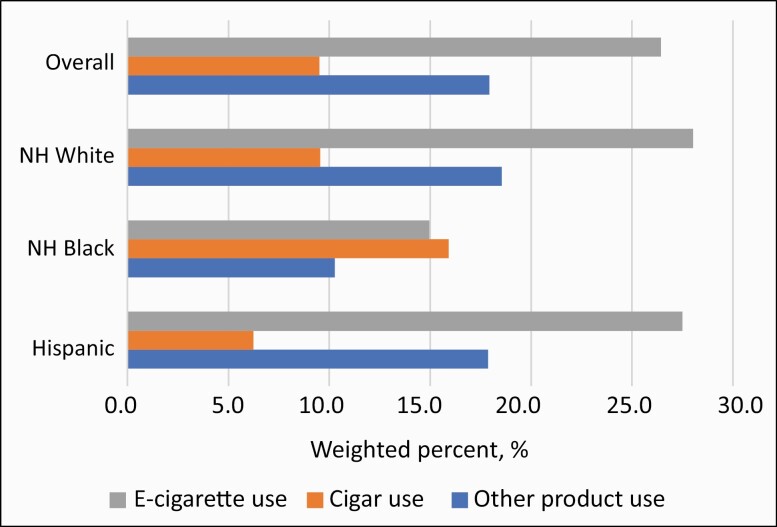
Of the 28 788 observations pooled across waves 1-4, respondents were 48.7% non-Hispanic white, 13.9% non-Hispanic black, and 23.1% Hispanic. Odds of cigarette initiation over 1-year follow-up were higher among youth with prior use of e-cigarettes (odds ratio [OR], 2.76; 95% confidence interval [CI], 2.21-3.45), cigars (OR, 2.00; 95% CI, 1.42-2.80), or other products (OR, 1.66; 95% CI, 1.28-2.14) compared to never users. At the population level, 20.6% of cigarette initiation was attributable to e-cigarette use among white youth and 21.6% among Hispanic youth, while only 3.5% of cigarette initiation was attributable to e-cigarette use among black youth. In contrast, 9.1% of cigarette initiation for black youth was attributable to cigar use compared to only 3.9% for both white and Hispanic youth.
Prior use of e-cigarettes, cigars, and other non-cigarette products were all associated with subsequent cigarette initiation. However, white and Hispanic youth were more likely to initiate cigarettes through e-cigarette use (vs. cigar or other product use), while black youth were more likely to initiate cigarettes through cigar use (vs. e-cigarette or other product use).
Our findings suggest that previous studies on effects of non-cigarette tobacco products may overlook the critical role of cigar products as a pathway into cigarette smoking among US youth, particularly black youth. While our data support the importance of e-cigarette use as a pathway into smoking, regulatory actions aimed at addressing youth e-cigarette use alone may contribute to disparities in black versus white tobacco use and further exacerbate inequities in tobacco-related disease. Thus, contemporary policy development and discourse about the effects of non-cigarette tobacco products on cigarette initiation should consider cigar and other non-cigarette products as well as e-cigarettes.
了解不同种族/族裔群体的青少年中哪些非香烟烟草制品先于吸烟,可以为考虑与烟草相关的健康差异的政策提供信息。
我们使用了来自人口评估烟草与健康研究波 1-4 的全国代表性纵向数据。该样本是一个由 12-17 岁的不吸烟青少年组成的动态队列。使用混合效应模型评估在 1 年间隔内使用非香烟产品(电子烟、雪茄产品或其他产品)与使用香烟之间的关系。
在波 1-4 期间汇总的 28788 个观察值中,受访者中非西班牙裔白人占 48.7%,非西班牙裔黑人占 13.9%,西班牙裔占 23.1%。与从未使用者相比,在 1 年的随访中,有电子烟(比值比 [OR],2.76;95%置信区间 [CI],2.21-3.45)、雪茄(OR,2.00;95% CI,1.42-2.80)或其他产品(OR,1.66;95% CI,1.28-2.14)使用史的青少年开始吸烟的几率更高。从人群水平来看,20.6%的香烟起始归因于白人青少年使用电子烟,21.6%归因于西班牙裔青少年,而只有 3.5%的香烟起始归因于黑人青少年使用电子烟。相比之下,9.1%的黑人青少年吸烟起始归因于雪茄使用,而白人青少年和西班牙裔青少年的这一比例分别为 3.9%。
先前使用电子烟、雪茄和其他非香烟产品均与随后的香烟起始有关。然而,白人青少年和西班牙裔青少年更有可能通过电子烟使用(而不是雪茄或其他产品使用)开始吸烟,而黑人青少年更有可能通过雪茄使用(而不是电子烟或其他产品使用)开始吸烟。
我们的研究结果表明,先前关于非香烟烟草制品影响的研究可能忽略了雪茄产品作为美国青少年吸烟的重要途径,尤其是黑人青少年。虽然我们的数据支持电子烟使用作为吸烟途径的重要性,但旨在解决青少年电子烟使用问题的监管措施可能导致黑人和白人之间在烟草使用方面的差距进一步扩大,并进一步加剧与烟草相关的疾病方面的不平等。因此,关于非香烟烟草制品对香烟起始影响的当代政策制定和讨论应考虑雪茄和其他非香烟产品以及电子烟。