Mallis Panagiotis, Michalopoulos Efstathios, Chatzistamatiou Theofanis, Stavropoulos-Giokas Catherine
Hellenic Cord Blood Bank, Biomedical Research Foundation Academy of Athens, Athens 11527, Greece.
World J Stem Cells. 2020 Aug 26;12(8):731-751. doi: 10.4252/wjsc.v12.i8.731.
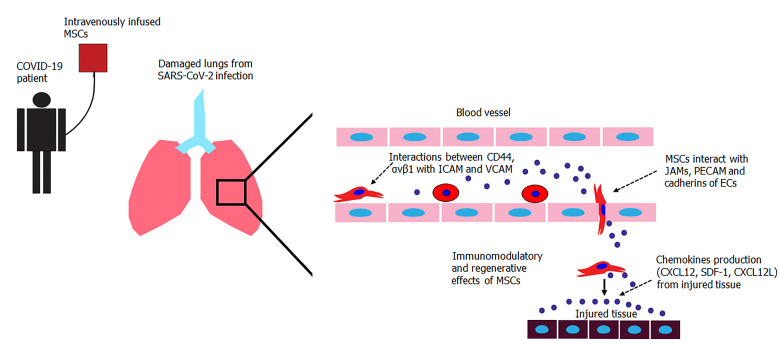
Severe acute respiratory syndrome coronavirus-2 and the related coronavirus disease-19 (COVID-19) is a worldwide emerging situation, which was initially reported in December 2019 in Wuhan, China. Currently, more than 7258842 new cases, and more than 411879 deaths have been reported globally. This new highly transmitted coronavirus is responsible for the development of severe acute respiratory distress syndrome. Due to this disorder, a great number of patients are hospitalized in the intensive care unit followed by connection to extracorporeal membrane oxygenation for breath supporting and survival. Severe acute respiratory distress syndrome is mostly accompanied by the secretion of proinflammatory cytokines, including interleukin (IL)-2, IL-6, IL-7, granulocyte colony-stimulating factor (GSCF), interferon-inducible protein 10 (IP10), monocyte chemotactic protein-1 (MCP1), macrophage inflammatory protein 1A (MIP1A), and tumor necrosis factor alpha (TNF-α), an event which is known as "cytokine storm". Further disease pathology involves a generalized modulation of immune responses, leading to fatal multiorgan failure. Currently, no specific treatment or vaccination against severe acute respiratory syndrome coronavirus-2 (SARS-CoV-2) has been developed. Mesenchymal stromal cells (MSCs), which are known for their immunosuppressive actions, could be applied as an alternative co-therapy in critically-ill COVID-19 patients. Specifically, MSCs can regulate the immune responses through the conversion of Th1 to Th2, activation of M2 macrophages, and modulation of dendritic cells maturation. These key immunoregulatory properties of MSCs may be exerted either by produced soluble factors or by cell-cell contact interactions. To date, several clinical trials have been registered to assess the safety, efficacy, and therapeutic potential of MSCs in COVID-19. Moreover, MSC treatment may be effective for the reversion of ground-glass opacity of damaged lungs and reduce the tissue fibrosis. Taking into account the multifunctional properties of MSCs, the proposed stem-cell-based therapy may be proven significantly effective in critically-ill COVID-19 patients. The current therapeutic strategy may improve the patient's overall condition and in parallel may decrease the mortality rate of the current disease.
严重急性呼吸综合征冠状病毒2(SARS-CoV-2)及相关的冠状病毒病19(COVID-19)是一种在全球范围内出现的新情况,最初于2019年12月在中国武汉被报道。目前,全球已报告超过7258842例新病例,以及超过411879例死亡病例。这种新的高传播性冠状病毒会导致严重急性呼吸窘迫综合征的发生。由于这种疾病,大量患者被收治在重症监护病房,随后连接体外膜肺氧合以维持呼吸和生存。严重急性呼吸窘迫综合征大多伴有促炎细胞因子的分泌,包括白细胞介素(IL)-2、IL-6、IL-7、粒细胞集落刺激因子(GSCF)、干扰素诱导蛋白10(IP10)、单核细胞趋化蛋白-1(MCP1)、巨噬细胞炎性蛋白1A(MIP1A)和肿瘤坏死因子α(TNF-α),这一事件被称为“细胞因子风暴”。进一步的疾病病理涉及免疫反应的全身性调节,导致致命的多器官功能衰竭。目前,尚未研发出针对严重急性呼吸综合征冠状病毒2(SARS-CoV-2)的特异性治疗方法或疫苗。间充质基质细胞(MSC)以其免疫抑制作用而闻名,可作为重症COVID-19患者的一种替代联合治疗方法。具体而言,MSC可通过将Th1转化为Th2、激活M2巨噬细胞以及调节树突状细胞成熟来调节免疫反应。MSC的这些关键免疫调节特性可能是通过产生的可溶性因子或细胞间接触相互作用来发挥作用的。迄今为止,已经开展了多项临床试验来评估MSC在COVID-19中的安全性、有效性和治疗潜力。此外,MSC治疗可能对逆转受损肺部的磨玻璃影和减少组织纤维化有效。考虑到MSC的多功能特性,所提出的基于干细胞的治疗方法可能在重症COVID-19患者中被证明具有显著疗效。当前的治疗策略可能会改善患者的整体状况,同时降低当前疾病的死亡率。