Tian Zhong-Gu, Yao Miaomiao, Chen Jie
Department of Orthopedics, Pinggu Hospital, Beijing Hospital of Traditional Chinese Medicine, Beijing, China.
Drug Clinical Trial Institution, Xi'an Gaoxin Hospital, Xi'an, China.
Ann Transl Med. 2020 Aug;8(16):991. doi: 10.21037/atm-20-4987.
Ankylosing spondylitis (AS) is a common form of inflammatory arthritis. Micheliolide (MCL), a sesquiterpene lactone, is reportedly involved in the alleviation of inflammatory response. This study aimed to investigate the mechanism of MCL in the treatment of AS.
Mice were randomly divided into five groups: the sham group, the MCL (50 mg/kg) group, the AS model group, the AS + MCL (20 mg/kg) group, and the AS + MCL (50 mg/kg) group. After the addition of the inhibitor celastrol, mice were randomly divided into five groups: the sham group, the AS model group, the AS + MCL (50 mg/kg) group, the AS + Celastrol (1 mg/kg) group, and the AS + Celastrol (1 mg/kg) + MCL (50 mg/kg) group.
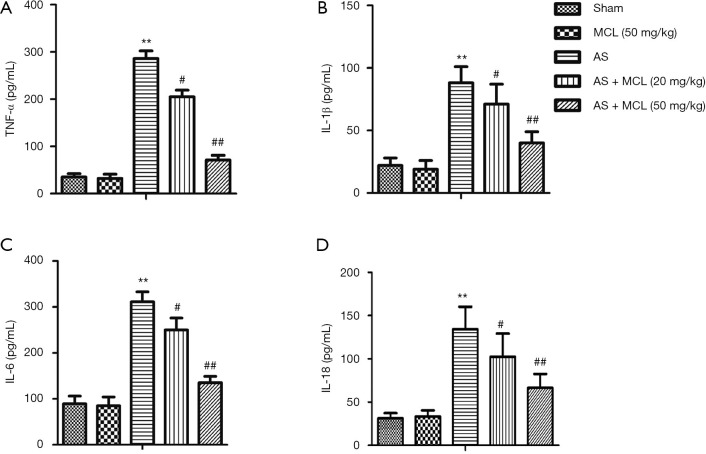
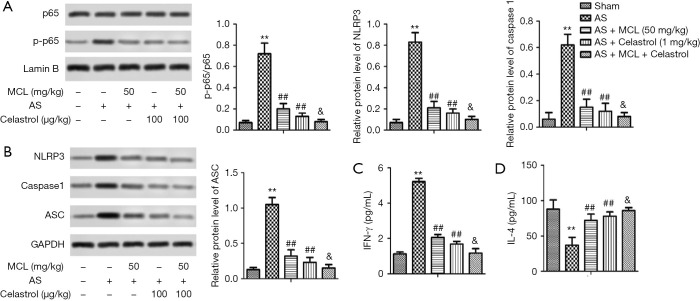
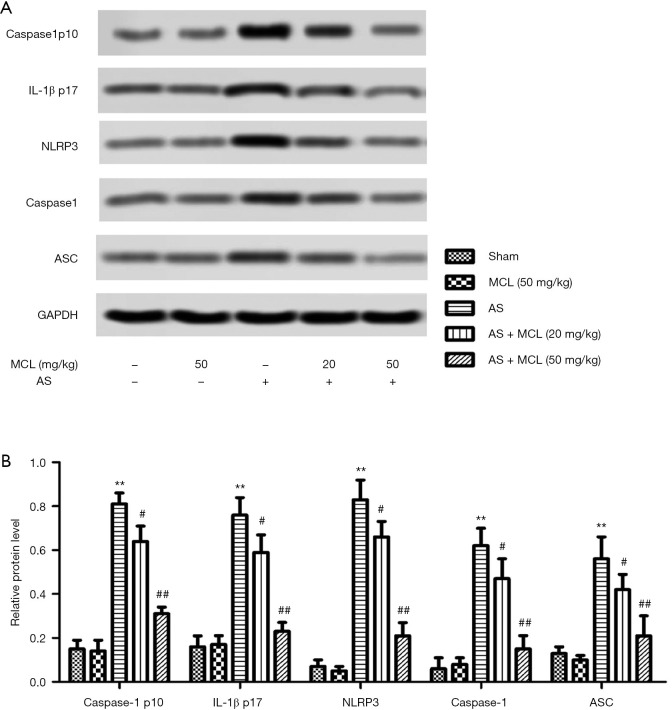
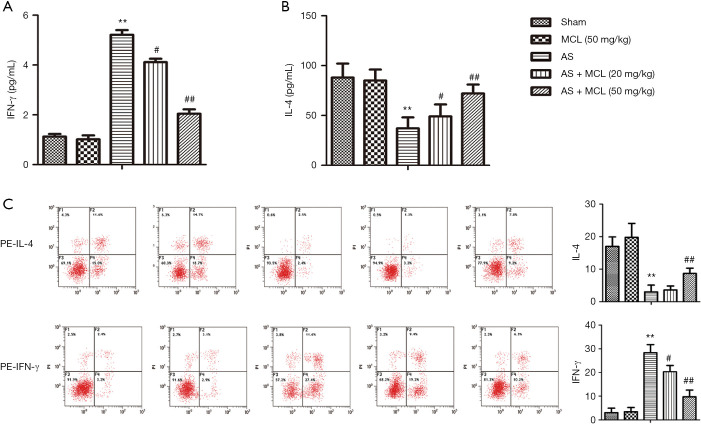
Compared with the AS model mice, the protein expression levels of tumor necrosis factor-α (TNF-α), interleukin (IL)-1β, IL-6, and IL-18 were decreased after MCL treatment. The protein expression levels of capase-1 p10, IL-1β p17, NOD-like receptor family and pyrin domain containing 3 (NLRP3), caspase-1, and apoptosis-associated speck-like protein (ASC) were also reduced. The protein expression levels of Interferon (IFN)-γ were down-regulated, but levels of IL-4 were increased. Western blotting and immunohistochemistry revealed that the levels of p-IκB α were up-regulated, while the levels of phosphorylated-p65 were down-regulated. After the addition of celastrol, MCL treatment significantly reduced the levels of p-p65, NLRP3, caspase-1, and ASC. Meanwhile, the levels of IFN-γ were markedly down-regulated, but the levels of IL-4 were enhanced.
Our study found that MCL suppressed the activation of NLRP3 inflammasome and maintained the balance of Th1/Th2 via regulating NF-κB signaling. Therefore, MCL could potentially be used to treat AS.
强直性脊柱炎(AS)是一种常见的炎性关节炎。米氏内酯(MCL)是一种倍半萜内酯,据报道其参与减轻炎症反应。本研究旨在探讨MCL治疗AS的机制。
将小鼠随机分为五组:假手术组、MCL(50mg/kg)组、AS模型组、AS + MCL(20mg/kg)组和AS + MCL(50mg/kg)组。加入抑制剂雷公藤红素后,将小鼠随机分为五组:假手术组、AS模型组、AS + MCL(50mg/kg)组、AS + 雷公藤红素(1mg/kg)组和AS + 雷公藤红素(1mg/kg)+ MCL(50mg/kg)组。
与AS模型小鼠相比,MCL治疗后肿瘤坏死因子-α(TNF-α)、白细胞介素(IL)-1β、IL-6和IL-18的蛋白表达水平降低。半胱天冬酶-1 p10、IL-1β p17、含核苷酸结合寡聚化结构域样受体家族吡咯结构域蛋白3(NLRP3)、半胱天冬酶-1和凋亡相关斑点样蛋白(ASC)的蛋白表达水平也降低。干扰素(IFN)-γ的蛋白表达水平下调,但IL-4水平升高。蛋白质免疫印迹法和免疫组织化学法显示,p-IκBα水平上调,而磷酸化-p65水平下调。加入雷公藤红素后,MCL治疗显著降低了p-p65、NLRP3、半胱天冬酶-1和ASC的水平。同时,IFN-γ水平明显下调,但IL-4水平升高。
我们的研究发现,MCL通过调节NF-κB信号通路抑制NLRP3炎性小体的激活并维持Th1/Th2平衡。因此,MCL可能具有治疗AS的潜力。