Han Zhenying, Shaligram Sonali, Faughnan Marie E, Clark Dewi, Sun Zhengda, Su Hua
Department of Anesthesia and Perioperative Care, University of California, San Francisco, CA 94143, USA.
Center for Cerebrovascular Research, University of California, San Francisco, CA 94143, USA.
Explor Med. 2020;1:136-148. doi: 10.37349/emed.2020.00010. Epub 2020 Jun 29.
To test if the impairment of mononuclear cell (MNC) migration in patients with hereditary hemorrhagic telangiectasia (HHT) is due to the reduction of the endoglin (ENG) receptor on the cell surface and oxidative stress.
MNCs of HHT patients and normal controls were subjected to migration assay. Fractions of MNCs were pre-incubated with antibodies specific to HHT causative genes ENG [hereditary hemorrhagic telangiectasia type 1 (HHT1)] or activin receptor-like kinase 1 [ALK1, hereditary hemorrhagic telangiectasia type 2 (HHT2)], AMD3100 or Diprotin-A to block ENG, ALK1 C-X-C chemokine receptor 4 (CXCR4) or CD26 (increased in HHT1 MNCs) before migration assay. The MNCs were allowed to migrate toward stromal cell-derived factor-1α (SDF-1α) for 18 h. The expression of , , superoxide dismutase 1 (SOD1) and glutathione peroxidase 1 () in MNCs and nitric oxide levels in the plasma were analyzed.
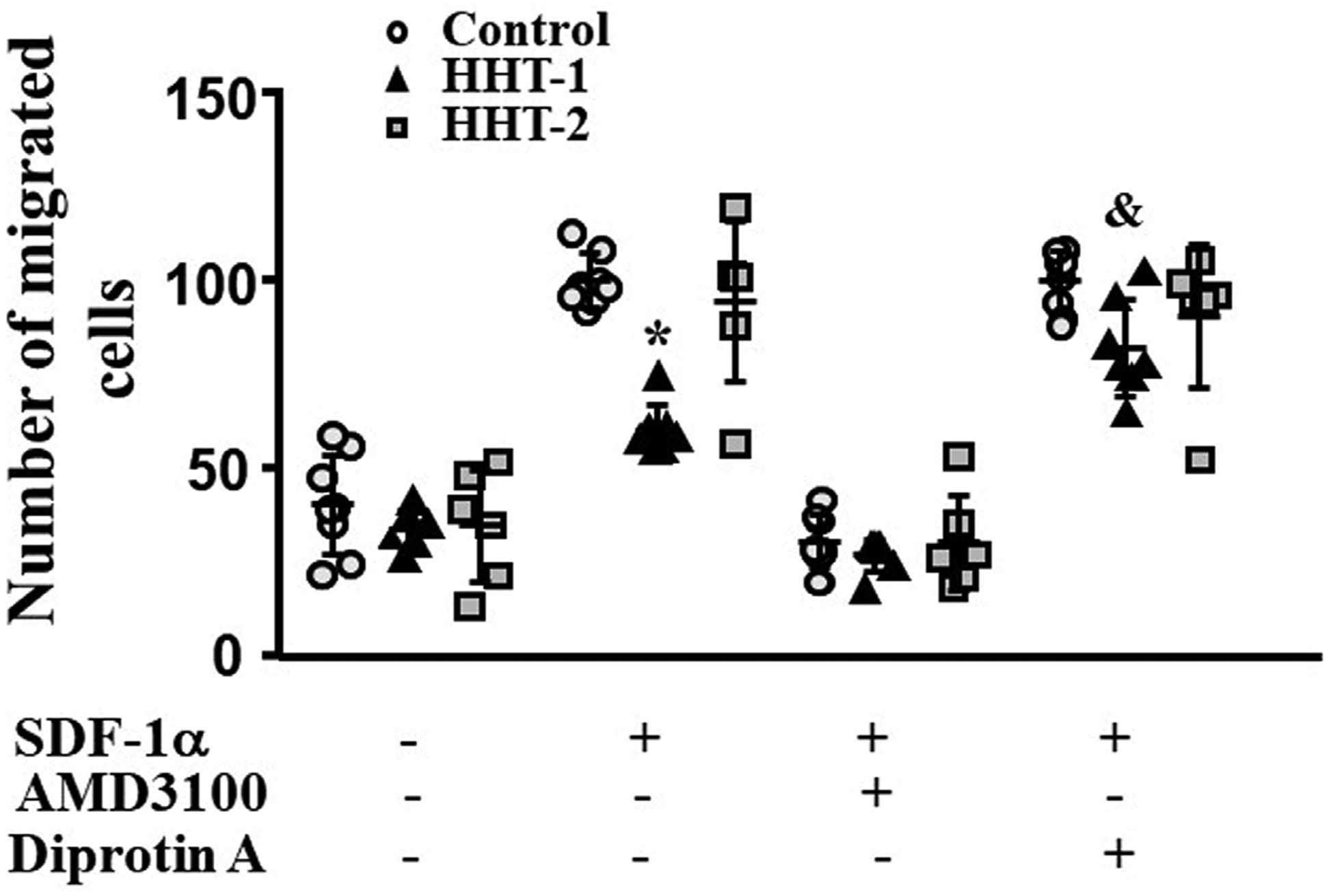
Compared to the controls, fewer HHT1 MNCs and similar number of HHT2 MNCs migrated toward SDF-1α. Diprotin-A pre-treatment improved HHT1 MNC-migration, but had no effect on normal and HHT2 MNCs. Pre-incubation with an anti-ENG antibody reduced the migration of normal MNCs. Diprotin-A did not improve the migration of ENG antibody pre-treated MNCs. Anti-ALK1 antibody had no effect on MNC-migration. AMD3100 treatment reduced normal and HHT MNC-migration. mRNA level was reduced in HHT1 and HHT2 MNCs. mRNA was reduced in HHT2 MNCs only. expression was higher in HHT1 MNCs. Pre-treatment of MNCs with anti-ENG or anti-ALK1 antibody had no effect on and expression. The expression of antioxidant enzymes, , was reduced in HHT1 MNCs, which was accompanied with an increase of ROS in HHT MNCs and nitric oxide in HHT1 plasma.
Reduction of ENG receptor on MNC surface reduced monocyte migration toward SDF-1α independent of CD26 expression. Increased oxidative stress could alter HHT MNC migration behavior.
检测遗传性出血性毛细血管扩张症(HHT)患者单核细胞(MNC)迁移受损是否归因于细胞表面内皮糖蛋白(ENG)受体减少及氧化应激。
对HHT患者和正常对照者的MNC进行迁移试验。在迁移试验前,将MNC的部分细胞与针对HHT致病基因ENG [遗传性出血性毛细血管扩张症1型(HHT1)]或激活素受体样激酶1 [ALK1,遗传性出血性毛细血管扩张症2型(HHT2)]、AMD3100或双丙酰氨-A的特异性抗体预孵育,以阻断ENG、ALK1、C-X-C趋化因子受体4(CXCR4)或CD26(在HHT1的MNC中增加)。使MNC向基质细胞衍生因子-1α(SDF-1α)迁移18小时。分析MNC中、、超氧化物歧化酶1(SOD1)和谷胱甘肽过氧化物酶1()的表达以及血浆中的一氧化氮水平。
与对照组相比,向SDF-1α迁移的HHT1的MNC较少,而HHT2的MNC数量相似。双丙酰氨-A预处理改善了HHT1的MNC迁移,但对正常和HHT2的MNC无影响。用抗ENG抗体预孵育可降低正常MNC的迁移。双丙酰氨-A未改善抗ENG抗体预处理的MNC的迁移。抗ALK1抗体对MNC迁移无影响。AMD3100处理降低了正常和HHT的MNC迁移。HHT1和HHT2的MNC中mRNA水平降低。仅HHT2的MNC中mRNA降低。HHT1的MNC中表达较高。用抗ENG或抗ALK1抗体预处理MNC对和表达无影响。抗氧化酶、的表达在HHT1的MNC中降低,这伴随着HHT的MNC中活性氧增加以及HHT1血浆中一氧化氮增加。
MNC表面ENG受体减少导致单核细胞向SDF-1α的迁移减少,与CD26表达无关。氧化应激增加可改变HHT的MNC迁移行为。