McDonald Jamie, Wooderchak-Donahue Whitney, VanSant Webb Chad, Whitehead Kevin, Stevenson David A, Bayrak-Toydemir Pinar
Department of Radiology, Hereditary Hemorrhagic Telangiectasia Center, University of Utah Salt Lake City, UT, USA ; Department of Pathology, University of Utah Salt Lake City, UT, USA.
Department of Pathology, University of Utah Salt Lake City, UT, USA ; ARUP Institute for Clinical and Experimental Pathology Salt Lake City, UT, USA.
Front Genet. 2015 Jan 26;6:1. doi: 10.3389/fgene.2015.00001. eCollection 2015.
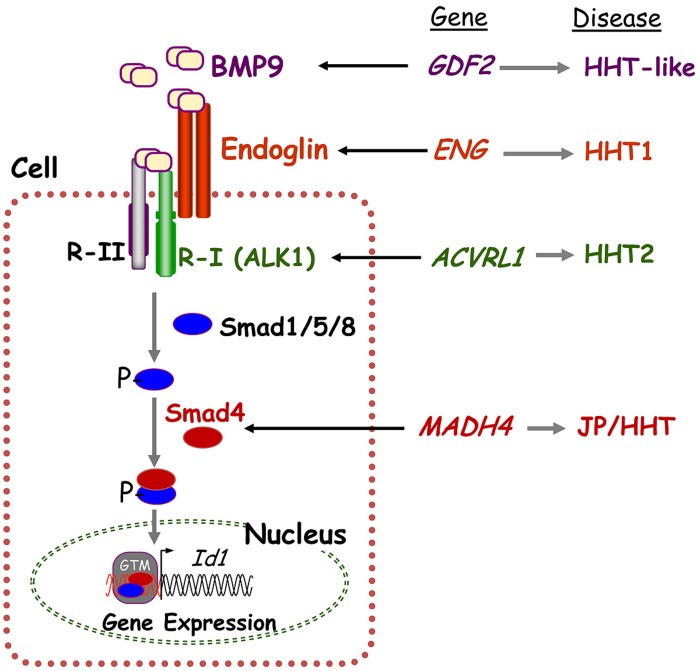
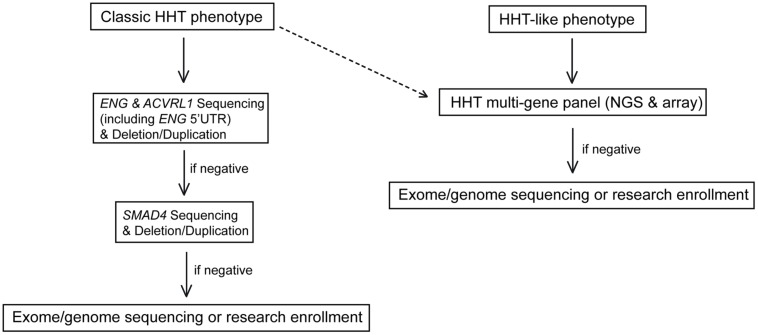
Hereditary hemorrhagic telangiectasia (HHT) is a vascular dysplasia characterized by telangiectases and arteriovenous malformations (AVMs) in particular locations described in consensus clinical diagnostic criteria published in 2000. Two genes in the transforming growth factor-beta (TGF-β) signaling pathway, ENG and ACVRL1, were discovered almost two decades ago, and mutations in these genes have been reported to cause up to 85% of HHT. In our experience, approximately 96% of individuals with HHT have a mutation in these two genes, when published (Curaçao) diagnostic criteria for HHT are strictly applied. More recently, two additional genes in the same pathway, SMAD4 and GDF2, have been identified in a much smaller number of patients with a similar or overlapping phenotype to HHT. Yet families still exist with compelling evidence of a hereditary telangiectasia disorder, but no identifiable mutation in a known gene. Recent availability of whole exome and genome testing has created new opportunities to facilitate gene discovery, identify genetic modifiers to explain clinical variability, and potentially define an increased spectrum of hereditary telangiectasia disorders. An expanded approach to molecular diagnostics for inherited telangiectasia disorders that incorporates a multi-gene next generation sequencing (NGS) HHT panel is proposed.
遗传性出血性毛细血管扩张症(HHT)是一种血管发育异常疾病,其特征为毛细血管扩张和动静脉畸形(AVM),具体位置在2000年发布的共识临床诊断标准中有描述。大约二十年前发现了转化生长因子-β(TGF-β)信号通路中的两个基因,即ENG和ACVRL1,据报道这些基因的突变导致高达85%的HHT病例。根据我们的经验,当严格应用已发布的(库拉索岛)HHT诊断标准时,约96%的HHT患者在这两个基因中存在突变。最近,在少数具有与HHT相似或重叠表型的患者中,又发现了同一信号通路中的另外两个基因,即SMAD4和GDF2。然而,仍有一些家族存在遗传性毛细血管扩张症的有力证据,但在已知基因中未发现可识别的突变。全外显子组和基因组检测的近期可用性为促进基因发现、识别解释临床变异性的遗传修饰因子以及潜在地定义遗传性毛细血管扩张症疾病的扩大谱带来了新机会。本文提出了一种扩展的遗传性毛细血管扩张症疾病分子诊断方法,该方法纳入了多基因下一代测序(NGS)HHT检测板。