Department of Neurology, Beijing Tiantan Hospital, Capital Medical University, Beijing, China.
China National Clinical Research Center for Neurological Diseases, Beijing, China.
Stroke Vasc Neurol. 2021 Mar;6(1):80-86. doi: 10.1136/svn-2020-000369. Epub 2020 Sep 21.
The relationship of high-sensitive C-reactive protein (hs-CRP) levels and infarction numbers with the prognosis of stroke is uncertain. This study evaluated the association of different hs-CRP levels and infarction numbers with the prognosis of acute minor ischaemic stroke or transient ischaemic attack (TIA).
A subset of 807 patients with both hs-CRP measurement and baseline MRI was included from the Clopidogrel in High-risk Patients with Acute Non-disabling Cerebrovascular Events trial. The primary efficacy outcome was the occurrence of an ischaemic stroke at the 1-year follow-up. Infarction numbers were classified as multiple acute infarctions (MAIs), single acute infarction and no acute infarction (NAI). The association between different hs-CRP levels with different infarction numbers and the risk of any outcome was analysed using multivariable Cox regression models.
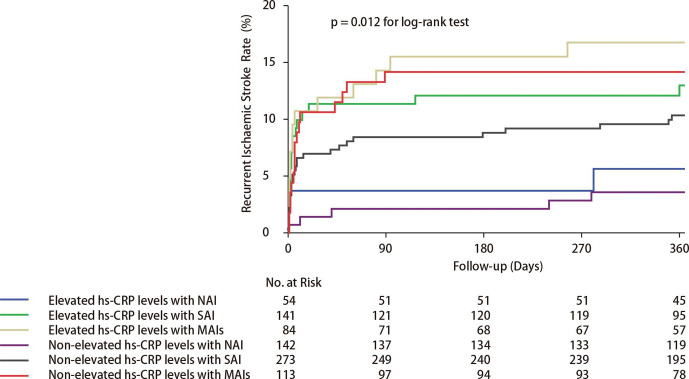
Among the 807 patients, 84 (10.4%) patients had a recurrent ischaemic stroke within 1 year. After adjustment for conventional confounding factors, patients with both elevated hs-CRP levels and MAIs were associated with approximately 4.7-fold of risk of ischaemic stroke within 1 year (16.7% vs 3.5%, HR 4.68, 95% CI 1.54 to 14.23, p=0.007), compared with those with non-elevated hs-CRP levels and NAI. Similar results were observed for the composite events.
Combined elevated hs-CRP levels and MAIs may increase 1-year stroke risk stratification efficiency in patients with minor ischaemic stroke or TIA compared with using those markers alone, which indicated that the combination of inflammatory and imaging markers might improve the effectiveness of risk stratification concerning minor ischaemic stroke or TIA.ClinicalTrials.gov Registry (NCT00979589).
高敏 C 反应蛋白(hs-CRP)水平与梗死灶数量与卒中预后的关系尚不确定。本研究评估了不同 hs-CRP 水平和梗死灶数量与急性小卒中和短暂性脑缺血发作(TIA)患者预后的相关性。
从氯吡格雷治疗高危急性非致残性脑血管事件(Clopidogrel in High-risk Patients with Acute Non-disabling Cerebrovascular Events)试验中选取了 807 例 hs-CRP 测量和基线 MRI 患者的亚组。主要疗效终点为 1 年随访时发生缺血性卒中。梗死灶数量分为多发急性梗死灶(MAIs)、单发急性梗死灶和无急性梗死灶(NAI)。采用多变量 Cox 回归模型分析不同 hs-CRP 水平与不同梗死灶数量与任何结局风险之间的关系。
在 807 例患者中,84 例(10.4%)患者在 1 年内复发缺血性卒中。在调整了常规混杂因素后,hs-CRP 水平升高且存在 MAIs 的患者在 1 年内发生缺血性卒中的风险约为 4.7 倍(16.7%比 3.5%,HR 4.68,95%CI 1.54 至 14.23,p=0.007),而非 hs-CRP 水平升高且存在 NAI 的患者。复合结局也观察到了类似的结果。
与单独使用这些标志物相比,hs-CRP 水平升高合并 MAIs 可能会增加小卒中和 TIA 患者 1 年卒中风险分层的效率,这表明炎症和影像学标志物的联合可能会提高小卒中和 TIA 风险分层的有效性。
ClinicalTrials.gov 注册号(NCT00979589)。