Li Jiejie, Pan Yuesong, Wang Mengxing, Meng Xia, Lin Jinxi, Li Zixiao, Li Hao, Wang Yilong, Zhao Xingquan, Liu Liping, Wang Yongjun
Department of Neurology, Beijing Tiantan Hospital, Capital Medical University and China National Clinical Research Center for Neurological Diseases.
Department of Neurology, Beijing Tiantan Hospital, Capital Medical University; China National Clinical Research Center for Neurological Diseases; Advanced Innovation Center for Human Brain Protection, Capital Medical University and Clinical Center for Precision Medicine in Stroke, Capital Medical University.
J Atheroscler Thromb. 2024 Mar 1;31(3):249-258. doi: 10.5551/jat.64229. Epub 2023 Sep 12.
Inflammation is associated with vascular events. We aimed to investigate the relationship between high-sensitivity C-reactive protein (hsCRP) levels with and without intracranial arterial stenosis (ICAS) and the prognosis of patients with minor stroke or transient ischemic attack.
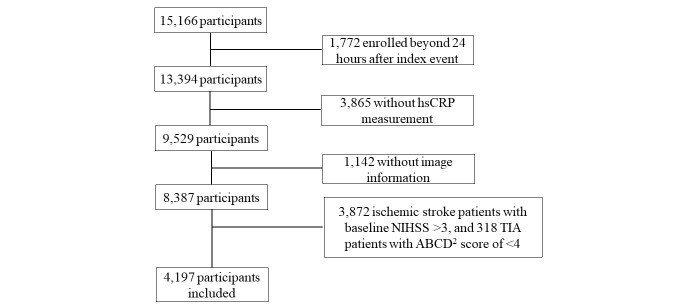
We used data from the Clopidogrel in High-Risk Patients with Acute Nondisabling Cerebrovascular Events trial (derivation cohort) and the Third China National Stroke Registry (validation cohort). Patients were divided into four groups according to the dichotomy of hsCRP level and ICAS status. The primary outcome was new ischemic stroke within 90 days, and the secondary outcome was dependence or death (Modified Rankin Scale score of 3-6) at 90 days. The associations between hsCRP level with and without ICAS and risk of outcomes were analyzed using multivariate Cox regression and logistic regression models.
In the derivation cohort, compared with patients with nonelevated hsCRP levels and no ICAS, those with both elevated hsCRP levels and ICAS had increased risk of recurrent stroke (adjusted hazard ratio [HR], 2.62; 95% confidence interval [CI], 1.28-5.34; p=0.008) and dependence or death (adjusted odds ratio [OR], 7.58; 95% CI, 1.30-44.13; p=0.02). Consistent relationships of elevated hsCRP levels and presence of ICAS with recurrent stroke (adjusted HR, 1.67; 95% CI, 1.13-2.45; p=0.009) and dependence or death (adjusted OR, 1.87; 95% CI, 1.23-2.84; p=0.003) were observed in the validation cohort.
Concomitant presence of increased hsCRP levels and ICAS was associated with increased risk of stroke recurrence and dependence or death in patients with minor ischemic stroke or transient ischemic attack.
炎症与血管事件相关。我们旨在研究伴和不伴颅内动脉狭窄(ICAS)时高敏C反应蛋白(hsCRP)水平与轻度卒中或短暂性脑缺血发作患者预后之间的关系。
我们使用了来自“急性非致残性脑血管事件高危患者的氯吡格雷”试验(推导队列)和第三次中国国家卒中登记(验证队列)的数据。根据hsCRP水平和ICAS状态的二分法将患者分为四组。主要结局为90天内新发缺血性卒中,次要结局为90天时的依赖或死亡(改良Rankin量表评分为3 - 6分)。使用多变量Cox回归和逻辑回归模型分析伴和不伴ICAS时hsCRP水平与结局风险之间的关联。
在推导队列中,与hsCRP水平未升高且无ICAS的患者相比,hsCRP水平升高且有ICAS的患者复发性卒中风险增加(校正风险比[HR],2.62;95%置信区间[CI],1.28 - 5.34;p = 0.008)以及依赖或死亡风险增加(校正比值比[OR],7.58;95% CI,1.30 - 44.13;p = 0.02)。在验证队列中观察到hsCRP水平升高和ICAS的存在与复发性卒中(校正HR,1.67;95% CI,1.13 - 2.45;p = 0.009)以及依赖或死亡(校正OR,1.87;95% CI,1.23 - 2.84;p = 0.003)之间存在一致的关系。
hsCRP水平升高和ICAS同时存在与轻度缺血性卒中或短暂性脑缺血发作患者的卒中复发风险以及依赖或死亡风险增加相关。