Bundy Jacob J, McCracken Ian W, Shin David S, Monroe Eric J, Johnson Guy E, Ingraham Christopher R, Kanal Kalpana M, Bundy Richa A, Jones Sean T, Valji Karim, Chick Jeffrey Forris Beecham
Wake Forest Baptist Health, One Medical Center Boulevard, Winston-Salem, NC, 27157, USA.
University of Washington, 1959 Northeast Pacific Street, Seattle, WA, 98195, USA.
CVIR Endovasc. 2020 Sep 22;3(1):69. doi: 10.1186/s42155-020-00159-6.
To quantify and categorize fluoroscopically-guided procedures with radiation doses exceeding 5000 mGy reference point air kerma (K). K > 5000 mGy has been defined as a "significant radiation dose" by the Society of Interventional Radiology. Identification and analysis of interventions with high radiation doses has the potential to reduce radiation-induced injuries.
Radiation dose data from a dose monitoring system for 19 interventional suites and 89,549 consecutive patient encounters from January 1, 2013 to August 1, 2019 at a single academic institution were reviewed. All patient encounters with K > 5000 mGy were included. All other encounters were excluded (n = 89,289). Patient demographics, medical specialty, intervention type, fluoroscopy time (minutes), dose area product (mGy·cm), and K (mGy) were evaluated.
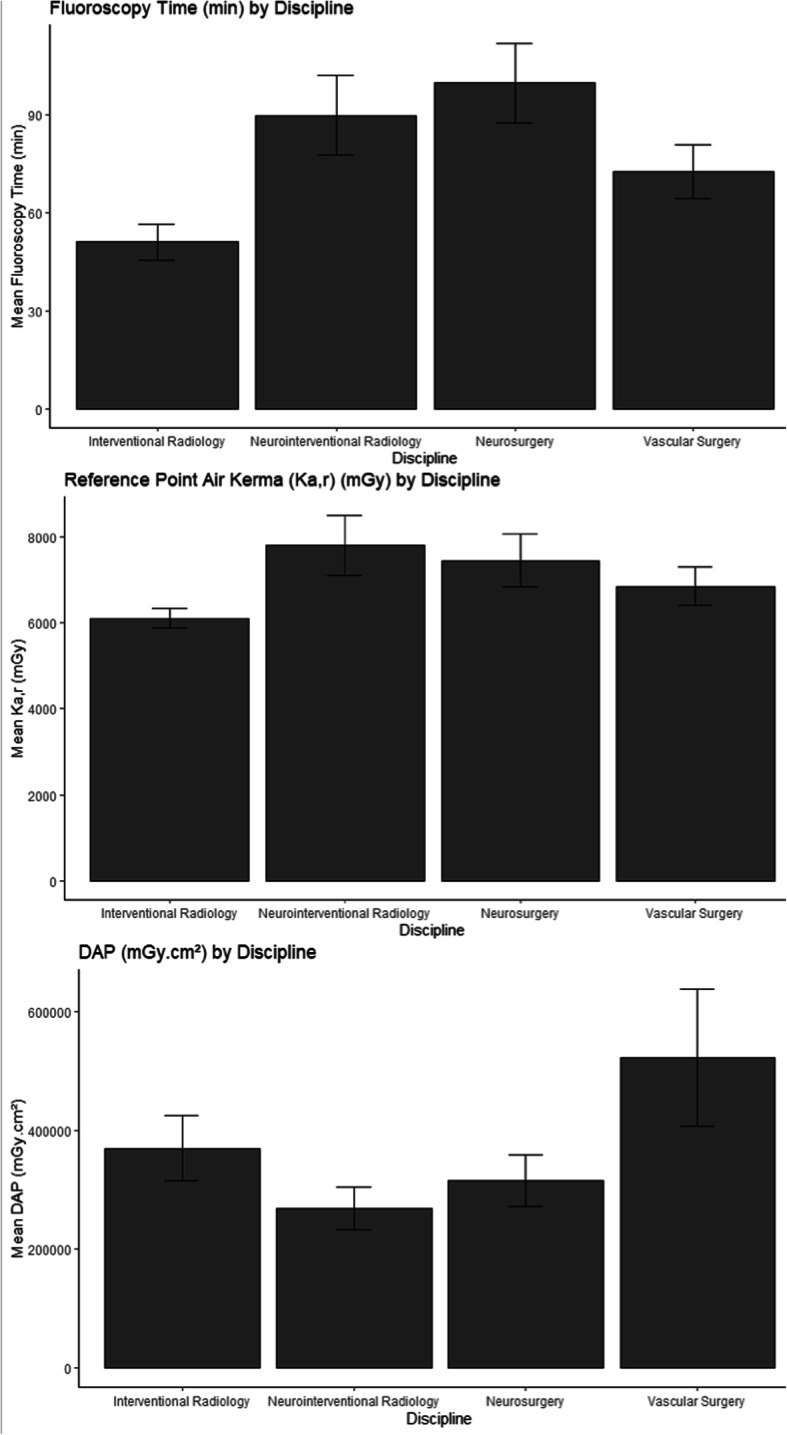
There were 260 (0.3%) fluoroscopically-guided procedures with K > 5000 mGy. Of the 260 procedures which exceeded 5000 mGy, neurosurgery performed 81 (30.5%) procedures, followed by interventional radiology (n = 75; 28.2%), neurointerventional radiology (n = 55; 20.7%), and vascular surgery (n = 49; 18.4%). The procedures associated with the highest K were venous stent reconstruction performed by interventional radiology, arteriovenous malformation embolization performed by neurointerventional radiology, spinal hardware fixation by neurosurgery, and arterial interventions performed by vascular surgery. Neurointerventional radiology had the highest mean K (7,799 mGy), followed by neurosurgery (7452 mGy), vascular surgery (6849 mGy), and interventional radiology (6109 mGy). The mean K for interventional radiology performed procedures exceeding 5000 mGy was significantly lower than that for neurointerventional radiology, neurosurgery, and vascular surgery.
Fluoroscopically-guided procedures with radiation dose exceeding 5000 mGy reference point air kerma are uncommon. The results of this study demonstrate that a large proportion of cases exceeding 5000 mGy were performed by non-radiologists, who likely do not receive the same training in radiation physics, radiation biology, and dose reduction techniques as radiologists.
对参考点空气比释动能(K)超过5000 mGy的透视引导下的手术进行量化和分类。介入放射学会已将K > 5000 mGy定义为“显著辐射剂量”。识别和分析高辐射剂量的手术有可能减少辐射引起的损伤。
回顾了某单一学术机构2013年1月1日至2019年8月1日期间19个介入手术室的剂量监测系统的辐射剂量数据以及89549例连续患者的情况。纳入所有K > 5000 mGy的患者情况。排除所有其他情况(n = 89289)。评估患者人口统计学资料、医学专业、手术类型、透视时间(分钟)、剂量面积乘积(mGy·cm)和K(mGy)。
有260例(0.3%)透视引导下的手术K > 5000 mGy。在这260例超过5000 mGy的手术中,神经外科进行了81例(30.5%),其次是介入放射学(n = 75;28.2%)、神经介入放射学(n = 55;20.7%)和血管外科(n = 49;18.4%)。与最高K相关的手术是介入放射学进行的静脉支架重建、神经介入放射学进行的动静脉畸形栓塞、神经外科进行的脊柱内固定以及血管外科进行的动脉介入。神经介入放射学的平均K最高(7799 mGy),其次是神经外科(7452 mGy)、血管外科(6849 mGy)和介入放射学(6109 mGy)。介入放射学进行的超过5000 mGy的手术的平均K显著低于神经介入放射学、神经外科和血管外科。
参考点空气比释动能辐射剂量超过5000 mGy的透视引导下的手术并不常见。本研究结果表明,超过5000 mGy的病例中有很大一部分是由非放射科医生进行的,他们可能没有接受与放射科医生相同的辐射物理学、辐射生物学和剂量降低技术方面的培训。