Department of Medical Epidemiology and Biostatistics, Karolinska Institutet, Stockholm, Sweden.
Department of Clinical Science and Education, Division of Pediatrics, Karolinska Institutet, Stockholm, Sweden.
PLoS Med. 2020 Sep 22;17(9):e1003207. doi: 10.1371/journal.pmed.1003207. eCollection 2020 Sep.
The complex etiology of autism spectrum disorder (ASD) is still unresolved. Preterm birth (<37 weeks of gestation) and its complications are the leading cause of death of babies in the world, and those who survive often have long-term health problems. Length of gestation, including preterm birth, has been linked to ASD risk, but robust estimates for the whole range of gestational ages (GAs) are lacking. The primary objective of this study was to provide a detailed and robust description of ASD risk across the entire range of GAs while adjusting for sex and size for GA.
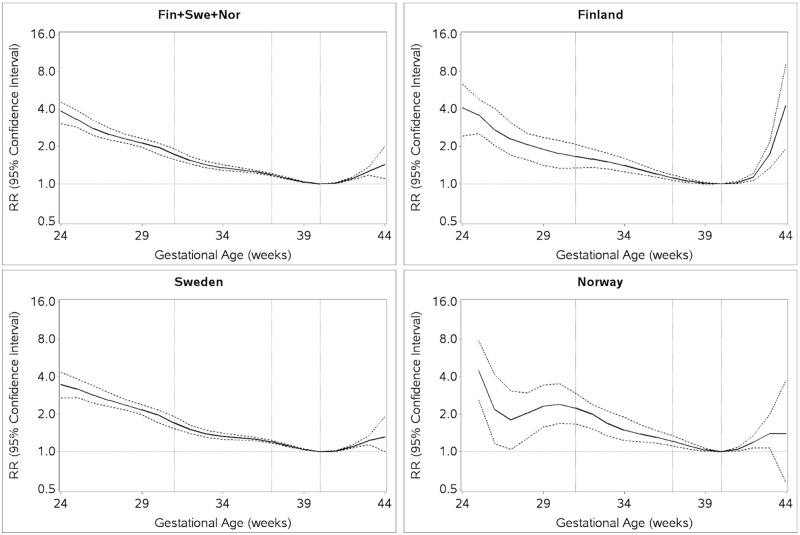
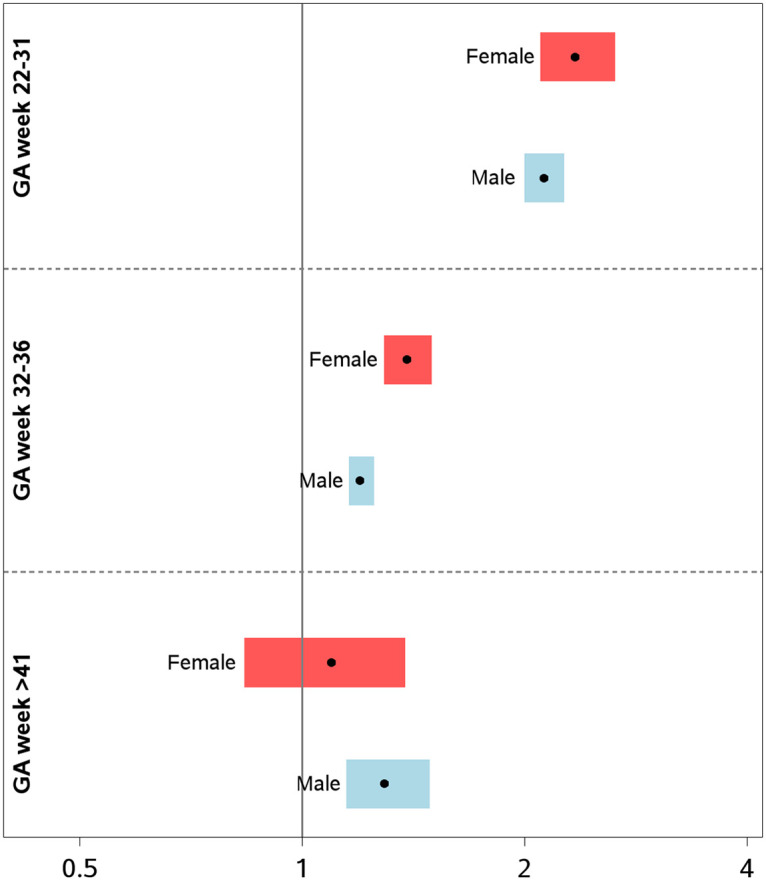
Our study had a multinational cohort design, using population-based data from medical registries in three Nordic countries: Sweden, Finland, and Norway. GA was estimated in whole weeks based on ultrasound. Children were prospectively followed from birth for clinical diagnosis of ASD. Relative risk (RR) of ASD was estimated using log-binomial regression. Analyses were also stratified by sex and by size for GA. The study included 3,526,174 singletons born 1995 to 2015, including 50,816 (1.44%) individuals with ASD. In the whole cohort, 165,845 (4.7%) were born preterm. RR of ASD increased by GA, from 40 to 24 weeks and from 40 to 44 weeks of gestation. The RR of ASD in children born in weeks 22-31, 32-36, and 43-44 compared to weeks 37-42 were estimated at 2.31 (95% confidence interval [CI] 2.15-2.48; 1.67% vs 0.83%; p-value < 0.001), 1.35 (95% CI 1.30-1.40; 1.08% vs 0.83%; p-value < 0.001), and 1.37 (95% CI 1.21-1.54; 1.74% vs 0.83%; p-value < 0.001), respectively. The main limitation of this study is the lack of data on potential causes of pre- or postterm birth. Also, the possibility of residual confounding should be considered.
In the current study, we observed that the RR of ASD increased weekly as the date of delivery diverged from 40 weeks, both pre- and postterm, independently of sex and size for GA. Given the unknown etiology of ASD and the lifelong consequences of the disorder, identifying groups of increased risk associated with a potentially modifiable risk factor is important.
自闭症谱系障碍(ASD)的复杂病因仍未得到解决。早产(<37 周妊娠)及其并发症是世界上婴儿死亡的主要原因,而那些幸存下来的婴儿往往存在长期的健康问题。妊娠期的长短,包括早产,与 ASD 风险有关,但缺乏对整个妊娠期(GA)范围的稳健估计。本研究的主要目的是在调整性别和 GA 大小的情况下,提供整个 GA 范围内 ASD 风险的详细和稳健描述。
我们的研究采用了一项多国家队列设计,使用来自瑞典、芬兰和挪威三个北欧国家医疗登记处的基于人群的数据。GA 是根据超声检查以整周为单位进行估计的。儿童从出生起就进行前瞻性随访,以临床诊断 ASD。使用对数二项式回归估计 ASD 的相对风险(RR)。还按性别和 GA 大小进行了分层分析。该研究包括 1995 年至 2015 年期间出生的 3526174 名单胎,其中 50816 名(1.44%)患有 ASD。在整个队列中,165845 名(4.7%)为早产儿。从 40 周到 24 周,从 40 周到 44 周,ASD 的 RR 随着 GA 的增加而增加。与 37-42 周 GA 相比,22-31 周、32-36 周和 43-44 周 GA 出生的儿童的 ASD RR 估计值分别为 2.31(95%置信区间 [CI] 2.15-2.48;1.67%比 0.83%;p 值<0.001)、1.35(95% CI 1.30-1.40;1.08%比 0.83%;p 值<0.001)和 1.37(95% CI 1.21-1.54;1.74%比 0.83%;p 值<0.001)。本研究的主要限制是缺乏关于早产或过期产潜在原因的数据。此外,还应考虑到残余混杂的可能性。
在目前的研究中,我们观察到,无论是早产还是过期产,随着分娩日期与 40 周的差距逐渐增大,ASD 的 RR 每周都在增加,这与性别和 GA 大小无关。鉴于 ASD 的病因不明以及该疾病的终身后果,确定与潜在可改变风险因素相关的风险增加群体非常重要。