Department of Medicine, Weill Cornell Medicine, New York, New York.
Department of Healthcare Policy and Research, Weill Cornell Medicine, New York, New York.
Cell Mol Gastroenterol Hepatol. 2021;11(2):525-550. doi: 10.1016/j.jcmgh.2020.09.008. Epub 2020 Sep 20.
BACKGROUND & AIMS: The incidence of inflammatory bowel diseases has increased over the last half century, suggesting a role for dietary factors. Fructose consumption has increased in recent years. Recently, a high fructose diet (HFrD) was shown to enhance dextran sodium sulfate (DSS)-induced colitis in mice. The primary objectives of the current study were to elucidate the mechanism(s) underlying the pro-colitic effects of dietary fructose and to determine whether this effect occurs in both microbially driven and genetic models of colitis.
Antibiotics and germ-free mice were used to determine the relevance of microbes for HFrD-induced worsening of colitis. Mucus thickness and quality were determined by histologic analyses. 16S rRNA profiling, in situ hybridization, metatranscriptomic analyses, and fecal metabolomics were used to determine microbial composition, spatial distribution, and metabolism. The significance of HFrD on pathogen and genetic-driven models of colitis was determined by using Citrobacter rodentium infection and Il10 mice, respectively.
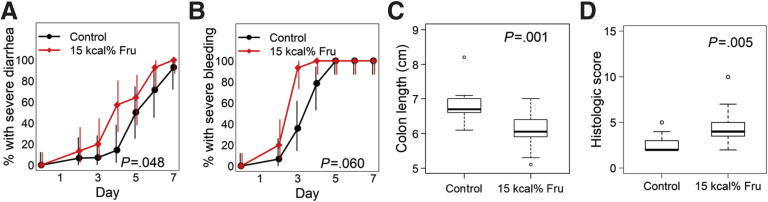
Reducing or eliminating bacteria attenuated HFrD-mediated worsening of DSS-induced colitis. HFrD feeding enhanced access of gut luminal microbes to the colonic mucosa by reducing thickness and altering the quality of colonic mucus. Feeding a HFrD also altered gut microbial populations and metabolism including reduced protective commensal and bile salt hydrolase-expressing microbes and increased luminal conjugated bile acids. Administration of conjugated bile acids to mice worsened DSS-induced colitis. The HFrD also worsened colitis in Il10 mice and mice infected with C rodentium.
Excess dietary fructose consumption has a pro-colitic effect that can be explained by changes in the composition, distribution, and metabolic function of resident enteric microbiota.
过去半个世纪以来,炎症性肠病的发病率有所增加,这表明饮食因素可能起作用。近年来,果糖的摄入量有所增加。最近的研究表明,高果糖饮食(HFrD)可增强小鼠对葡聚糖硫酸钠(DSS)诱导的结肠炎。本研究的主要目的是阐明饮食果糖引起结肠炎的促炎作用机制,并确定该作用是否发生在微生物驱动和遗传结肠炎模型中。
使用抗生素和无菌小鼠确定微生物在 HFrD 诱导的结肠炎恶化中的相关性。通过组织学分析确定粘液厚度和质量。使用 16S rRNA 分析、原位杂交、宏转录组分析和粪便代谢组学来确定微生物组成、空间分布和代谢。使用柠檬酸杆菌感染和 Il10 小鼠分别确定 HFrD 对病原体和遗传驱动的结肠炎模型的意义。
减少或消除细菌可减轻 DSS 诱导的结肠炎中 HFrD 介导的恶化。HFrD 喂养通过减少厚度和改变结肠粘液的质量来增强肠道腔微生物对结肠粘膜的可及性。HFrD 喂养还改变了肠道微生物群和代谢,包括减少保护性共生体和胆汁盐水解酶表达的微生物以及增加腔内共轭胆汁酸。给小鼠施用共轭胆汁酸会加重 DSS 诱导的结肠炎。HFrD 还加重了 Il10 小鼠和感染 C rodentium 的小鼠的结肠炎。
过量的饮食果糖摄入具有促结肠炎作用,这可以通过肠道常驻微生物群落的组成、分布和代谢功能的变化来解释。