School of Social Development, East China University of Political Science and Law, 555 Longyuan Road Songjiang District, Shanghai 201620, China.
Rory Meyer College of Nursing, New York University, 433 First Avenue, New York, NY 10010, USA.
Int J Environ Res Public Health. 2020 Sep 19;17(18):6851. doi: 10.3390/ijerph17186851.
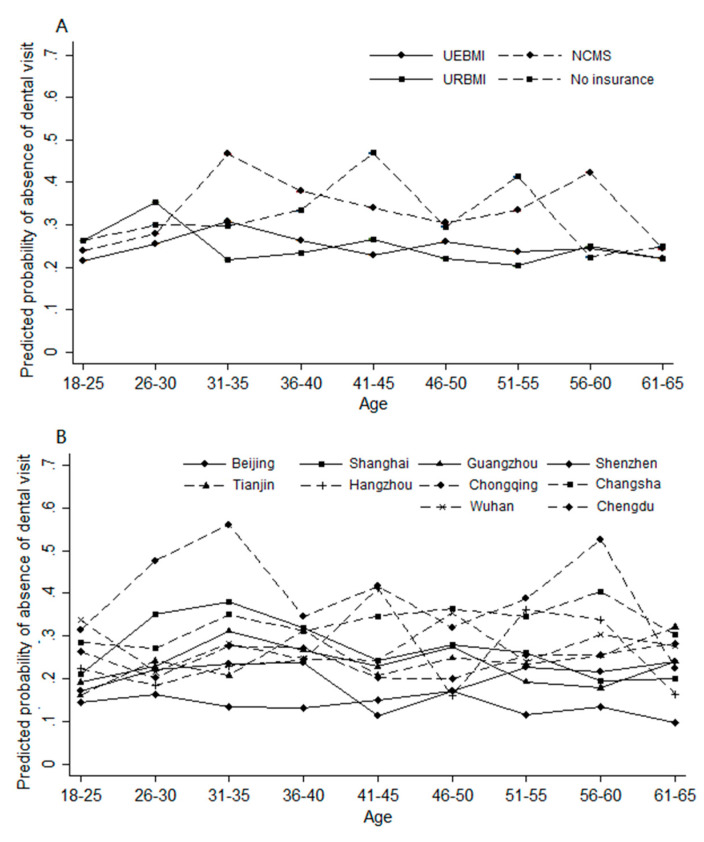
The aims of the study were to present the prevalence of dental service utilization among adults (age between 18 and 65) in Chinese megacities and to examine the associations of health insurance and city of residence with dental visits. This study was a cross-sectional analysis of the 2019 New Era and Living Conditions in Megacities Survey data with a sample of 4835 participants aged 18-65 from 10 different megacities in China. The data including gross domestic product (GDP) per capita of each megacity obtained from the National Bureau of Statistics of China as a city-level characteristic. After adjusting sampling weights, approximately 24.28% of the participants had at least one dental visit per year. Findings from multilevel mixed-effects linear models showed that participants residing in megacities with higher GDP per capita (β = 0.07, < 0.001) who had Urban Employee Basic Medical Insurance (β = 0.25, < 0.001) or Urban Resident Basic Medical Insurance (β = 0.19, < 0.01) had more frequent dental visits after adjusting demographic characteristics, socioeconomic status, health status, health behavior and attitude, and oral health indicators. Margins post-estimation model results demonstrated disparities in the predicted probability of having never visited a dentist by types of health insurance and city of residence. In conclusion, the prevalence of dental visits in China was found to be low. This study highlights socioeconomic inequalities in dental service utilization. There is a great need to develop more dental care programs and services and expand health insurance to cover dental care in China.
本研究旨在展示中国特大城市成年人(18 至 65 岁)的牙科服务利用情况,并探讨健康保险和居住城市与牙科就诊的关系。这是一项对 2019 年新时代和特大城市生活状况调查数据的横断面分析,样本为来自中国 10 个不同特大城市的 4835 名 18-65 岁的参与者。数据包括中国国家统计局获得的每个特大城市的人均国内生产总值(GDP),作为城市层面的特征。在调整抽样权重后,大约 24.28%的参与者每年至少进行一次牙科就诊。多层次混合效应线性模型的结果表明,居住在人均 GDP 较高的特大城市(β=0.07,<0.001)、参加城镇职工基本医疗保险(β=0.25,<0.001)或城镇居民基本医疗保险(β=0.19,<0.01)的参与者,在调整人口特征、社会经济状况、健康状况、健康行为和态度以及口腔健康指标后,牙科就诊更频繁。边际后估计模型结果表明,不同类型的健康保险和居住城市之间,从未看过牙医的预测概率存在差异。总之,研究发现中国的牙科就诊率较低。本研究强调了牙科服务利用方面的社会经济不平等。中国需要制定更多的牙科保健计划和服务,并扩大健康保险范围,以涵盖牙科保健。