Talukdar Rounik, Barman Diplina, Thakkar Vallabh, Kanungo Suman
Division of Epidemiology, ICMR-National Institute of Cholera and Enteric Diseases, West Bengal, India.
Jan Swasthya Sahyog, Chhattisgarh, India.
Health Promot Perspect. 2022 Dec 31;12(4):325-335. doi: 10.34172/hpp.2022.42. eCollection 2022.
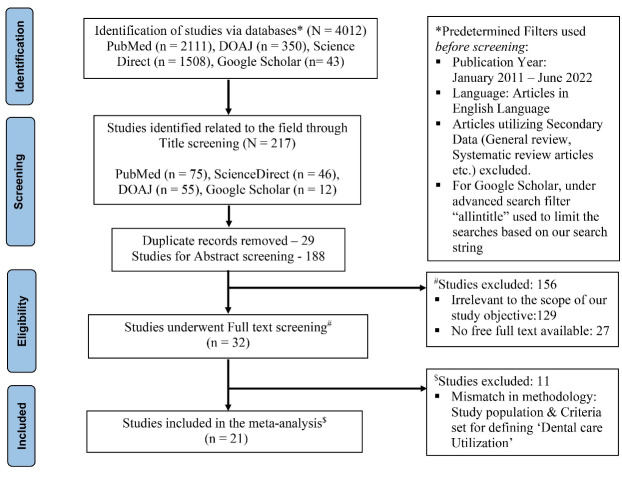
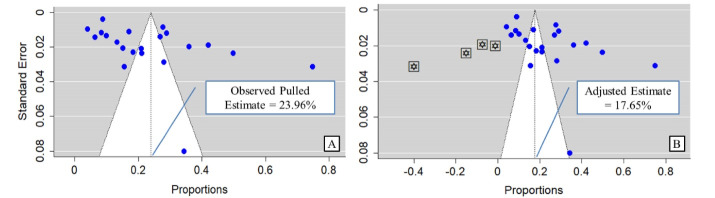
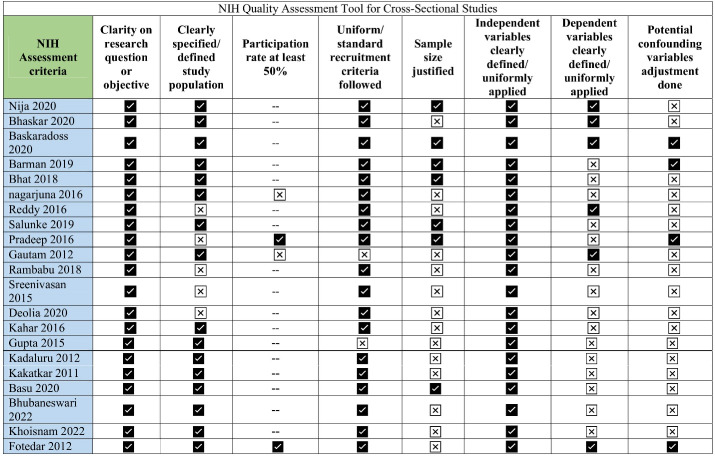
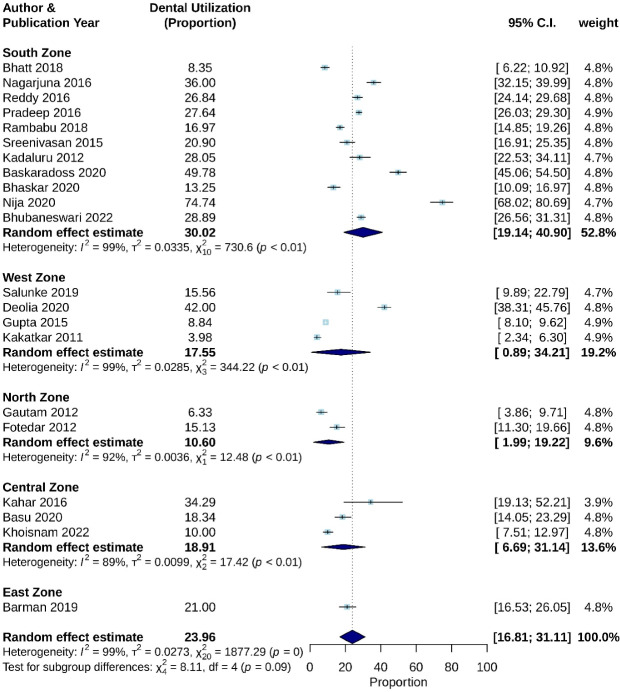
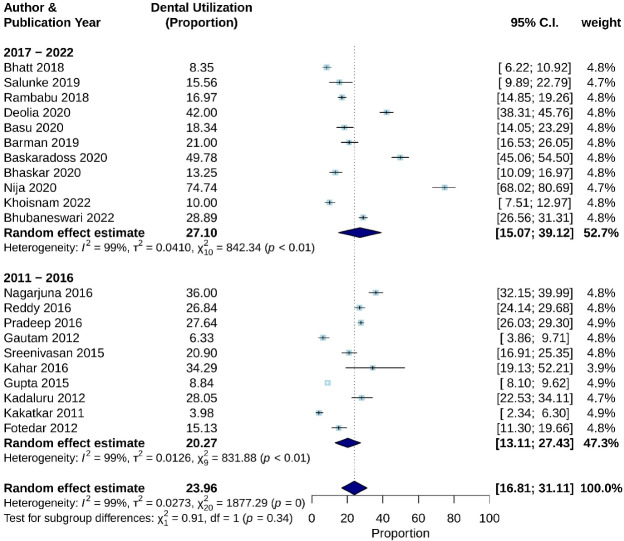
This study aimed to generate a pooled national estimate on dental health care services utilization by the adult population in India from any public or private facility in an effort to highlight the demand and usage for oral health care. In this meta-analysis, PubMed, ScienceDirect, DOAJ, and Google Scholar were searched using a search strategy that combined MeSH headings and keywords (e.g., "Oral Health", "Dental Health Services", utilization, India, etc.) for articles on dental utilization among Indian adults, published between January 2011 and June 2022. Study quality was assessed using the NIH Quality assessment tool, and a random-effects inverse-variance method was used for pulling utilization proportions. Meta-regression and sub-group analyses were conducted to identify the sources of heterogeneity. Heterogeneity is reported as I. To examine publication bias, the funnel plot, egger's test, and trim-and-fill analysis were performed. From 4012 identified articles, 21 were eligible for inclusion. The pooled dental care utilization amongst Indian adults were found to be 23.96% (confidence interval [CI]: 16.81%- 31.11%, <0.001, I=98.93%), and the highest estimate was in South Zone (30.02%, CI: 19.14-40.90, <0.01, I=98.63%). Visual inspection of the funnel plot revealed the presence of publication bias (egger's value 0.02). A mild decrease in utilization estimate was noted through trim and fill analysis (adjusted estimate 17.65%, CI: 8.97-26.33, =0.03). No significant subgroup effect was found for the variables study zone and conduction years ( value: 0.09 & 0.34 respectively). Future studies should be undertaken to focus on the demand and supply of oral health care services since an evidential gap has been identified due to the uneven distribution of studies available from various regions of India. The heterogeneity can be attributed to the diverse socioeconomic, literacy, and inherent health system performance status.
本研究旨在对印度成年人口从任何公共或私人机构获得的牙科保健服务利用情况进行全国性汇总估计,以突出口腔保健的需求和使用情况。在这项荟萃分析中,使用结合医学主题词和关键词(如“口腔健康”、“牙科保健服务”、“利用情况”、“印度”等)的检索策略,在PubMed、ScienceDirect、DOAJ和谷歌学术上检索2011年1月至2022年6月期间发表的关于印度成年人牙科利用情况的文章。使用美国国立卫生研究院质量评估工具评估研究质量,并采用随机效应逆方差方法汇总利用比例。进行了Meta回归和亚组分析以确定异质性来源。异质性以I²报告。为检验发表偏倚,进行了漏斗图、埃格检验和修剪填充分析。从4012篇已识别的文章中,有21篇符合纳入标准。印度成年人的牙科保健综合利用率为23.96%(置信区间[CI]:16.81%-31.11%,P<0.001,I²=98.93%),最高估计值出现在南区(30.02%,CI:19.14-40.90,P<0.01,I²=98.63%)。漏斗图的视觉检查显示存在发表偏倚(埃格值为0.02)。通过修剪填充分析发现利用率估计值略有下降(调整后估计值为17.65%,CI:8.97-26.33,P=0.03)。未发现研究区域和开展年份变量有显著的亚组效应(P值分别为0.09和0.34)。由于印度各地区现有研究分布不均已发现证据差距,未来应开展研究关注口腔保健服务的需求和供应。异质性可归因于社会经济、识字率和固有卫生系统绩效状况的多样性。