Kotz Frederik, Mader Markus, Dellen Nils, Risch Patrick, Kick Andrea, Helmer Dorothea, Rapp Bastian E
Laboratory of Process Engineering, NeptunLab, Department of Microsystems Engineering (IMTEK), University of Freiburg, 79110 Freiburg, Germany.
Freiburg Materials Research Center (FMF), University of Freiburg, 79104 Freiburg im Breisgau, Germany.
Micromachines (Basel). 2020 Sep 19;11(9):873. doi: 10.3390/mi11090873.
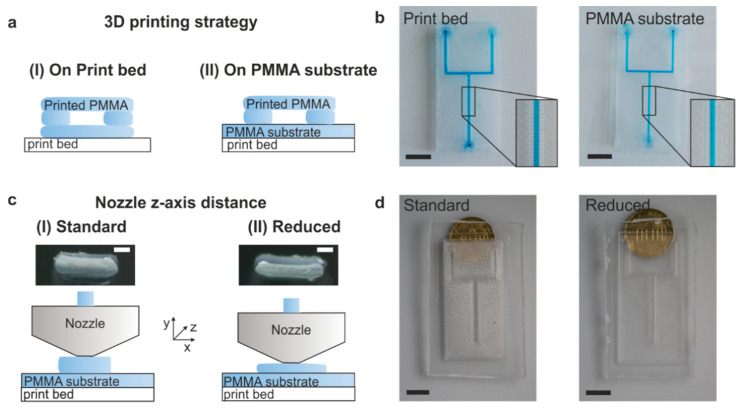
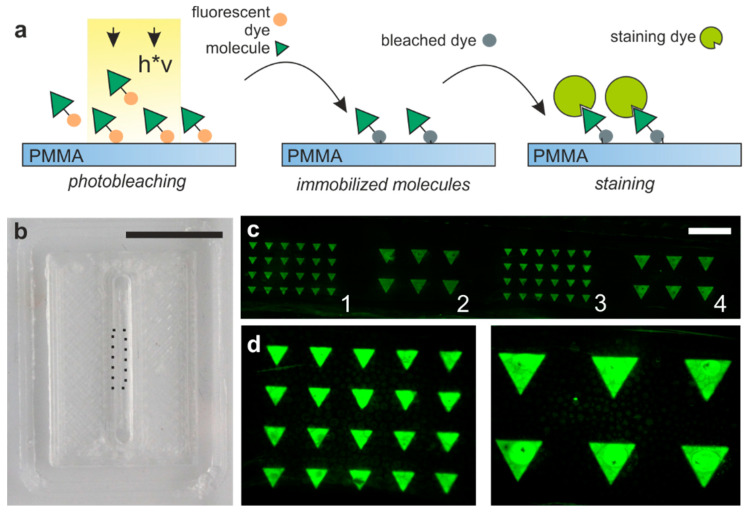
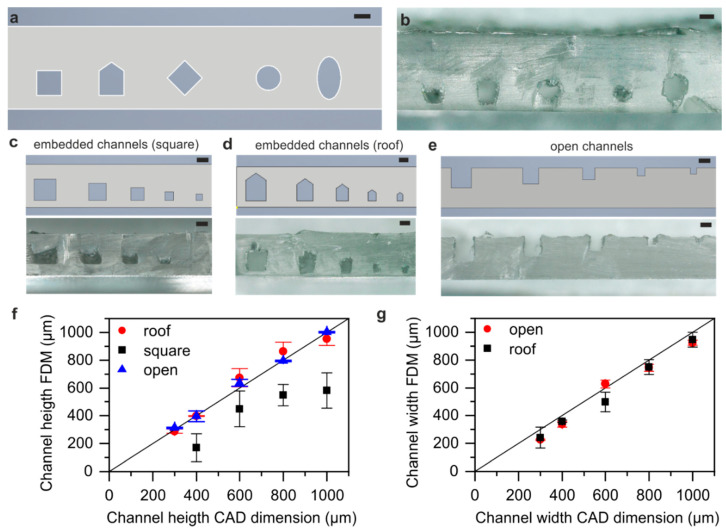
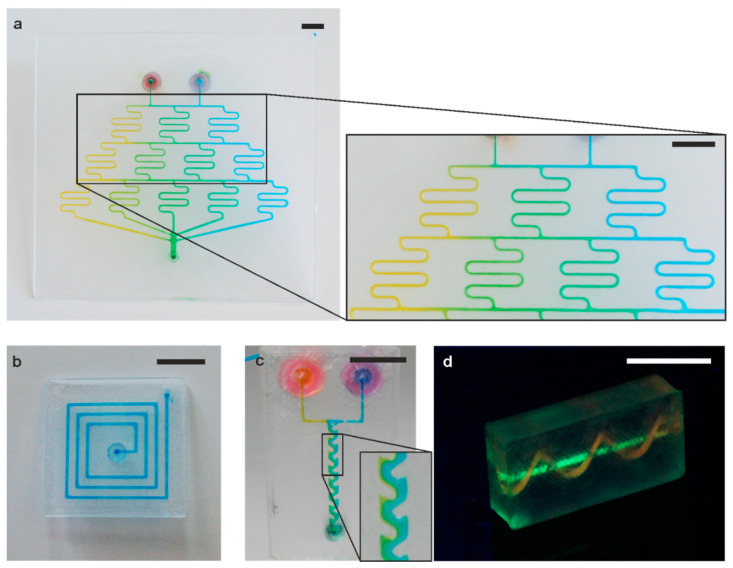
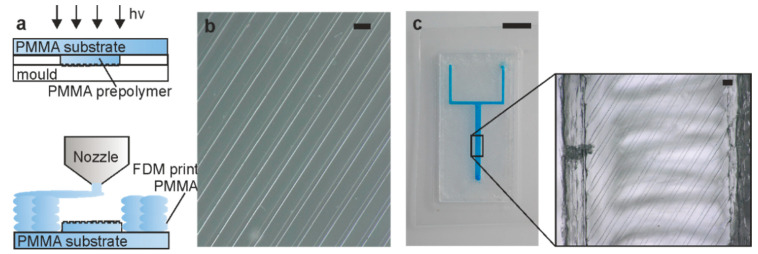
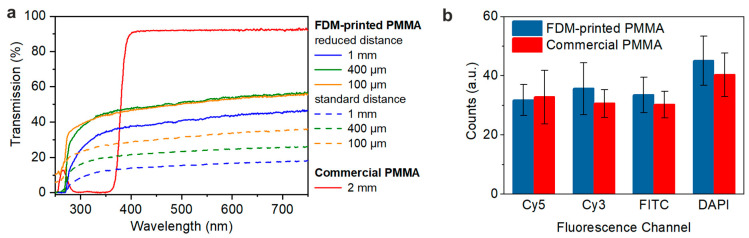
Polymethylmethacrylate (PMMA) is one of the most important thermoplastic materials and is a widely used material in microfluidics. However, PMMA is usually structured using industrial scale replication processes, such as hot embossing or injection molding, not compatible with rapid prototyping. In this work, we demonstrate that microfluidic chips made from PMMA can be 3D printed using fused deposition modeling (FDM). We demonstrate that using FDM microfluidic chips with a minimum channel cross-section of ~300 µm can be printed and a variety of different channel geometries and mixer structures are shown. The optical transparency of the chips is shown to be significantly enhanced by printing onto commercial PMMA substrates. The use of such commercial PMMA substrates also enables the integration of PMMA microstructures into the printed chips, by first generating a microstructure on the PMMA substrates, and subsequently printing the PMMA chip around the microstructure. We further demonstrate that protein patterns can be generated within previously printed microfluidic chips by employing a method of photobleaching. The FDM printing of microfluidic chips in PMMA allows the use of one of microfluidics' most used industrial materials on the laboratory scale and thus significantly simplifies the transfer from results gained in the lab to an industrial product.
聚甲基丙烯酸甲酯(PMMA)是最重要的热塑性材料之一,也是微流控领域广泛使用的材料。然而,PMMA通常采用工业规模的复制工艺进行加工,如热压印或注塑成型,这些工艺与快速成型不兼容。在这项工作中,我们证明了由PMMA制成的微流控芯片可以使用熔融沉积建模(FDM)进行3D打印。我们展示了使用FDM能够打印出最小通道横截面约为300 µm的微流控芯片,并展示了各种不同的通道几何形状和混合器结构。通过在商用PMMA基板上进行打印,芯片的光学透明度得到了显著提高。使用这种商用PMMA基板还能够将PMMA微结构集成到打印芯片中,方法是先在PMMA基板上生成微结构,然后围绕该微结构打印PMMA芯片。我们进一步证明,通过采用光漂白方法,可以在先前打印的微流控芯片内生成蛋白质图案。在PMMA中对微流控芯片进行FDM打印,使得在实验室规模上能够使用微流控领域最常用的工业材料之一,从而显著简化了从实验室成果到工业产品的转化过程。