Department of Pediatric Surgery, West China Hospital of Sichuan University, Chengdu, Sichuan Province, The People's Republic of China.
President & Dean's Office, West China Hospital of Sichuan University, Chengdu, Sichuan Province, The People's Republic of China.
BMC Cancer. 2020 Sep 22;20(1):906. doi: 10.1186/s12885-020-07356-5.
Pancreatic neuroendocrine neoplasms (p-NENs) are a group of highly heterogeneous tumors with distinct clinicopathological features and long-term prognosis. In 2017, in order to better stratify patients into prognostic groups and predicting their outcomes, World Health Organization (WHO) officially updated its grading system for p-NENs which distinguished these neoplasms among Grading 1 (G1) pancreatic neuroendocrine tumors (p-NETs), G2 p-NETs, G3 p-NETs and G3 pancreatic neuroendocrine carcinomas (p-NECs). However, this new grading classification for p-NENs has not yet been rigorously validated.
Data of patients who were surgically treated and histopathologically diagnosed as p-NENs at West China Hospital of Sichuan University from January 2002 to December 2018 were retrospectively collected and analyzed according the novel WHO 2017 grading classification.
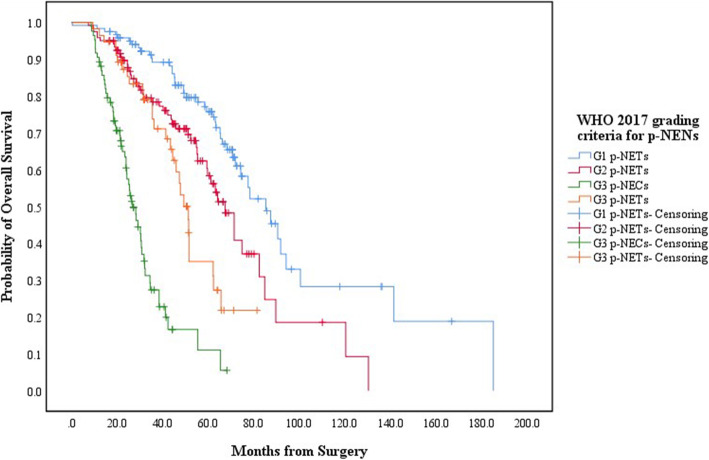
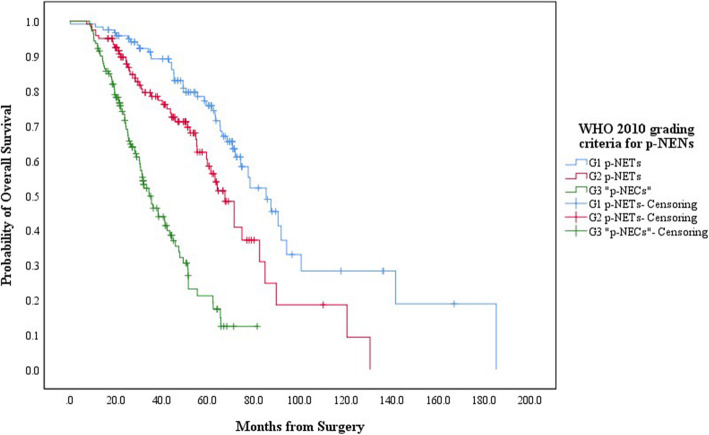
We eventually enrolled 480 eligible patients with p-NENs in our present study, in which 150 patients with WHO 2017 G1 p-NETs, 158 with G2 p-NETs, 64 with G3 p-NETs and 108 with G3 p-NECs were identified. The estimated 5-year overall survival for patients with G1 p-NETs, G2 p-NETs, G3 p-NETs and G3 p-NECs was 75.8, 58.4, 35.1 and 11.1%, with a median survival time of 85.3mons, 67.4mons, 51.3mons and 26.8mons, respectively. Patients with G2 p-NETs present notably worse survival than those with G1 p-NETs (P = 0.03). Survival of G3 p-NETs were significantly worse than that of G1 p-NETs or G2 p-NETs (P < 0.001, P = 0.023, respectively), as well as that when comparing G3 p-NECs with G1 p-NETs or G2 p-NETs (P < 0.001, P < 0.001, respectively). Patients with G3 p-NECs showed statistically shorter survival than those with G3 p-NETs (P < 0.001). Both WHO 2017 and 2010 grading criteria could be independent predictor for the OS of p-NENs (P = 0.016, P = 0.022; respectively). The 95% confidence intervals of WHO 2017 grading classification (0.983-9.454) was slightly smaller than that of WHO 2010 criteria (0.201-13.374), indicating a relatively more accurate predicting ability for the prognosis of p-NENs.
The WHO 2017 grading classification for p-NENs could successfully allocate patients into four groups with distinct clinical features and significant survival differences, which might be superior to the WHO 2010 criteria for its better prognostic stratification and more accurate predicting ability.
胰腺神经内分泌肿瘤(p-NENs)是一组具有不同临床病理特征和长期预后的高度异质性肿瘤。2017 年,为了更好地将患者分为预后组并预测其结局,世界卫生组织(WHO)正式更新了其用于 p-NENs 的分级系统,将这些肿瘤分为分级 1(G1)胰腺神经内分泌肿瘤(p-NETs)、G2 p-NETs、G3 p-NETs 和 G3 胰腺神经内分泌癌(p-NECs)。然而,这种用于 p-NENs 的新分级分类尚未经过严格验证。
回顾性收集 2002 年 1 月至 2018 年 12 月在四川大学华西医院接受手术治疗和组织病理学诊断为 p-NENs 的患者数据,并根据新的 WHO 2017 分级分类进行分析。
我们最终纳入了本研究中 480 名符合条件的 p-NENs 患者,其中包括 150 名 WHO 2017 G1 p-NETs、158 名 G2 p-NETs、64 名 G3 p-NETs 和 108 名 G3 p-NECs 患者。G1 p-NETs、G2 p-NETs、G3 p-NETs 和 G3 p-NECs 患者的 5 年总生存率估计分别为 75.8%、58.4%、35.1%和 11.1%,中位生存时间分别为 85.3mons、67.4mons、51.3mons 和 26.8mons。G2 p-NETs 患者的生存情况明显差于 G1 p-NETs(P=0.03)。G3 p-NETs 的生存情况明显差于 G1 p-NETs 或 G2 p-NETs(P<0.001,P=0.023),与 G3 p-NECs 相比也是如此(P<0.001,P<0.001)。G3 p-NECs 患者的生存时间明显短于 G3 p-NETs(P<0.001)。WHO 2017 分级标准和 2010 分级标准均为 p-NENs OS 的独立预测因素(P=0.016,P=0.022)。WHO 2017 分级分类的 95%置信区间(0.983-9.454)略小于 WHO 2010 标准的 95%置信区间(0.201-13.374),表明其对 p-NENs 的预后具有更好的预测能力。
WHO 2017 分级分类可成功将患者分为具有不同临床特征和显著生存差异的四组,其对预后的分层优于 WHO 2010 标准,预测能力更准确。