Sarwar Golam, Reza Masud, Khan Mohammad Niaz Morshed, Gourab Gorkey, Rahman Mahbubur, Rana A K M Masud, Khan Shaan Muberra, Irfan Samira Dishti, Ahmed Shahriar, Banu Rupali Sisir, Banu Sayera, Khan Sharful Islam
Infectious Diseases Division, International Centre for Diarrhoeal Disease Research Bangladesh, Dhaka, Bangladesh.
National Tuberculosis Control Program, Directorate General of Health Services, Govt. Of the People's Republic of Bangladesh, Dhaka, Bangladesh.
BMJ Open. 2020 Sep 22;10(9):e037371. doi: 10.1136/bmjopen-2020-037371.
Although Bangladesh is a country of generalised tuberculosis (TB) epidemic, the HIV prevalence is low among general populations, and 3.9% among key populations. Despite the high possibility of HIV-TB coinfection, scientifically tested approaches for increasing TB case detection among sexual minority people are yet to be developed and implemented in Bangladesh. Such approaches could foster service delivery linkages between communities and the government health system. Findings of this experimental research are likely to provide new insights for programme managers and policy planners for adopting a similar approach in order to enhance TB referral, thus ultimately increasing TB case detections and reducing the likelihood of TB-related mortalities and morbidities, irrespective of HIV status.
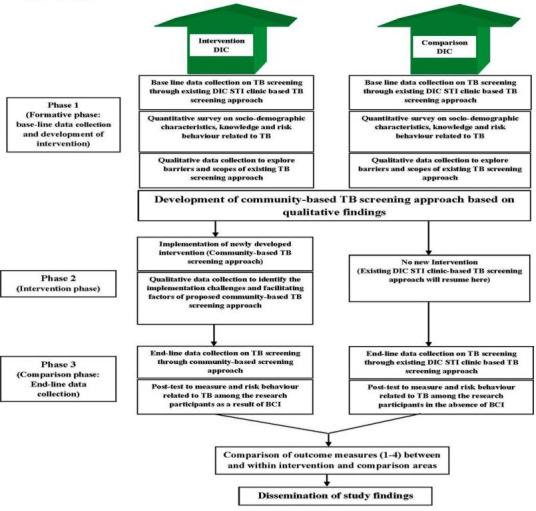
This operational research will follow a quasi-experimental design, applying both qualitative and quantitative methods, in two drop-in centres in three phases. Phase 1 will encompass baseline data collection and development of a community-based TB screening approach. In phase 2, the newly developed intervention will be implemented, followed by end-line data collection in phase 3. Qualitative data collection will be continued throughout the first and second phases. The baseline and end-line data will be compared both in the intervention and comparison areas to measure the impact of the intervention.
Ethical approval was obtained from the Institutional Review Board of International Centre for Diarrhoeal Disease Research, Bangladesh. The findings will be disseminated through diverse scientific forums including peer-reviewed journals, presentation at conferences and among the policy-makers for policy implication. The study started in January 2019 and will continue until June 2020.
尽管孟加拉国是一个结核病普遍流行的国家,但普通人群中的艾滋病毒感染率较低,关键人群中的感染率为3.9%。尽管艾滋病毒与结核病合并感染的可能性很高,但在孟加拉国,尚未开发并实施用于增加性少数群体中结核病病例发现的科学测试方法。此类方法可促进社区与政府卫生系统之间的服务提供联系。这项实验研究的结果可能会为项目管理人员和政策规划者提供新的见解,以便采用类似方法来加强结核病转诊,从而最终增加结核病病例发现,并降低与结核病相关的死亡和发病可能性,无论艾滋病毒感染状况如何。
这项行动研究将采用准实验设计,在三个阶段对两个接待中心同时应用定性和定量方法。第一阶段将包括基线数据收集以及基于社区的结核病筛查方法的开发。在第二阶段,将实施新开发的干预措施,随后在第三阶段进行终线数据收集。定性数据收集将在第一阶段和第二阶段全程持续进行。将对干预地区和对照地区的基线数据和终线数据进行比较,以衡量干预措施的影响。
已获得孟加拉国腹泻病研究国际中心机构审查委员会的伦理批准。研究结果将通过各种科学论坛进行传播,包括同行评审期刊、在会议上的展示以及向政策制定者传达以用于政策参考。该研究于2019年1月开始,将持续到2020年6月。