Institute of Theory of Electrical Engineering, Measurement, and Information Systems, Warsaw University of Technology, Warsaw 00-662, Poland.
Comput Intell Neurosci. 2020 Aug 27;2020:2909267. doi: 10.1155/2020/2909267. eCollection 2020.
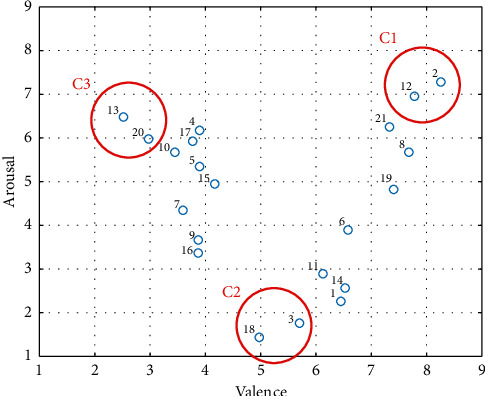
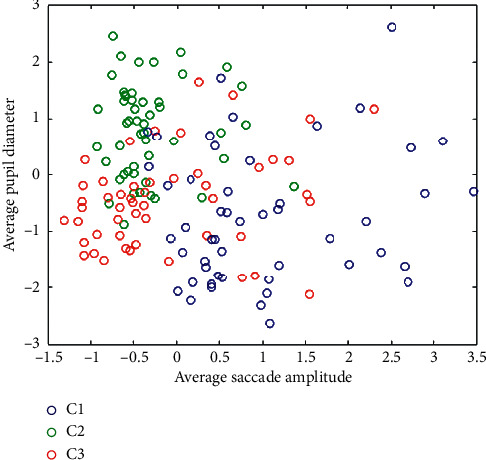
This article reports the results of the study related to emotion recognition by using eye-tracking. Emotions were evoked by presenting a dynamic movie material in the form of 21 video fragments. Eye-tracking signals recorded from 30 participants were used to calculate 18 features associated with eye movements (fixations and saccades) and pupil diameter. To ensure that the features were related to emotions, we investigated the influence of luminance and the dynamics of the presented movies. Three classes of emotions were considered: high arousal and low valence, low arousal and moderate valence, and high arousal and high valence. A maximum of 80% classification accuracy was obtained using the support vector machine (SVM) classifier and leave-one-subject-out validation method.
本文报告了使用眼动追踪技术进行情绪识别研究的结果。通过呈现 21 个视频片段的动态电影材料来引发情绪。从 30 名参与者那里记录的眼动追踪信号用于计算与眼球运动(注视和眼跳)和瞳孔直径相关的 18 个特征。为了确保这些特征与情绪有关,我们研究了亮度和呈现电影的动态性的影响。考虑了三类情绪:高唤醒和低效价、低唤醒和中效价以及高唤醒和高效价。使用支持向量机(SVM)分类器和留一受试者外验证方法,最多可获得 80%的分类准确率。