Department of Industrial Engineering and Engineering Management, Business School of Sichuan University, Chengdu 610065, China.
Comput Math Methods Med. 2020 Sep 3;2020:1720134. doi: 10.1155/2020/1720134. eCollection 2020.
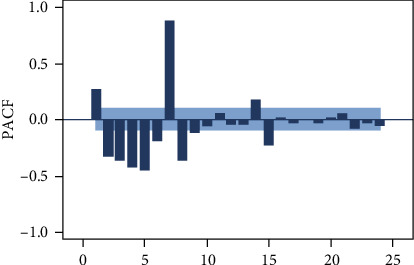
This paper is aimed at establishing a combined prediction model to predict the demand for medical care in terms of daily visits in an outpatient blood sampling room, which provides a basis for rational arrangement of human resources and planning. On the basis of analyzing the comprehensive characteristics of the randomness, periodicity, trend, and day-of-the-week effects of the daily number of blood collections in the hospital, we firstly established an autoregressive integrated moving average model (ARIMA) model to capture the periodicity, volatility, and trend, and secondly, we constructed a simple exponential smoothing (SES) model considering the day-of-the-week effect. Finally, a combined prediction model of the residual correction is established based on the prediction results of the two models. The models are applied to data from 60 weeks of daily visits in the outpatient blood sampling room of a large hospital in Chengdu, for forecasting the daily number of blood collections about 1 week ahead. The result shows that the MAPE of the combined model is the smallest overall, of which the improvement during the weekend is obvious, indicating that the prediction error of extreme value is significantly reduced. The ARIMA model can extract the seasonal and nonseasonal components of the time series, and the SES model can capture the overall trend and the influence of regular changes in the time series, while the combined prediction model, taking into account the comprehensive characteristics of the time series data, has better fitting prediction accuracy than a single model. The new model can well realize the short-to-medium-term prediction of the daily number of blood collections one week in advance.
本文旨在建立一个综合预测模型,以预测门诊采血室的日就诊量需求,为合理配置人力资源和规划提供依据。在分析医院采血日数量的随机性、周期性、趋势性和周内效应的综合特征的基础上,首先建立了自回归积分移动平均模型(ARIMA)模型来捕捉周期性、波动性和趋势性,其次,考虑到周内效应,构建了一个简单的指数平滑(SES)模型。最后,基于两种模型的预测结果,建立了残差修正的组合预测模型。将模型应用于成都市某大型医院门诊采血室 60 周的日就诊量数据,对未来一周的采血日数量进行预测。结果表明,组合模型的 MAPE 总体最小,其中周末的改善明显,表明极值预测误差显著降低。ARIMA 模型可以提取时间序列的季节性和非季节性成分,SES 模型可以捕捉时间序列的整体趋势和规则变化的影响,而综合考虑时间序列数据的综合特征的组合预测模型,比单一模型具有更好的拟合预测精度。新模型可以很好地实现未来一周采血日数量的短期到中期预测。